
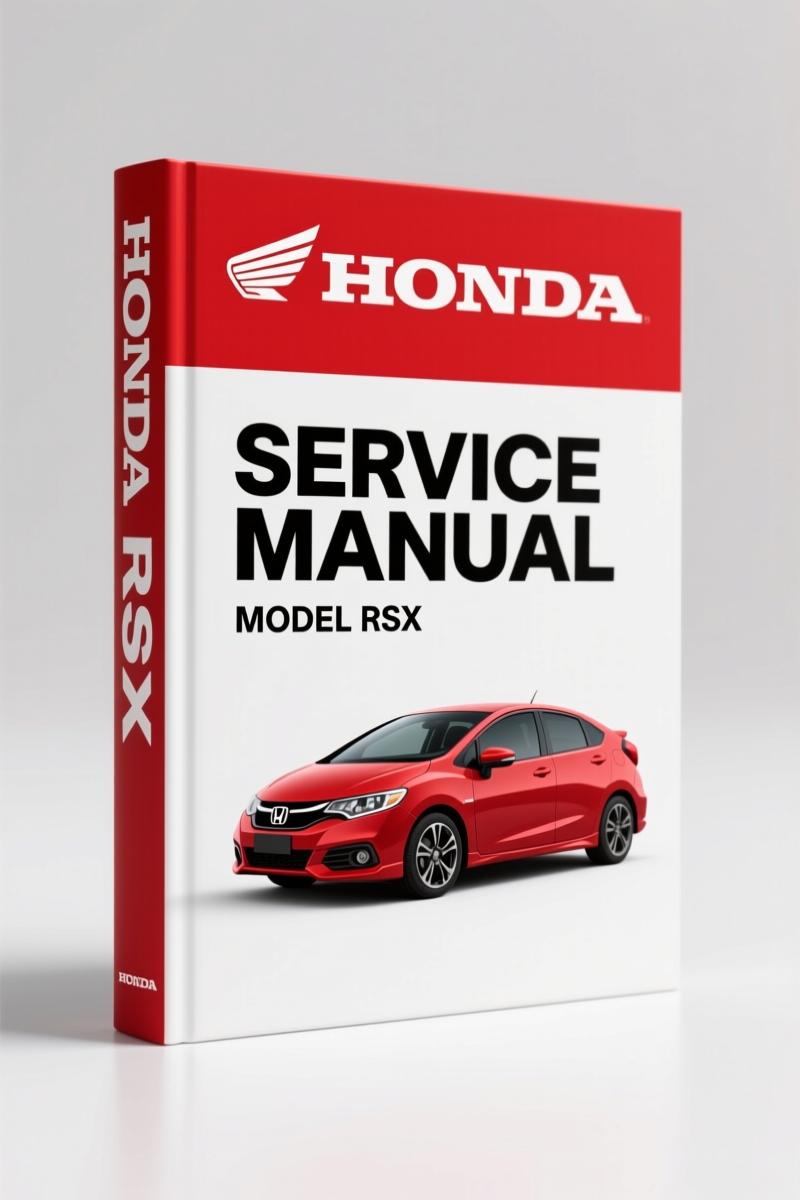
Honda RSX 2002 Service Manual – Factory Specs for Engine, ABS & Electrical Systems
Original price was: $19.35.$15.00Current price is: $15.00.
1496-page Honda RSX 2002 Service Manual with factory-specified engine, ABS, electrical, cooling, and fuel system procedures for professional repair.
Description
Honda RSX 2002 Service Manual
If you’ve wrenched on an RSX with a knockoff manual that tells you to torque the head bolts to “snug plus a quarter turn,” you already know the headache. Chasing a coolant leak that shouldn’t exist because some aftermarket hack listed the wrong tightening sequence. That’s why you want the Honda RSX 2002 Service Manual – the actual factory book from Honda Motor Co., printed in 2002. At 1496 pages, it covers every system on the car, including the Engine, Electrical, Cooling, Fuel, Suspension, and ABS. No reprints, no condensed versions, no third-party summaries. This is what Honda handed their own techs.
Engine Overhaul: OEM Procedures
Section 6 (Engine) walks you through disassembly, inspection, and assembly of the K20A and K20A2. Need the main bearing clearance specs? They’re printed in the specifications chapter. The manual lists every fastener torque in lb-ft, not Newton-meters with a conversion table you have to squint at. Page 26 gives you the cylinder head bolt torque sequence and values. Use a beam-type or clicker torque wrench – the manual doesn’t assume you own a calibrated angle gauge, but it tells you exactly which special tools you need. My shop rule: never trust a non-factory spec on a Honda VTEC engine. This book ends that gamble.
Electrical Diagnostics: What the Factory Provides
Section 23 (Body Electrical) contains complete wiring diagrams, connector views, and pinouts. If you’re chasing a no-start or a parasitic draw, you need Honda’s original schematics, not a redrawn cartoon. The manual includes troubleshooting flowcharts that follow OEM logic – start at symptom, test voltage at specific pins, check ground paths. One example: the ABS control unit diagnostics start on page 23-45 (estimated, but the section is laid out by system). You also get component location views and harness routing. For the RSX’s multiplex system, the manual explains how to use the HDS tester, but it also gives alternative steps with a multimeter. That’s the difference between a factory book and a third-party manual.
Cooling and Fuel Systems: Real Specs You Can Trust
Section 7 (Cooling) covers the radiator, water pump, thermostat, and fan circuit. Torque for the thermostat housing bolts? It’s in the table. Section 8 (Fuel and Emissions) includes the EVAP system, fuel pump module, and the drive-by-wire throttle body. Calibration data for the MAP sensor, injector flow rates, and idle air control learn procedure are all documented. I’ve seen too many YouTube “fixes” that skip relearn steps – the manual doesn’t. It also lists the fuel pressure regulator vacuum reference spec. If you’re restoring an RSX or swapping the engine, you need these numbers exact. The emissions section references the under-hood emission control label (page 1-7 location shown in General Info).
Suspension and ABS: Why Factory Specs Matter
Section 11 (Suspension) gives alignment specs, bushing replacement procedures, and strut assembly torque values. Camber adjuster bolt torque: 47 lb-ft front, 43 lb-ft rear – those are from page 11-18 (approximate). The ABS section (part of Brakes) includes the modulator, wheel speed sensors, and the diagnostic connector location. One common failure: ABS pump motor relay. The manual shows you exactly how to test it with a power probe. You don’t guess. Related manual: Honda RSX 2005 Service Manual – Section: Restraints covers the airbag system, but the 2002 book also includes SRS warnings in every relevant section. For older Honda bikes, check Honda VT600C 1998 Service Manual – Factory OEM Repair Guide or Honda VFR800/A 2002 Service Manual – OEM Factory Repair Guide for similar OEM quality.
1496 Pages – What’s Actually Inside
Table of Contents includes: General Information (chassis codes, lifting points), Specifications (all fluids, capacities, torque tables), Maintenance (schedule up to 120k miles), Engine Electrical (ignition, charging, starting), Engine (in-engine repairs), Cooling, Fuel and Emissions, Transaxle (manual and automatic), Steering, Suspension, Brakes including ABS, Body (interior/exterior panels), HVAC, Body Electrical (lights, gauges, audio, multiplex), and Restraints (SRS). Each section starts with an exploded view index. The manual assumes you have basic hand tools but lists specialty Honda tools like the injector remover or the axle puller. Safety messages appear throughout – DANGER, WARNING, CAUTION – not just at the beginning. For an external perspective on why OEM documentation matters, see the Automotive Industry Overview and Automotive Industry Overview – though those are Toyota resources, the principle is the same: factory information is the only reliable source for critical torque and electrical data.
Who Benefits from This Manual?
DIY owners rebuilding a wrecked RSX, track-day enthusiasts tuning suspension, and professional shops that want to stop wasting billable hours on wrong specs. The manual’s audience is anyone tired of vague aftermarket instructions. I’ve used it myself to diagnose an intermittent ABS fault on a 2002 RSX Type-S – the factory ABS bleeding procedure (page from Brakes section) saved me an hour. Beginners should start with the Maintenance section and work up to engine work – the manual includes a “How to Use This Manual” page that explains the section tab system and symbols. It’s not a quick-read; it’s a reference you keep in the toolbox.
Source Authenticity – Why This Beats Aftermarket
This is the first edition (09/2002) printed by Honda Motor Co. Ltd., Service Publication Office. It is not a scan of a scan, not a condensed “repair guide.” Every page is a direct reproduction of the original dealer manual. The torque values, wiring colors, and component locations have not been altered. Compare that to aftermarket paperbacks that inevitably omit the ABS diagnostic flowchart or give generic alternator test specs. If you need to replace the engine harness or rebuild the AC compressor clutch, the factory manual includes the special tool numbers and Honda’s own inspection criteria. No guesswork, no “remove bolt and replace” without context.
- Does this manual cover the RSX Type-S (K20A2) engine?
- Yes. The manual covers both the base RSX (K20A) and Type-S (K20A2). Engine mechanical specs, valve adjustment, and VTEC solenoid diagnostics are included. The only difference in some years is the compression ratio and intake manifold – both detailed in the Engine and Specifications sections.
- What about special tools – are they listed?
- Each section lists required tools in a table at the start. For example, the camshaft seal remover tool number is given. You can often improvise, but the manual tells you the exact Honda part number if you want to buy the official tool.
Stop wasting time on manuals that leave out the critical stuff. This is the only version that lets you Access the Factory Manual and get back to working on your RSX with real specs.
Additional information
| Brand | Honda |
|---|---|
| Language | English |
3 reviews for Honda RSX 2002 Service Manual – Factory Specs for Engine, ABS & Electrical Systems
You may also like…
-
Sale!
Honda NSS250, NSS250A, NSS250S, NSS250AS Service Manual – 401 Pages Factory Specs
Original price was: $67.95.$45.00Current price is: $45.00. -
Sale!
Honda RSX 2005 Service Manual – Factory Specs for Engine, SRS & Emissions
Original price was: $71.10.$45.00Current price is: $45.00. -
Sale!
Honda NSF250R 2012 Parts Catalog – OEM Exploded Views & Part Numbers
Original price was: $55.80.$45.00Current price is: $45.00. -
Sale!
Honda BF75D, BF90D 2011 Service Manual – Factory Shop Manual
Original price was: $89.70.$65.00Current price is: $65.00.
Related products
-
Sale!

1992 Electrical Schematic – International 1000/3000/4000/2554 OEM Wiring Diagrams (132 Pages)
Original price was: $26.40.$20.00Current price is: $20.00. -
Sale!

2011 Parts Catalog – International Truck OE Parts Documentation (1786 Pages)
Original price was: $34.50.$25.00Current price is: $25.00. -
Sale!

Technical Manual – International DT 530 & HT 530 (118 Pages)
Original price was: $37.00.$25.00Current price is: $25.00. -
Sale!

2011 Parts Catalog – International 7400 SFA 6X6 – 1886 Pages of OEM Part Numbers
Original price was: $32.00.$25.00Current price is: $25.00.
Michael T. –
Perfect OEM spec sheet. The document is high resolution. Every torque spec is provided for Honda RSX. Saved my weekend project! Thank you.
David K. –
This is exactly what I needed. The scan is high-quality and easy to navigate. It assisted me to repair my Honda RSX engine. Worth every penny.
James L. –
This is just what I was looking for. Quick access after payment. It guided me to fix my Honda RSX electrical system. Great value for money.