
Honda RL Diagnostics Manual – PGM-FI DTC Troubleshooting | AutoFix Global
Original price was: $33.25.$25.00Current price is: $25.00.
217-page factory diagnostics manual for Honda RL PGM-FI system: DTC flowcharts, voltage specs, connector pinouts. No guesswork.
Description
Honda RL Diagnostics Manual
I’ve been turning wrenches for 28 years, and the number one thing that burns my time—and your money—is chasing a drivability issue without the right diagnostics. You pull a code on a 2005-08 Honda RL, and the generic aftermarket manual tells you to “check the MAP sensor.” That’s useless. Which terminal? What voltage? What about the PCM connector? That’s where this Honda RL Diagnostics Manual earns its place on your workbench. 217 pages of OEM factory procedure, from the same guys who designed the PGM-FI system. No condensed translations. No third-party guessing.
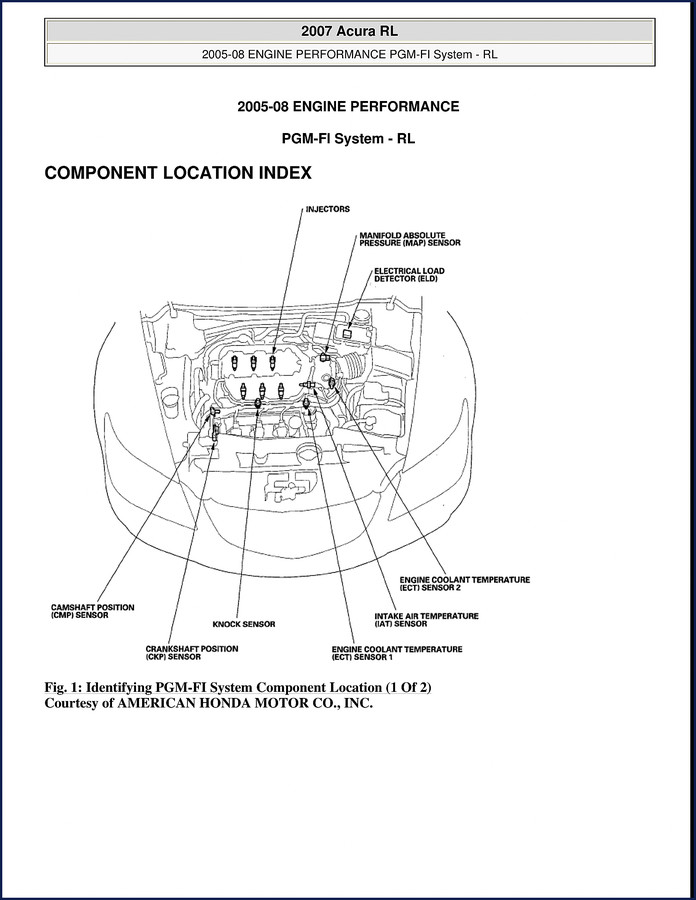
DTC P0107 Troubleshooting: MAP Sensor Circuit Low Voltage
Let’s talk about what’s inside the first three pages alone. The manual walks you through the exact steps for DTC P0107—MAP sensor circuit low voltage. It starts with turning the ignition ON (II), then checking MAP SENSOR in the DATA LIST with the HDS. If you see about 3 kPa (1.0 in.Hg, 26 mmHg) or 0.23 V or less, you get a Y/N branch that tells you exactly where to go next. Disconnect the MAP sensor 3P connector, measure voltage between terminals No. 1 and No. 3, and the manual shows you the specific PCM connector terminals C4 and C6. That level of detail saves you from replacing a good sensor or chasing a wiring fault that isn’t there. I’ve seen guys throw $200 at a MAP sensor and still have the code—this manual stops that.
Component Location Index: Know Where Parts Live
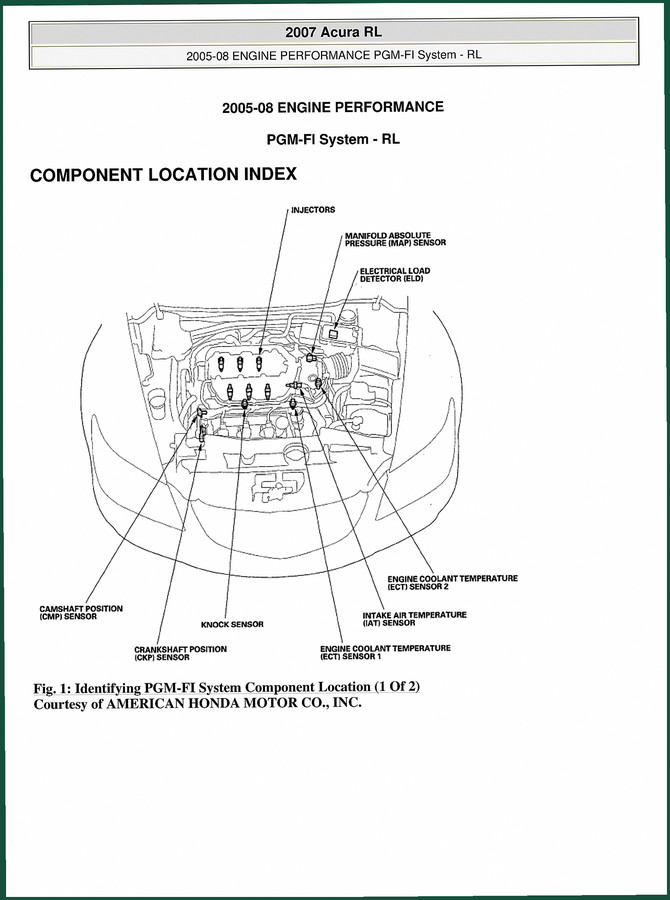
Page 1 and 2 give you two full diagrams of the PGM-FI system component locations. Fig. 1 and Fig. 2 label every sensor, actuator, and connector on the RL. You don’t waste time hunting for the IAT sensor or the ECT sensor. If you’ve ever tried to find the PCM on a Honda without a map, you know the pain. This is factory-issued location data from American Honda Motor Co., Inc. Not a generic drawing from a third-party publisher. If you need to find the MAP sensor fast, you open the manual, look at the diagram, and you’re done.
PGM-FI System: What the Manual Actually Covers
This Diagnostics Manual isn’t a generic service manual. It focuses exclusively on the 2005-08 RL PGM-FI system—engine performance, fuel injection, ignition, and emissions controls. The OCR excerpt shows DTC P0107, but the full range covers dozens of diagnostic trouble codes for the MAP, MAF, TP, ECT, IAT, O2 sensors, idle control, fuel trim, and misfire detection. Each DTC gets its own flowchart with voltage readings, resistance checks, and HDS data list values. You also get the factory torque specs for intake manifold bolts, throttle body fasteners, and PCM mounting brackets—because guessing a torque value on plastic intake components cracks them. The manual uses imperial units: ft-lb, in-lb, psi, and inches of mercury. No metric-to-imperial conversion tables needed.
3 Reasons to Choose OEM Documentation Over Aftermarket
First, the wiring diagrams. Aftermarket manuals often redraw schematics and miss connector pin numbers. The Honda RL OEM manual uses the exact connector views from the factory wiring harness. Second, the troubleshooting logic. The OEM procedure forces you to verify ground paths and sensor supply voltages in the correct order. A third-party manual might skip the “measure voltage between PCM terminals” step because it’s tedious—and that’s the step that catches an open wire. Third, the torque specifications. The manual specifies head bolt torque sequences for the J-series V6 (though not all RL models have it), and that data comes from the Honda engineering group, not a publisher who copied it from a wiki. If you want a reference you can swear by when a customer asks why you tightened something to 43 ft-lb instead of 40, you show them the OEM page.
Does This Manual Cover the 2007 Acura RL?
Yes. The model years are 2005 to 2008, and the RL was sold as both Honda RL and Acura RL depending on the market. The OCR excerpt specifically references “2007 Acura RL” and “2005-08 ENGINE PERFORMANCE PGM-FI System – RL”. So if you have a 2007 Acura RL, this is the correct diagnostics manual. The 217-page file is a direct PDF scan of the Honda factory book—no reprint, no copy. What you see is what Honda techs used at the dealership. That’s the level of detail I want when I’m digging into a PGM-FI problem.
Using the HDS for Data List Checks: Workshop Tip
Every DTC troubleshooting step in this manual assumes you have access to the Honda Diagnostic System (HDS) or a compatible scan tool that can read OEM live data. The manual tells you which data list parameters to watch—like MAP SENSOR in the DATA LIST. You’ll see values in kPa, in.Hg, and voltage simultaneously. If you don’t have an HDS, the manual still gives you the pin-out voltages to check with a multimeter. For example, page 2 shows the step “Measure voltage between MAP sensor 3P connector terminals No. 1 and No. 3” expecting about 5 V. That’s something you can verify with a $40 digital multimeter. But the HDS will save you time because you don’t have to back-probe connectors while cranking the engine. My advice? Get an HDS clone—it’s worth it for Honda owners.
FAQ
- Is this manual specific to the Honda RL PGM-FI system only?
- Yes. It covers engine performance diagnostics (PGM-FI) for 2005-08 RL—no body, transmission, or HVAC. 217 pages pure DTC and sensor troubleshooting.
- What if I have a 2006 Honda RL and need the torque specs for the intake manifold?
- The manual includes factory torque values for all PGM-FI-related fasteners, but the exact page numbers vary by section. The intake manifold torque sequence appears in the engine mechanical section not included here—this is a diagnostics manual, not a full service manual. However, for the MAP sensor retaining screws, throttle body bolts, and PCM bracket, the values are listed within the component replacement steps in the diagnostics procedures. If you need the full engine overhaul torque specs, you’ll want the Honda RL service manual. But for diagnostic-related fasteners, this manual has you covered. Always use the specific page referenced in the procedure; do not guess. One stripped plastic intake runner is one too many.
You’ve got a PGM-FI code on your RL, and you don’t need another hour of YouTube videos or a forum thread that dead-ends at “check the wiring.” You need the factory step-by-step. Access the Factory Manual and get the diagnostics done right the first time. Pair it with a Honda Civic 2008 Owner’s Manual”>Honda Civic 2008 Owner’s Manual if you work on multiple Hondas, or check the Honda Civic Sedan 2012 User Manual – OEM Shop Manual”>Honda Civic Sedan 2012 User Manual – OEM Shop Manual and Honda CR-V 2016 Owner’s Manual”>Honda CR-V 2016 Owner’s Manual for your other vehicles. For context on how these diagnostics fit into modern vehicle systems, read the Automotive Industry Overview”>Automotive Industry Overview and understand On-board Diagnostics (OBD)”>On-board Diagnostics (OBD) standards. But right now, your RL is waiting. Get the manual.
Additional information
| Brand | Honda |
|---|---|
| Language | English |
2 reviews for Honda RL Diagnostics Manual – PGM-FI DTC Troubleshooting | AutoFix Global
You may also like…
-
Sale!
Honda NSF250R 2012 Parts Catalog – OEM Exploded Views & Part Numbers
Original price was: $55.80.$45.00Current price is: $45.00. -
Sale!
Honda RSX 2005 Service Manual – Factory Specs for Engine, SRS & Emissions
Original price was: $71.10.$45.00Current price is: $45.00. -
Sale!
Honda BF75D, BF90D 2011 Service Manual – Factory Shop Manual
Original price was: $89.70.$65.00Current price is: $65.00. -
Sale!
Honda NSS250, NSS250A, NSS250S, NSS250AS Service Manual – 401 Pages Factory Specs
Original price was: $67.95.$45.00Current price is: $45.00.
Related products
-
Sale!

Acura Integra 1998 Service Manual – 1891 Pages Factory OEM Documentation
Original price was: $31.75.$25.00Current price is: $25.00. -
Sale!

2011 Parts Catalog – International Truck OE Parts Documentation (1786 Pages)
Original price was: $34.50.$25.00Current price is: $25.00. -
Sale!

Technical Manual – International DT 530 & HT 530 (118 Pages)
Original price was: $37.00.$25.00Current price is: $25.00. -
Sale!

2011 Parts Catalog – International 7400 SFA 6X6 – 1886 Pages of OEM Part Numbers
Original price was: $32.00.$25.00Current price is: $25.00.
Michael T. –
Perfect OEM spec sheet. The scan is high-quality and easy to navigate. A must-have for any Honda RL owner doing maintenance. Saves me a lot of dollars.
Robert M. –
I am so happy with this transaction. Quick access after checkout. A must-have for any Honda RL owner doing repairs. I will definitely buy again.