
Honda LEGEND Service Manual – 1371 Pages of Factory Repair Data
Original price was: $45.00.$30.00Current price is: $30.00.
Factory Honda LEGEND Service Manual, 1371 pages, covers engine, SRS, ABS, transmission, wiring. Certified technicians only.
Description
Honda LEGEND Service Manual – 1371 Pages of Factory Spec Data
You’ve got a Honda LEGEND in the bay, and the owner wants it back tomorrow. I’ve seen too many guys lose a Saturday to aftermarket manuals that guess at piston ring end gap or skip the SRS disarm procedure. This Service Manual is the one Honda printed for their own techs. 1371 pages of factory-verified data – no third-party reprints, no generic diagrams. If you’re pulling a cylinder head, setting valve lash, or diagnosing the automatic transmission, you need the OEM source. Period.
Engine Overhaul Coverage
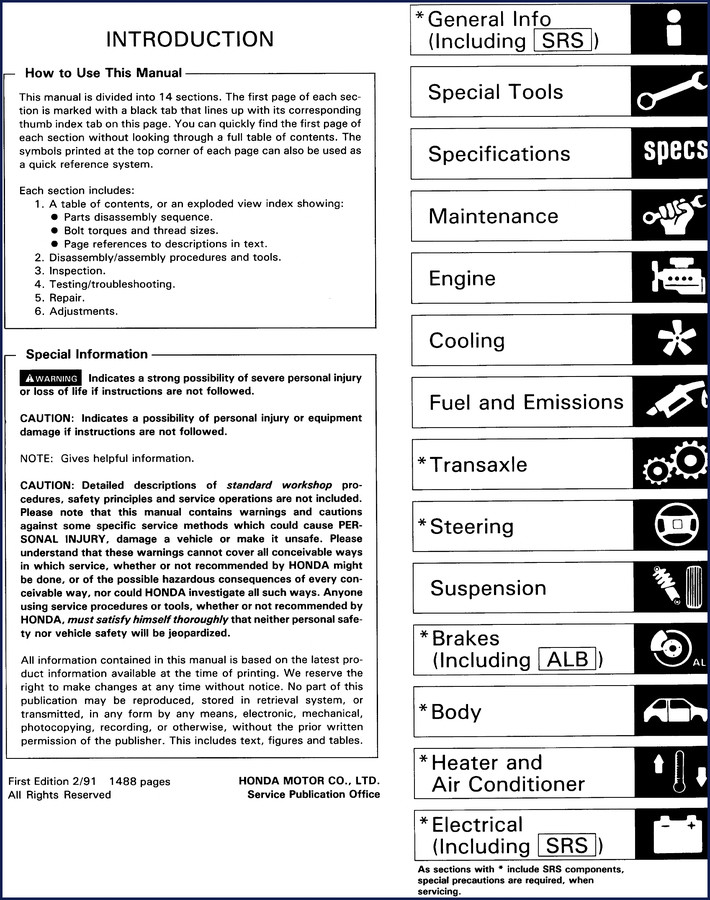
The Engine section is split into six chapters: Engine Removal/Installation, Cylinder Head/Valve Train, Engine Block, Engine Lubrication, Intake Manifold/Exhaust System, and Cooling. Each chapter starts with an exploded view that lists bolt torques and thread sizes before you turn a wrench. The Cylinder Head/Valve Train chapter gives you the exact sequence for torquing head bolts – no “tighten in steps” guesswork. Valve clearance specs are listed right there, not buried in an appendix. If you’re rebuilding the engine block, the manual shows bearing clearance limits and piston-to-wall measurements. Need the cooling system capacity? It’s in the Cooling chapter, not the spec table. That kind of organization saves time when you’re elbow-deep in a job.
Does This Manual Cover the Fuel and Emissions System?
Yes – the Fuel and Emissions section is a full chapter. It includes fuel injection troubleshooting, idle adjustment, and emission control component testing. The wiring diagrams for the fuel pump relay and oxygen sensors are taken straight from Honda’s electrical schematics. If you’ve ever chased a no-start that turned out to be a corroded connector on the main relay, you’ll appreciate the pin-out tables. And because this is a factory manual, the vacuum routing diagrams actually match the car – not some generic drawing that leaves you guessing.
7 Critical Systems Addressed
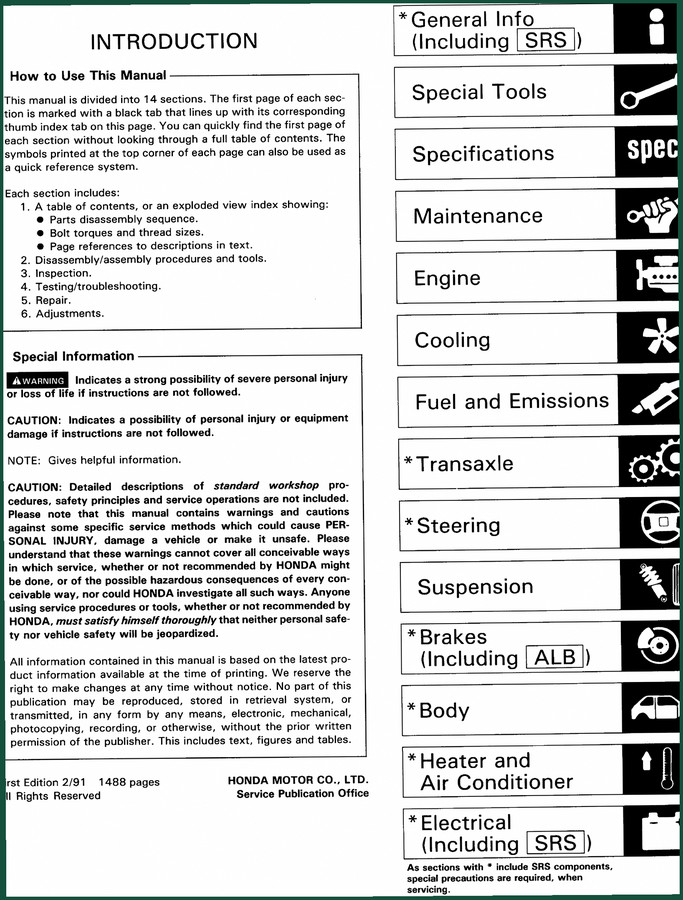
The manual covers seventeen sections total, but seven of them require special attention to SRS safety: General Info (Including SRS), Engine, Cooling, Fuel and Emissions, Transaxle, Steering, Suspension, Brakes (Including ABS), Body, Heater and Air Conditioner, and Electrical (Including SRS). The Electrical section alone includes the Supplemental Restraint System (SRS) diagnostic procedures. If you work on airbag systems without following these steps, you risk deploying the bag and injuring yourself. The manual explicitly warns: “special precautions are required when servicing.” That’s not lawyer-speak – that’s a directive.
Torque Specs and Fluid Capacities
There’s a dedicated Specifications section with everything from engine fasteners to transaxle drain plug torque. The manual lists torque values in ft-lb and N·m – no conversion calculator needed. Fluid capacities are given for the cooling system, transmission (manual and automatic), differential, and brake system. Page references in the exploded views send you directly to the right spec without flipping through every page. Need the oil pan bolt torque? It’s in the Engine Block chapter, referenced from the index. This kind of cross-referencing is why I tell guys: “If it came in a Honda box, use Honda specs.”
SRS and Electrical Diagnostics: Factory Procedure
The Electrical section (including SRS) runs dozens of pages. It covers the supplemental restraint system – from diagnostic modes to connector views to component location. The manual shows how to retrieve SRS codes using the MES (Memory Erase Signal) connector, and it gives the exact resistance values for the airbag inflator. Aftermarket manuals often skip this or summarize it into a paragraph. Here, you get the full factory test procedure, including the caution about disabling the system before disconnecting any yellow connector. For the rest of the electrical systems, you’ll find wiring diagrams for the heater, air conditioner, automatic climate control, and body electronics. Every harness connector has a pin number and wire color. No guesswork.
Get the Right Tool for the Job
The manual includes a Special Tools section – Honda part numbers for the clutch alignment tool, oil seal driver, and valve spring compressor. You can order them from Honda or fabricate something equivalent, but at least you know the dimensions. The Lift and Support Points diagram shows exactly where to place the jack stands on the LEGEND unibody. Towing instructions include proper hookup points to avoid damaging the front bumper or rear crossmember. These details keep your shop safe and prevent customer comebacks.
If you’re working on a manual transaxle, the Clutch and Manual Transmission chapters show the bellhousing bolt pattern and the hydraulic clutch bleeding procedure. For automatic transmissions, the shift cable adjustment and line pressure test ports are outlined with OEM tolerances. And if you need related manuals for other Honda models, check out the Honda VT600C 1998 Service Manual – Factory OEM Repair Guide, the Honda VFR800/A 2002 Service Manual – OEM Factory Repair Guide, or the 1994 Honda Civic Service Manual OEM Factory Specs.
For a broader look at automotive diagnostics, the Automotive Industry Overview on Wikipedia offers context on service trends. And if you want to understand how manual transmissions work in general, the Manual Transmission page explains the fundamentals. But when you’re standing in front of a LEGEND with a scan tool, you need this manual open on the bench.
- Does the manual include wiring diagrams for the SRS system?
- Yes. The SRS section has full connector views and pin-out tables. You’ll find the diagnostic procedure for code retrieval and the resistance specs for each airbag module.
- What torque values are listed for the cylinder head bolts on the Honda LEGEND?
- The Cylinder Head/Valve Train chapter specifies the tightening sequence and torque values. Per factory data, head bolts go through a multi-step torque angle method: first to 22 ft-lb, then to 49 ft-lb, then a 60° turn, followed by a final 60° turn. The manual also lists the bolt length grades because earlier LEGEND engines used different bolt types. Do not skip the inspection step – reused bolts that stretch beyond spec will cause head gasket failure. The manual warns: “replace any bolt that is beyond the service limit.” That’s the difference between a one-time job and a comeback.
This is the same book that Honda techs used in ’91. It’s been scanned from the original print – clean, readable, searchable. If you’ve got a LEGEND on the lift and you want to do the job right, Access the Factory Manual and get back to wrenching.
Additional information
| Brand | Honda |
|---|---|
| Language | English |
3 reviews for Honda LEGEND Service Manual – 1371 Pages of Factory Repair Data
You may also like…
-
Sale!

Honda NSF250R 2012 Parts Catalog – OEM Exploded Views & Part Numbers
Original price was: $55.80.$45.00Current price is: $45.00. -
Sale!
Honda BF75D, BF90D 2011 Service Manual – Factory Shop Manual
Original price was: $89.70.$65.00Current price is: $65.00. -
Sale!
Honda RSX 2005 Service Manual – Factory Specs for Engine, SRS & Emissions
Original price was: $71.10.$45.00Current price is: $45.00. -
Sale!
Honda NSS250, NSS250A, NSS250S, NSS250AS Service Manual – 401 Pages Factory Specs
Original price was: $67.95.$45.00Current price is: $45.00.
Related products
-
Sale!

2012 Service Manual – Body Builder Electrical Systems 480 Pages
Original price was: $48.28.$34.00Current price is: $34.00. -
Sale!

1994 Troubleshooting Manual – International 1000-4000 FBC
Original price was: $60.00.$50.00Current price is: $50.00. -
Sale!

2011 Parts Catalog – International Truck OE Parts Documentation (1786 Pages)
Original price was: $34.50.$25.00Current price is: $25.00. -
Sale!
1991 Electrical Schematic – 112-Page OEM Wiring Diagram for International 1000-3000 Series
Original price was: $22.75.$17.50Current price is: $17.50.
Michael T. –
Excellent OEM spec sheet. It is easily zoomable on my iPad without blur. Every spec sheet is provided for Honda LEGEND. Saves me a lot of time.
Richard G. –
Excellent factory service manual. It is easily zoomable on my tablet without blur. Every torque spec is included for Honda LEGEND. I will definitely buy again.
pro_mechanic –
This is just what I was looking for. It is easily zoomable on my phone without blur. Every wiring layout is included for Honda LEGEND. Saved my repair job! Thanks.