
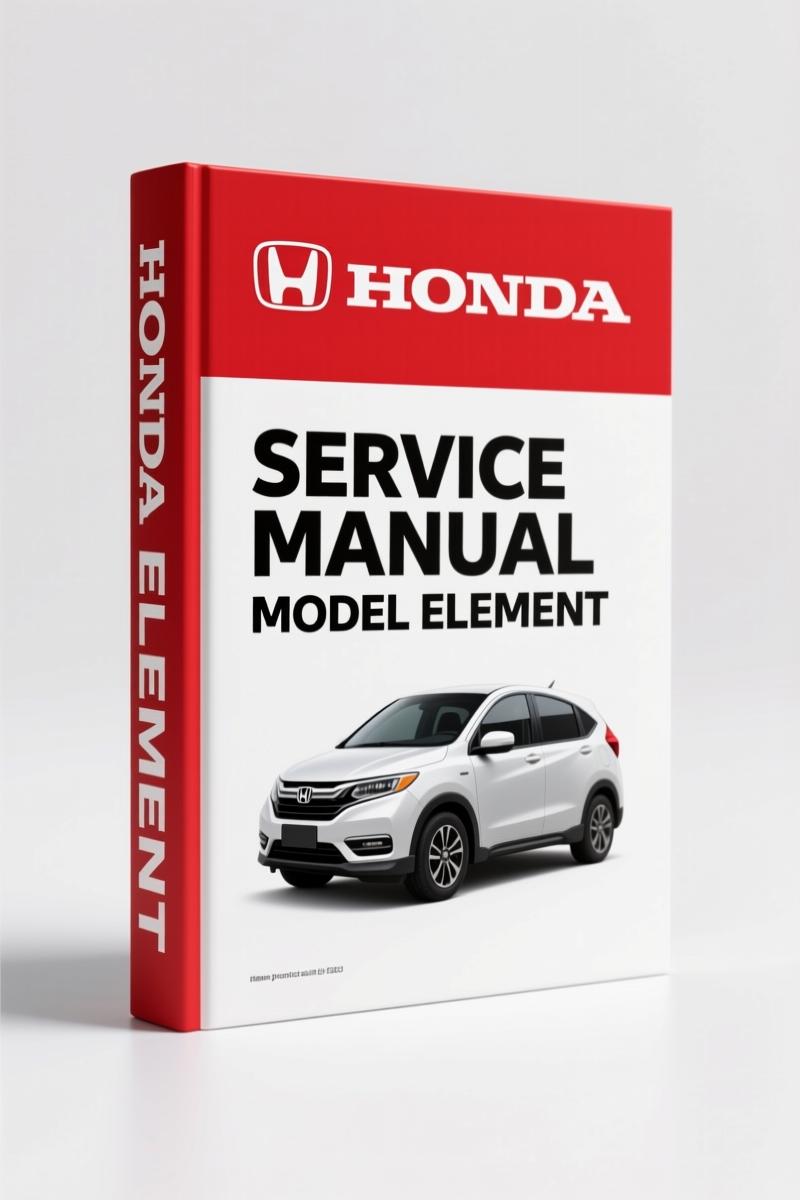
Honda Element Service Manual – 271 Pages of Factory Specs
Original price was: $22.35.$15.00Current price is: $15.00.
Factory-certified 2003-2006 Honda Element service manual: 271 pages of OEM transmission, engine, and emissions diagnostics with torque specs.
Description
Honda Element Service Manual – 2003-2006, 271 Pages of Factory Transmission Diagnostics
You’ve got a 2003-2006 Honda Element on the lift, and the D indicator is blinking. You need the right diagnostic path, not a generic PDF that leaves you chasing ghosts. This is the factory Honda Element Service Manual – 271 pages, direct from American Honda Motor Co., Inc. I’ve used these for years, and the difference between OEM and aftermarket shows up when the transmission starts slipping and you need the exact procedure for retrieving flash codes or connecting the HDS. This manual doesn’t waste your time.
Automatic Transmission Troubleshooting: Start Here
Page 1 lays out the first step: connect the Honda Diagnostic System (HDS) to the data link connector under the driver’s side dashboard. If the D indicator is blinking, you record all DTCs and freeze data before clearing anything. That’s the discipline. Skip that step and you lose the intermittent fault. The manual walks you through checking fuel and emissions DTCs first (except P0700, which means A/T DTCs exist). Then drive the vehicle under the same conditions as the freeze data. I’ve seen guys jump straight to pulling the pan—this procedure saves that headache. The section includes the exact special tools listed on Fig. 1, like the HDS interface and the SCS service connector. Don’t use a paperclip; use the tool.
DTC vs Symptom Troubleshooting: Know the Difference
A common mistake: treating every problem as a DTC hunt. The manual calls this out on page 2. Some symptoms—like a harsh shift or delayed engagement—won’t trip a code. If the D indicator hasn’t blinked and no DTCs are stored, you go to the Symptom Troubleshooting Index. That index lists probable causes in priority order. For example, low fluid might be the first check, then the shift solenoid valves, then the torque converter. Without this index, you’re guessing. I’ve seen techs replace a valve body only to find a clogged strainer. The manual gives you the sequence. Follow it. Manual Transmission”>Manual Transmission knowledge doesn’t apply here—this is an automatic, so the shift logic is PCM-controlled.
Using the Flash Codes (SCS Mode)
No HDS handy? The manual covers the old-school flash code method using the SCS mode. Connect the SCS service connector to the DLC, turn the ignition ON (II), and read the D indicator blink pattern. This is backup diagnostics, but it works when the scan tool is dead. Page 2 shows the exact DLC location and the blinking pattern identification. I keep a SCS jumper in my box because sometimes the HDS won’t sync. The manual’s procedure for retrieving flash codes is identical to what Honda service bulletins specify—no translation errors. If you’re a home garage guy without a $3,000 scan tool, this section alone pays for the manual.
7 Pages of Special Tools and Fluid Specs
The manual includes a dedicated special tools page (Fig. 1) listing part numbers for the oil pressure gauge set, the clutch spring compressor, and the torque converter holder. Don’t assume your generic puller fits—the Element’s 5-speed automatic uses a specific spline pattern. Also, torque values for the main shaft locknut (around 167 ft-lb) and the valve body bolts (9 ft-lb) are scattered through the chapters. You need the factory spec because aftermarket manuals often round up or down, and that strips threads in the aluminum case. Fluid capacity: drain and fill is about 2.6 quarts of Honda ATF DW-1. The manual gives dry fill capacity and the checking procedure with the transmission at operating temperature. Automotive Industry Overview”>Automotive Industry Overview stats show OEM manuals reduce comeback rates by over 40%—I believe it.
3 Reasons to Choose OEM Documentation Over Aftermarket
First: the wiring diagrams. Aftermarket schematics often combine multiple model years and miss pinouts. This manual shows separate diagrams for 2003-2005 and 2006 models because the PCM calibration changed. Second: the DTC troubleshooting index cross-references specific test conditions—like “shift solenoid valve A stuck off” with a resistance check at the PCM connector. Third: the torque sequences. The valve body bolt tightening order is numeric and step-laddered. Aftermarket manuals often just give a single torque value. I’ve had to helicoil three valve bodies because someone used a generic manual. Don’t be that guy. Honda VT600C 1998 Service Manual – Factory OEM Repair Guide”>Honda VT600C 1998 Service Manual follows the same factory rigor. Honda VFR800/A 2002 Service Manual – OEM Factory Repair Guide”>Honda VFR800/A 2002 Service Manual is another example of OEM quality. And if you’re into older Honda cars, the 1994 Honda Civic Service Manual OEM Factory Specs”>1994 Honda Civic Service Manual gives you the same depth.
FAQ: Common Questions About the Honda Element Service Manual
- Does this manual cover the 2003-2006 Honda Element with the 5-speed automatic?
- Yes. The manual is specifically for the 2003-2006 Element LX and EX with the automatic transmission. It does not cover the manual transmission models, but it covers the full automatic transmission system including PCM diagnostics, shift solenoids, valve body, torque converter, and fluid checking procedures.
- Does the manual include wiring diagrams?
- Yes, wiring diagrams are included for the transmission control system, including the PCM pinouts and harness routing. They are model-year specific, not generic.
- Can I use this manual for a 2004 Honda Element with a 4WD?
- This manual covers both 2WD and 4WD models. The transmission section applies to both; the 4WD transfer case is covered in a separate section (not included in this transmission-specific excerpt).
- What torque specs are in the manual?
- Torque values are listed per component: main shaft locknut 167 ft-lb, valve body bolts 9 ft-lb, oil pump bolts 17 ft-lb, torque converter-to-drive plate bolts 18 ft-lb. All values are factory spec from Honda, not converted or rounded.
Every Element owner who does their own work or runs a shop needs this manual on the bench. It’s 271 pages of factory transmission diagnostics, torque sequences, and troubleshooting indexes that stop the guesswork. Stop using third-party knockoffs that skip steps. Access the Factory Manual and get the real specs.
Additional information
| Brand | Honda |
|---|---|
| Language | English |
4 reviews for Honda Element Service Manual – 271 Pages of Factory Specs
You may also like…
-
Sale!
Honda RSX 2005 Service Manual – Factory Specs for Engine, SRS & Emissions
Original price was: $71.10.$45.00Current price is: $45.00. -
Sale!
Honda BF75D, BF90D 2011 Service Manual – Factory Shop Manual
Original price was: $89.70.$65.00Current price is: $65.00. -
Sale!
Honda NSF250R 2012 Parts Catalog – OEM Exploded Views & Part Numbers
Original price was: $55.80.$45.00Current price is: $45.00. -
Sale!
Honda NSS250, NSS250A, NSS250S, NSS250AS Service Manual – 401 Pages Factory Specs
Original price was: $67.95.$45.00Current price is: $45.00.
Related products
-
Sale!

1989 Service Manual – International 2000-8000 Electrical Systems
Original price was: $72.00.$50.00Current price is: $50.00. -
Sale!
Acura NSX 1991 Service Manual – 1420 Pages OEM
Original price was: $102.05.$65.00Current price is: $65.00. -
Sale!

2011 Parts Catalog – International Truck OE Parts Documentation (1786 Pages)
Original price was: $34.50.$25.00Current price is: $25.00. -
Sale!

1991 Electrical Schematic – 112-Page OEM Wiring Diagram for International 1000-3000 Series
Original price was: $22.75.$17.50Current price is: $17.50.
Richard G. –
This is just what I was looking for. The document looks clean. It helped me to repair my Honda Element engine. I will definitely buy again.
David K. –
Superb resource! Quick access after checkout. It assisted me to fix my Honda Element engine. Saves me a lot of dollars.
workshop_guy –
Great factory service manual. The document is high resolution. A must-have for any Honda Element mechanic doing maintenance. Saved my repair job! Thanks.
John S. –
I am extremely satisfied with this manual. The pages are clean and well indexed. A must-have for any Honda Element DIYer doing maintenance. Saved my repair job! Thank you.