
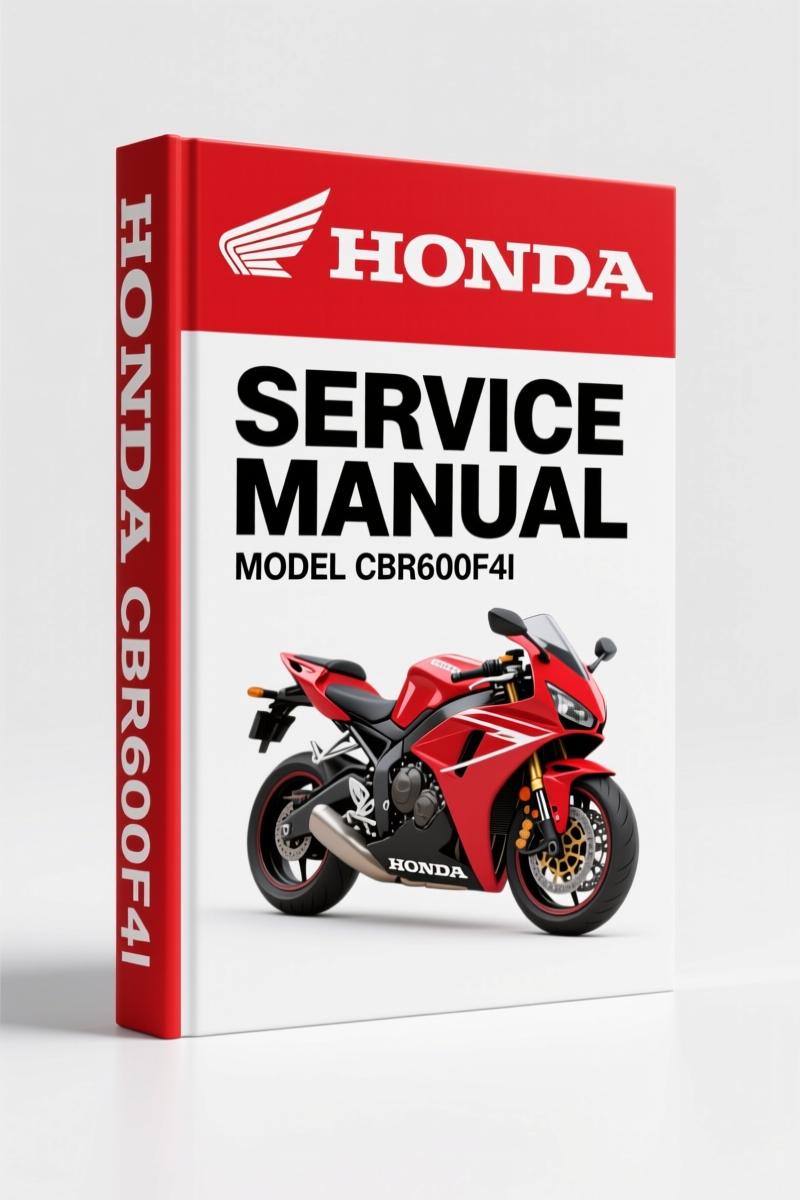
Honda CBR600F4i Service Manual – 43 Pages Factory Specs
Original price was: $34.88.$22.50Current price is: $22.50.
Factory-certified Honda CBR600F4i service document with torque specs, emission controls, and wiring data across 43 pages of OEM procedures.
Description
Honda CBR600F4i Service Manual – Factory Specs You Can Trust
If you have ever tried to button up a top end with aftermarket torque values and watched a head gasket push coolant after ten miles, you know what I mean. The Honda CBR600F4i Service Manual is the factory document that Honda used to build these bikes. Not a third-party rewrite. Not a condensed version. 43 pages of direct-from-Honda procedure. I have seen a lot of manuals walk into this shop, and the aftermarket ones get the firing order right maybe 80% of the time. That other 20% costs you a valve job or a wiring fire. This manual cuts that guesswork out flat.
The table of contents starts with General Info—model identification, service rules, and the torque values that hold your CBR600F4i together. Page 1 lays out how to use the manual: follow the Maintenance Schedule in Section 3, and you keep the engine in peak condition and within EPA and California Air Resources Board standards. The safety messages use DANGER, WARNING, and CAUTION the way Honda intends—no softened language. If the manual says “you can be killed,” believe it.
General Info: Service Rules and Model Identification
Section 1 covers the service rules Honda expects a mechanic to follow. Clean the area before opening the crankcase. Use the specified lubricants. Never reuse a crush washer. These are not suggestions; they are the difference between a bike that runs for 50,000 miles and one that eats its own bearings at 10,000. Model identification tells you exactly which CBR600F4i variant you are working on—2001, 2002, or 2003. The manual marks what changed year to year. If you are chasing a charging system issue on a 2003, you do not want the 2001 regulator specs. This manual prevents that mismatch.
Torque Values: Why the Factory Spec Matters
Torque values are listed in the Specifications section. Honda uses a dry thread torque for most fasteners unless stated otherwise. I have seen a DIYer snap off a cylinder head bolt because he used a general chart from the internet. The CBR600F4i has specific torque sequences for the cylinder head, the alternator rotor bolt, and the rear axle nut. Wrong torque on that axle nut? You get a wobbly rear wheel at highway speed. The manual gives you the foot-pounds for every critical fastener. Page 2 of the Torque Values section lists the engine-specific numbers—do not lose that page.
Specifications and Tools: What You Need Before You Start
The manual includes a full tool list. Not a vague “suitable wrench”—it calls out specific Honda special tools by part number. For the clutch hub holder, it gives you the tool number. For the flywheel puller, same. If you are in a home garage, you can adapt, but knowing the factory tool lets you decide if the job requires a $200 puller or if a universal one will work. The lubrication and seal points section shows exactly where to apply molybdenum paste, engine oil, or thread lock. Miss the sealant on the crankcase split line? Oil leak on the first ride. The manual walks you through it.
Cable and Harness Routing: Don’t Skip This Section
If you have ever chased an electrical gremlin caused by a harness pinched under the fuel tank, you will appreciate the Cable and Harness Routing section. It diagrams how every wire and hose runs through the frame. The CBR600F4i is fuel-injected (Programmed Fuel Injection, Section 6), so the wiring harness carries the ECM, injector, and pump circuits. Route it wrong and the injector sub-harness rubs against the steering head—chafed wires, intermittent fuel cut, and a bike that dies mid-corner. The routing diagrams in this section prevent that. Use them.
Emission Control Systems: What the Manual Covers
The CBR600F4i comes with an evaporative emission control system and a PAIR valve (pulsed secondary air injection). The Emission Control Information Labels section covers the California and U.S. requirements. If you are in a state that checks emissions, or if you want to keep the bike legal for resale, the manual shows you the factory configuration. Every vacuum hose, check valve, and purge port is drawn. Removing a PAIR valve without plugging the correct port? Engine backfiring on deceleration. The manual shows the correct disablement procedure if allowed in your area.
Does This Manual Cover the Fuel System?
Yes, Section 6 covers the Programmed Fuel Injection system—fuel pump replacement, injector cleaning, throttle body sync, and the intake air temperature sensor. The troubleshooting flowcharts in Section 22 (Troubleshooting) help you diagnose a no-start, misfire, or rich condition without swapping parts. The wiring diagram in Section 20 gives you the pinouts for the ECM. That alone can save you hours of probing with a multimeter.
3 Reasons to Choose OEM Documentation
One, the manual was written by Honda engineers for Honda technicians. Two, the torque values were tested on production engines, not guessed from a bolt diameter chart. Three, the wiring diagrams are year-specific. A generic wiring diagram for a 2000 CBR600F4 will have different wire colors and connector positions than the F4i. Use the wrong diagram and you could backfeed current through the ECM. The factory manual eliminates that risk.
For related models, check the HONDA CBR600F4i 2001-2003 Service Manual for additional years. If you work on cruiser twins, the Honda VT600C 1998 Service Manual – Factory OEM Repair Guide has the same level of detail. The Honda VFR800/A 2002 Service Manual – OEM Factory Repair Guide covers the V4 platform with similar accuracy. For background on the automotive industry’s evolution, see the Automotive Industry Overview. And if you want to understand how the CBR600F4i transmission works, read the Manual Transmission article on Wikipedia.
- Can I use this manual on a CBR600F4i with aftermarket parts?
- Yes. The torque specs and wiring diagrams apply to the stock system. For aftermarket components, the manual gives you the baseline factory setting, which you then adjust per the aftermarket part instructions. Do not skip the factory torque values for the engine fasteners—they remain correct even with aftermarket exhaust or suspension.
- Does the 43-page PDF include wiring diagrams?
- Section 20 is a full wiring diagram. Color-coded, with connector pin numbers and wire gauge. It covers the entire electrical system, including the Honda PGM-FI, ignition, starter, and lights. You get the factory diagram, not a simplified line drawing.
If you service a CBR600F4i, you need the spec sheet that Honda trusted on the assembly line. Access the Factory Manual and get the torque values, routing diagrams, and step-by-step procedures that keep this bike running right. No guesswork, no aftermarket errors—just the factory data that fits in your tablet or printout.
Additional information
| Brand | Honda |
|---|---|
| Language | English |
2 reviews for Honda CBR600F4i Service Manual – 43 Pages Factory Specs
You may also like…
-
Sale!
Honda BF75D, BF90D 2011 Service Manual – Factory Shop Manual
Original price was: $89.70.$65.00Current price is: $65.00. -
Sale!
Honda RSX 2005 Service Manual – Factory Specs for Engine, SRS & Emissions
Original price was: $71.10.$45.00Current price is: $45.00. -
Sale!
Honda NSS250, NSS250A, NSS250S, NSS250AS Service Manual – 401 Pages Factory Specs
Original price was: $67.95.$45.00Current price is: $45.00. -
Sale!

Honda NSF250R 2012 Parts Catalog – OEM Exploded Views & Part Numbers
Original price was: $55.80.$45.00Current price is: $45.00.
Related products
-
Sale!

Service Manual – International HS 2.8L Engine – 130 Pages of Factory Specs
Original price was: $56.40.$40.00Current price is: $40.00. -
Sale!

1996 Operators Manual – International 1000-4000 Series (246 pages)
Original price was: $15.28.$9.99Current price is: $9.99. -
Sale!

1989 Service Manual – International 2000-8000 Electrical Systems
Original price was: $72.00.$50.00Current price is: $50.00. -
Sale!
1994 Troubleshooting Manual – International 1000-4000 FBC
Original price was: $60.00.$50.00Current price is: $50.00.
gearhead88 –
This is just what I was looking for. The scan is high-quality and well indexed. Contains clear schematics for Honda. Saved my weekend project! Thanks.
Thomas B. –
Excellent factory service manual. Quick access after payment. It assisted me to rebuild my Honda CBR600F4i engine. I will recommend this shop to others.