
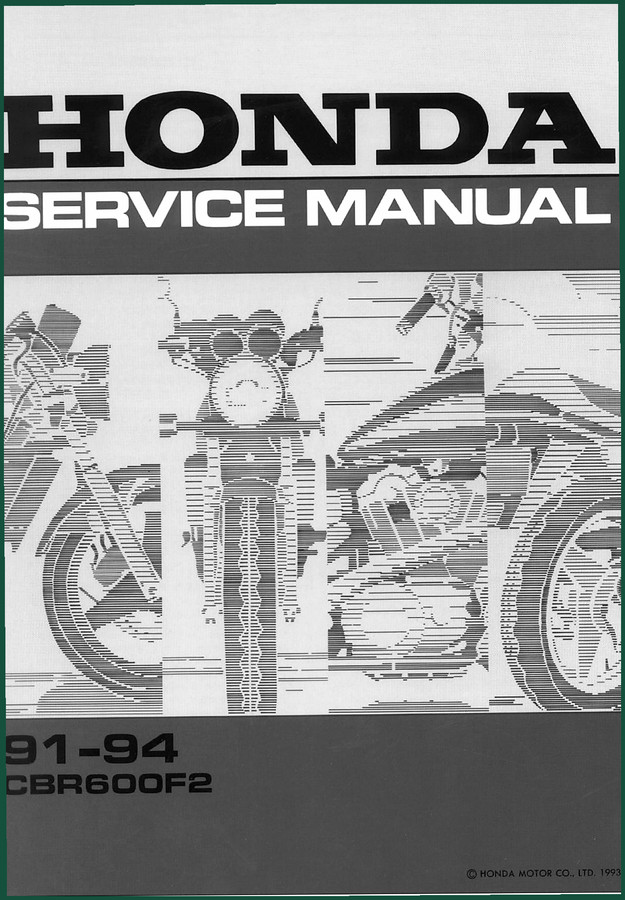
Honda CBR600F2 1993 Service Manual – Factory Specs, 196 Pages
Original price was: $47.40.$30.00Current price is: $30.00.
Factory-certified 1993 Honda CBR600F2 service manual: 196 pages covering engine, fuel, cooling, suspension, and brake systems with OEM torque specs.
Description
Honda CBR600F2 1993 Service Manual – Factory OEM Repair Guide

You’ve got a Honda CBR600F2 1993 Service Manual on the bench, and you’re about to start an engine rebuild. If you’re pulling torque values from a forum or a chilton’s book, you’re asking for a failed head gasket or a spun bearing. I’ve been torquing bolts for 28 years, and the only spec I trust is the one printed by the manufacturer. This manual comes straight from Honda Motor Co., Ltd. – 196 pages of factory procedures that cover every system on the CBR600F2. No shortcuts, no aftermarket approximations.
196 Pages of Factory Specs
Page count isn’t vanity – it’s a sign of thoroughness. This manual has 21 sections, starting with General Information and ending with Index. Each section focuses on a specific subsystem: you get Lubrication, Cooling, Engine and Drive Train Fuel System, Cylinder Head, Clutch/Gearshift Linkage, Crankcase/Cylinder/Piston, Crankshaft/Transmission, Front and Rear Wheel/Suspension/Steering, Brake System, and full electrical coverage from the Charging System through Lights/Meters/Switches. The Wiring Diagram occupies Section 19, and Troubleshooting is Section 20. If you don’t know where to start, the manual tells you to go to Troubleshooting first. That’s sound advice.
Engine and Drive Train Fuel System – What’s Inside
Section 6 covers the Engine and Drive Train Fuel System. This isn’t a generic carburetor diagram – it’s the specific settings for the CBR600F2’s fuel system, including the California and Canada models (codes AC and CM). You’ll find the fuel flow path, component locations, and the exact procedures for checking the fuel pump pressure and cleaning the carburetors. The manual warns you about fuel spillage and fire hazards – that’s the kind of safety warning that gets ignored until it’s too late. Every adjustment spec comes from the same department that designed the bike.
Does This Manual Cover the Cooling System?
Yes. Section 5 is dedicated to the Cooling System. It covers radiator removal, coolant capacity, hose routing, and thermostat testing. If you’re pulling the engine, you need to drain the coolant first – the manual tells you the sequence. It also includes the torque specs for the water pump and thermostat housing bolts. A common mistake is overtightening the radiator cap, which cracks the neck. The factory spec for the cap is in this section, printed clearly. No need to guess.
Torque values printed on the page, not pulled from a memory.
Crankshaft and Transmission: Tolerances You Can Trust
Section 11 covers the Crankshaft and Transmission together – because those two components live inside the crankcase and must be assembled within tight clearances. The manual gives you the runout limits for the crankshaft, the bearing oil clearances, and the gear selector mechanism. If you’re replacing transmission parts, you need the exact shim thicknesses. This is where aftermarket manuals fall apart – they either omit the shim chart or round it to the nearest 0.1 mm. Honda’s own document gives you every number. For a deep dive on how manual transmissions work in general, see this Manual Transmission overview from a trusted source. But for the CBR600F2, stick to this manual.
Brake System and Suspension: Safety-Critical Data
Section 14 is the Brake System – hydraulic brakes on both ends, with master cylinder and caliper overhaul procedures. The manual includes bleeding sequence, torque specs for banjo bolts, and brake pad wear limits. Section 12 covers Front Wheel/Suspension/Steering, and Section 13 covers Rear Wheel/Suspension. If you’re rebuilding forks, you need the oil viscosity and volume – it’s in Section 13. If you’re replacing brake lines, you need the banjo bolt torque from Section 14. I’ve seen too many stripped caliper bolts from using generic torque values. Don’t do it.
3 Reasons to Choose OEM Documentation
First, the manual is model-specific. Section 8 is Cylinder Head – it includes the cylinder head bolt tightening sequence and torque steps. Second, the wiring diagram in Section 19 is color-coded to the actual harness. Third, the Troubleshooting section (20) is a diagnostic flow chart. You don’t need a multimeter guru – you need the factory logic. For a broader look at the automotive industry and why OEM data matters, check this Automotive Industry Overview. But for your CBR600F2, this is the only document you need.
Factory data. No shortcuts.
Audience Fit – Who This Manual Serves
If you’re a home garage enthusiast doing your own valve adjustments or a shop owner who wants to keep a technician from chasing phantom electrical faults, this is for you. The manual assumes you have basic mechanical knowledge – it’s written for people who have “acquired basic knowledge of maintenance on Honda motorcycles,” as the introduction says. That means you should know how to use a torque wrench and read a micrometer. If you’re a beginner, pair this manual with the Honda Common Service Manual for the fundamentals. But don’t skip the factory specs.
Related manuals you might need for other projects:
- Honda VT600C 1998 Service Manual – Factory OEM Repair Guide
- Honda VFR800/A 2002 Service Manual – OEM Factory Repair Guide
- 1994 Honda Civic Service Manual OEM Factory Specs
Frequently Asked Questions
- What model years does this manual cover?
- 1991-1994 CBR600F2. It covers all regional variants: California, Canada, and general models.
- Does this manual include torque specs for the cylinder head?
- Yes. Section 8 has the full tightening sequence and torque values for the cylinder head bolts.
- How many pages is it?
- 196 pages.
- Why should I use this over a Haynes or Clymer manual?
- Haynes and Clymer are generic – they take data from multiple models and simplify it. This Honda Service Manual gives you the exact factory specifications for the CBR600F2. For example, the crankshaft runout limit, the transmission shim thicknesses, and the cooling system capacity are all model-specific. The wiring diagram is from Honda’s own engineers, not a third-party redraw. If you want to get the job done right without buying parts twice, use the OEM document. Aftermarket manuals don’t include the California emissions procedures or the specific tightening sequences for the crankcase bolts. You’ll find those on page 26 and page 84 of this manual.
Stop guessing. Access the Factory Manual now and get the specs that Honda engineers wrote. Your CBR600F2 deserves factory data, not a forum post.
Additional information
| Brand | Honda |
|---|---|
| Language | English |
2 reviews for Honda CBR600F2 1993 Service Manual – Factory Specs, 196 Pages
You may also like…
-
Sale!
Honda NSF250R 2012 Parts Catalog – OEM Exploded Views & Part Numbers
Original price was: $55.80.$45.00Current price is: $45.00. -
Sale!
Honda RSX 2005 Service Manual – Factory Specs for Engine, SRS & Emissions
Original price was: $71.10.$45.00Current price is: $45.00. -
Sale!
Honda NSS250, NSS250A, NSS250S, NSS250AS Service Manual – 401 Pages Factory Specs
Original price was: $67.95.$45.00Current price is: $45.00. -
Sale!
Honda BF75D, BF90D 2011 Service Manual – Factory Shop Manual
Original price was: $89.70.$65.00Current price is: $65.00.
Related products
-
Sale!

1992 Electrical Schematic – International 1000/3000/4000/2554 OEM Wiring Diagrams (132 Pages)
Original price was: $26.40.$20.00Current price is: $20.00. -
Sale!
1989 Service Manual – International 1000-4000, 7000, 8000 Instruments
Original price was: $58.80.$40.00Current price is: $40.00. -
Sale!

2006 Service Manual – International DT 466E, 530E Diesel Engine
Original price was: $67.50.$50.00Current price is: $50.00. -
Sale!

Service Manual – International HS 2.8L Engine – 130 Pages of Factory Specs
Original price was: $56.40.$40.00Current price is: $40.00.
diy_master –
This is just what I required. It is easily zoomable on my iPad without blur. Every torque spec is provided for Honda CBR600F2. Saved my repair job! Thank you.
John S. –
Excellent quality! The PDF quality is excellent. Every wiring layout is provided for Honda CBR600F2. I will definitely buy again.