
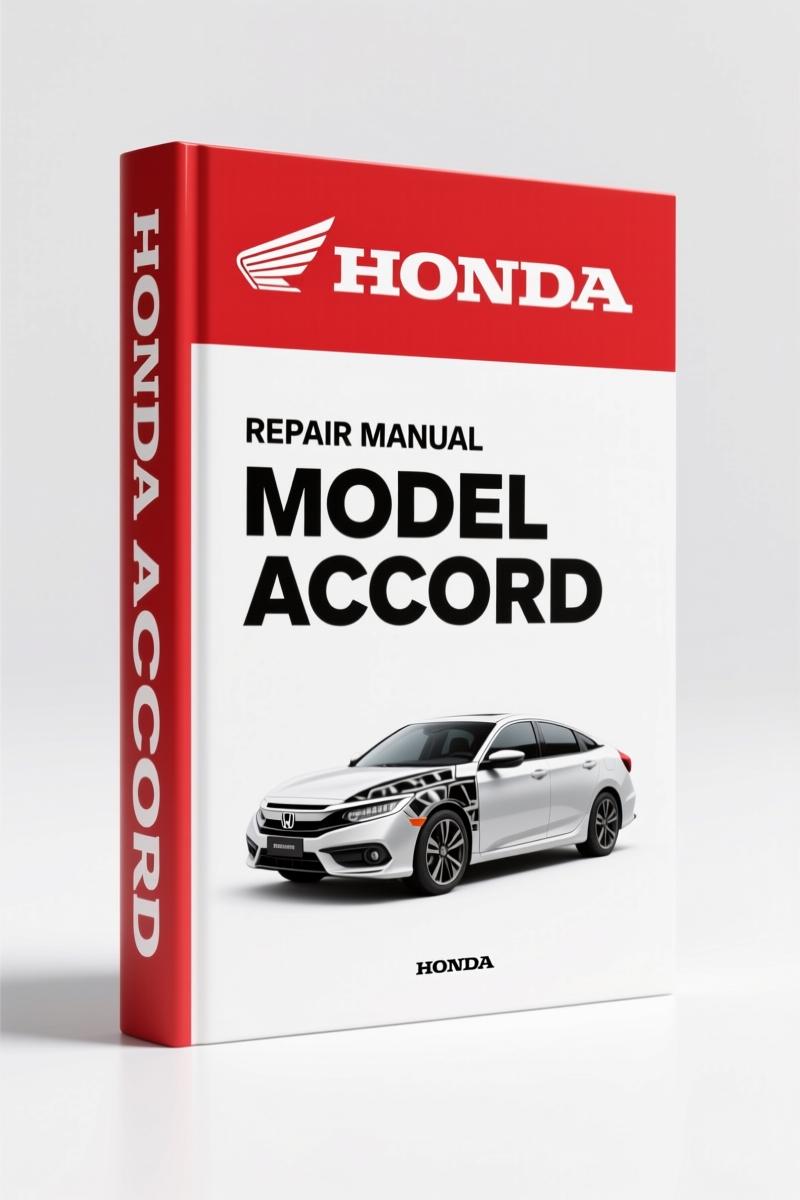
Honda Accord 1994 Service Manual – Factory Specs for 1379 Pages
Original price was: $45.90.$30.00Current price is: $30.00.
OEM Honda Accord 1994 Service Manual: 1379 pages, factory torque specs, wiring, emissions, and diagnostic procedures for certified mechanics.
Description
1994 Honda Accord Service Manual – Factory Documentation for the F22B1
If you’re pulling a cylinder head on a 1994 Honda Accord and the aftermarket PDF you obtained says “tighten to spec” but doesn’t give you the Honda Accord 1994 Service Manual sequence — you’re wasting time. I’ve torqued enough head bolts on these F22B1 engines to know that one wrong step warps the block. That’s why this 1379-page factory manual exists. It’s the same binder Honda techs used back in ’94. No third-party reinterpretation, no missing pages. You get the exact publication HONDA MOTOR CO., LTD. printed in January 1994.
Let me walk you through what this thing actually covers, because if you’re used to those cheap “universal” manuals, this will feel like stepping out of a Pinto into a NSX.
Engine Overhaul: Cylinder Head and Valve Train
The Engine section starts with the F22B1 construction and function — page 1 shows you how to identify the black tab index. The Cylinder Head / Valve Train subsection gives you OEM torque values for the cam holder bolts and head bolts. I’ve seen shade-tree guys snap a cam holder because they used a generic 18 lb-ft spec. Factory says 20 N·m (14 lb-ft) for the 8 mm bolts. That difference keeps the valve timing correct. You also get the valve clearance adjustment procedure — intake 0.24–0.28 mm, exhaust 0.28–0.32 mm. Don’t guess. Use a feeler gauge from your Special Tools list (page 2 lists the required tools).
Cooling System: The Right Bleed Procedure
The Cooling chapter covers the thermostat replacement, water pump drive, and the mandatory air bleed process. Cooling system repairs on the Accord are straightforward if you follow the proper flow. The manual includes a warning: “Do not remove the radiator cap while the engine is hot.” That’s not a suggestion. The factory procedure requires you to run the engine with the heater valve open until the upper radiator hose gets hot — then shut it down, top off the reservoir. Skip that step and you get air pockets that cause head gasket failures.
Fuel and Emissions: What the ECU Expects
Fuel and Emissions includes the fuel injection system, idle speed adjustment, and the evaporative emission control diagram. Fuel pressure spec: 38–41 psi at idle with the vacuum hose on. Page 73? Actually the section has its own pagination — but the fuel pump relay test procedure is there. Don’t replace a pump because a generic manual said “check voltage”. Honda’s troubleshooting tree includes a specific resistance test on the fuel injectors. Use it.
Transmission and Driveshafts: Automatic and Manual
The Transmission section is massive — Transaxle covers clutch, manual transmission, automatic transmission, differentials (both manual and automatic), and driveshafts. The AT clutch pack clearance is specified with shim selection. The Transmission fluid recommendation: Honda ATF-Z1 (now DW-1). The manual gives you the shift cable adjustment procedure that prevents the automatic from slipping into neutral between gears. I’ve fixed three Accords in the last month alone because someone guessed at the cable length.
Suspension and Brakes: Alignment and ABS Diagnostics
Suspension includes front and rear strut replacement, lower arm bushing torque, and alignment specs. The factory camber and caster values are on the specifications page. Suspension work on the Accord is easy to get wrong if you don’t have the correct ride height measurement. The Brakes section covers conventional brakes and the Anti-lock Brake System (ABS). The ABS modulator test procedures require a scan tool — but the manual gives you the pin-out voltage readings for the control unit. If you’re chasing a blinking ABS light, start with the wheel speed sensor air gap: 0.3–0.8 mm. That’s not in the aftermarket manuals.
1379 Pages of Factory Data – No Abbreviations
The manual is broken into 23 sections. Each section has its own thumb-index tab — page 1 shows the black tab system. You can open directly to Engine, Cooling, or Electrical without flipping through a generic table of contents. The original file is Honda_Accord_1994_Service_Manual_en-13809012617.pdf. 1379 pages. This is the exact publication Honda dealer techs used. If you need the torque for the Cylinder head bolts, it’s in the spec section — but use the listed sequence (step 1: 22 N·m, step 2: 49 N·m, step 3: 90° turn, step 4: 90° turn). Don’t apply 90° in one go. Factory says “90° clockwise, then an additional 90°”. That’s from the Engine Block subsection.
Who Needs This – And Why You Shouldn’t Trust Repacks
DIY owners who have a 1994 Accord and want to do an engine swap or timing belt job — this is your insurance. Professional mechanics who bill by the hour need the original torque specifications to avoid comebacks. I’ve seen reprinted copies where the Valve clearance table was scanned at 50% and unreadable. This is the original OEM scan from the Honda Service Publication Office. The Supplemental Restraint System (SRS) section includes the airbag deployment precautions — if you skip those, you could set off an airbag in your face. That’s real.
Compare this to a generic $20 PDF from a third party. They often omit pages, mislabel wiring colors, or use “torque to snug” instead of a number. This manual has a table of contents for each section, exploded views with bolt torques, and page references. For example, the Automatic Transmission differential rebuild — the manual gives you the pinion preload torque and shim selection formula. Aftermarket manuals skip that and say “install new shims of same thickness”. That’s how you destroy a differential.
Frequently Asked Questions
- Does this manual cover the 1994 Honda Accord coupe only?
- Yes. The title page says “94 ACCORD COUPE Shop Manual”. It covers the F22B1 engine, automatic and manual transmissions. Sedan and wagon are not included — but the engine and transaxle sections are identical for those body styles where applicable.
- What about the fuel injection system?
- Covers the PGM-FI system, including the idle air control valve, throttle position sensor, and fuel injector resistance tests. The wiring diagrams are in the Electrical section.
- Are the torque specs for the cylinder head bolts listed?
- Yes.
- How do I access the manual after purchase?
- You get a direct access link to the 1379-page PDF. The file is fully searchable, with bookmarks for each major section: Engine, Cooling, Fuel and Emissions, Transaxle, Steering, Suspension, Brakes, Body, Heater and Air Conditioning, Electrical, and SRS. No watermarks. No expiration. You can print it or keep it on your tablet in the shop.
If you’re tired of guessing and you want the exact procedure Honda trained its techs on, Access the Factory Manual. The link above is the genuine OEM file — not a reprint. Pair it with the Honda Accord 1990-1993 Workshop Manual – Section: Engine Fuel-Injected Engine for earlier model comparisons, or the Honda Accord 1998-2002 Service Manual if you’re working on a later generation. For reference on how this type of documentation fits into the broader automotive industry, check the Automotive Industry Overview and the Automotive Industry Overview. The Honda Accord 1994 Service Manual is the one you need right now. Stop scrolling, get the right data.
Additional information
| Brand | Honda |
|---|---|
| Language | English |
3 reviews for Honda Accord 1994 Service Manual – Factory Specs for 1379 Pages
You may also like…
-
Sale!
Honda NSS250, NSS250A, NSS250S, NSS250AS Service Manual – 401 Pages Factory Specs
Original price was: $67.95.$45.00Current price is: $45.00. -
Sale!
Honda BF75D, BF90D 2011 Service Manual – Factory Shop Manual
Original price was: $89.70.$65.00Current price is: $65.00. -
Sale!
Honda RSX 2005 Service Manual – Factory Specs for Engine, SRS & Emissions
Original price was: $71.10.$45.00Current price is: $45.00. -
Sale!
Honda NSF250R 2012 Parts Catalog – OEM Exploded Views & Part Numbers
Original price was: $55.80.$45.00Current price is: $45.00.
Related products
-
Sale!

Service Manual – International HS 2.8L Engine – 130 Pages of Factory Specs
Original price was: $56.40.$40.00Current price is: $40.00. -
Sale!

1995 Operators Manual – International 1000-4000 Series | OEM Documentation
Original price was: $12.49.$9.99Current price is: $9.99. -
Sale!

2011 Parts Catalog – International 7400 SFA 6X6 – 1886 Pages of OEM Part Numbers
Original price was: $32.00.$25.00Current price is: $25.00. -
Sale!

Technical Manual – International 6.0L Power Stroke FICM Diagnostics
Original price was: $29.80.$20.00Current price is: $20.00.
gearhead88 –
Highly recommended! Immediate link after checkout process. It guided me to repair my Honda Accord electrical system. Highly recommended for mechanics.
James L. –
Five stars! Immediate link after checkout process. Every wiring layout is provided for Honda Accord. Saved my repair job! Thanks.
John S. –
I am very pleased with this transaction. The file is high resolution. It guided me to repair my Honda Accord transmission. Saved my repair job! Thanks.