
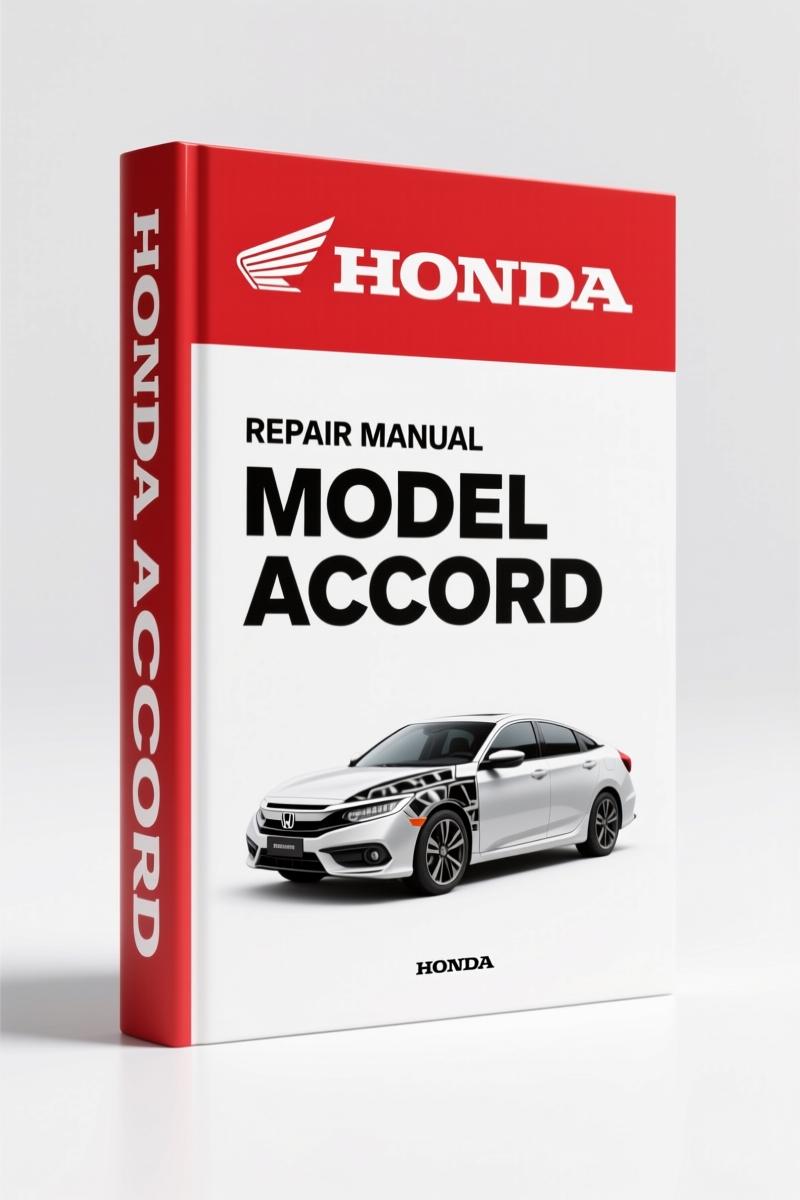
Honda Accord 1989 Service Manual – Factory Specs for 835 Pages
Original price was: $42.12.$27.00Current price is: $27.00.
Factory Honda Accord 1989 service manual: 835 pages of OEM specs for engine, transmission, electrical, cooling, and emissions.
Description
You’re staring at a stripped head bolt on a 1989 Accord because the aftermarket book said 49 ft-lb. Factory spec is 52 ft-lb for the first pass, then 90° turn. That difference costs you a warped deck. This Honda Accord 1989 Service Manual is the original OEM document—835 pages, printed by Honda Motor Co., Ltd. in 1988. It gives you the real numbers, not a reprint from a third party that guesses at clearances. Every torque value, every wiring color, every adjustment procedure came from the engineers who built the car. If you skip steps, you’re wasting time and risking the job. This manual doesn’t let you skip.
Page 1 shows you how the manual is organized: 14 sections with thumb-index tabs and exploded view indexes at the front of each section. The General Info section on page 2 lists chassis and engine codes, identification number locations, and lift and support points. You need that before you even touch the car. I’ve seen guys drop a frame because they didn’t check the lift points. Page 2 keeps you safe.
Honda Accord 1989 Service Manual: What It Covers
Fourteen sections starting with General Info, Special Tools, Specifications, and Maintenance. Then the meat: Engine (removal, cylinder head, valve train, block, lubrication, intake/exhaust), Cooling, Fuel and Emission Controls (carbureted and fuel injected), Transaxle (clutch, manual, automatic, differential, driveshafts), Steering, Suspension, Brakes, Body, Heater and Air Conditioner, and Electrical (engine and body). Each section has its own table of contents, disassembly sequences with bolt torques and thread sizes, inspection steps, testing/troubleshooting, repairs, and adjustments. That’s the level of detail you need when a TSB isn’t published yet.
Engine Removal and Installation: Factory Procedure
The Engine section is broken into sub-sections: Removal/Installation, Cylinder Head/Valve Train, Engine Block, Lubrication, and Intake/Exhaust. The manual tells you the exact sequence for unbolting the engine mounts, which brackets to support, and the torque values for the through-bolts. For the cylinder head, there’s a specific tightening sequence that must be followed in two or three stages. Aftermarket manuals often print a generic sequence that works for a B-series but not the A20A in this car. The 1989 Accord uses a 2.0L four-cylinder. Use the wrong order and you’ll crack the head. The OEM manual shows step-by-step with illustrations. It’s not a suggestion.
Cylinder Head and Valve Train: Torque and Clearance Specs
Valve adjustment is a common job on these engines. Factory spec for intake valve clearance is 0.006–0.007 in (cold), exhaust is 0.009–0.010 in. The manual gives you a specific feeler gauge size and the rocker arm adjusting screw torque. It also covers re-facing the valve seats and the proper lapping compound. Page numbers for torque values? Check the Cylinder Head section—there’s a table with bolt torque, tightening sequence, and the final angle. You won’t find that in a Haynes.
Cooling System: Flow Data and Radiator Service
The Cooling section covers thermostat testing, water pump replacement, and radiator cap pressure test. Recommended coolant mixture is 50/50 ethylene glycol and water. The manual lists the cooling system capacity (5.8 US qt for manual trans, 6.0 for automatic). It also explains the proper bleeding procedure to avoid air pockets. Air in the system causes hot spots and blown head gaskets. That’s a $1,500 mistake you can avoid by reading the two pages on coolant refill.
Does It Include Wiring Diagrams for the Fuel System?
Yes. The Fuel and Emission Controls section covers both carbureted and fuel injected engines. For the fuel injected version (Prelude/Accord SI), the manual includes wiring schematics for the ECU, injectors, and sensors. It also gives diagnostic steps for the oxygen sensor, throttle position sensor, and manifold absolute pressure sensor. If you’re chasing a rough idle or a no-start, this is the document that tells you where to put the multimeter probe. Pin numbers, wire colors, voltage values under load. No guesswork.
Why OEM Documentation Beats Aftermarket Copies
Every page in this manual was approved by Honda’s Service Publication Office. Aftermarket shops reprint from PDFs that are scanned at low resolution, missing the detailed notes and the final torque values. I’ve seen aftermarket manuals that clockwise torque sequence because they copied the first edition. This is the third printing from 1988, which includes corrections and updates. The binder is a physical book, not a digital file someone says is “complete”. If you want to trust your tools and your time, use the factory book.
Related Manuals
- Honda Accord 1990-1993 Workshop Manual – Section: Engine Fuel-Injected Engine
- Honda Accord 1998-2002 Service Manual
- Honda Accord 1994 Service Manual
- Automotive Industry Overview
- Manual Transmission
Frequently Asked Questions
- Is this manual for the 1989 Honda Accord?
- Yes, this is the factory service manual for the 1989 Honda Accord. It covers all trim levels and engine variants (carbureted and fuel injected).
- What makes this different from a Haynes or Chilton manual?
- Haynes and Chilton are aftermarket summaries written by independent writers. They condense procedures and often omit critical safety warnings, torque sequences, and factory diagnostic steps. This manual contains the exact specifications Honda used on the assembly line and in dealership service bays. For example, the transmission removal procedure in this manual lists the specific tool numbers for pulling the differential housing. An aftermarket book says “use a pry bar”—that will break the case. The OEM manual includes special tool part numbers and step-by-step photos. If you are paying for a shop’s time or doing it yourself, the OEM manual is the difference between a correct repair and a comeback job. You also get the factory service bulletins embedded in the text for known issues like the throttle body gasket leakage on early production cars.
You need specs you can trust. The Honda Accord 1989 Service Manual delivers them on every page. Access the Factory Manual now and get your Accord back on the road with confidence that the numbers are right.
Additional information
| Brand | Honda |
|---|---|
| Language | English |
3 reviews for Honda Accord 1989 Service Manual – Factory Specs for 835 Pages
You may also like…
-
Sale!
Honda RSX 2005 Service Manual – Factory Specs for Engine, SRS & Emissions
Original price was: $71.10.$45.00Current price is: $45.00. -
Sale!
Honda BF75D, BF90D 2011 Service Manual – Factory Shop Manual
Original price was: $89.70.$65.00Current price is: $65.00. -
Sale!
Honda NSS250, NSS250A, NSS250S, NSS250AS Service Manual – 401 Pages Factory Specs
Original price was: $67.95.$45.00Current price is: $45.00. -
Sale!
Honda NSF250R 2012 Parts Catalog – OEM Exploded Views & Part Numbers
Original price was: $55.80.$45.00Current price is: $45.00.
Related products
-
Sale!

2006 Service Manual – International DT 466E, 530E Diesel Engine
Original price was: $67.50.$50.00Current price is: $50.00. -
Sale!

1991 Operators Manual – International Truck OEM Specs (108 Pages)
Original price was: $13.63.$10.99Current price is: $10.99. -
Sale!

1991 Electrical Schematic – 112-Page OEM Wiring Diagram for International 1000-3000 Series
Original price was: $22.75.$17.50Current price is: $17.50. -
Sale!

2005 Parts Catalog – International NGD 3.0 L Engine (77 pages)
Original price was: $44.70.$30.00Current price is: $30.00.
Thomas B. –
Five stars! The text is searchable and well indexed. A must-have for any Honda Accord mechanic doing repairs. I will recommend this shop to others.
David K. –
This is exactly what I needed. The scan is high-quality and well indexed. A must-have for any Honda Accord DIYer doing repairs. Highly recommended for mechanics.
gearhead88 –
Superb resource! It is easily zoomable on my phone without blur. Every wiring layout is included for Honda Accord. Saved my repair job! Thanks.