
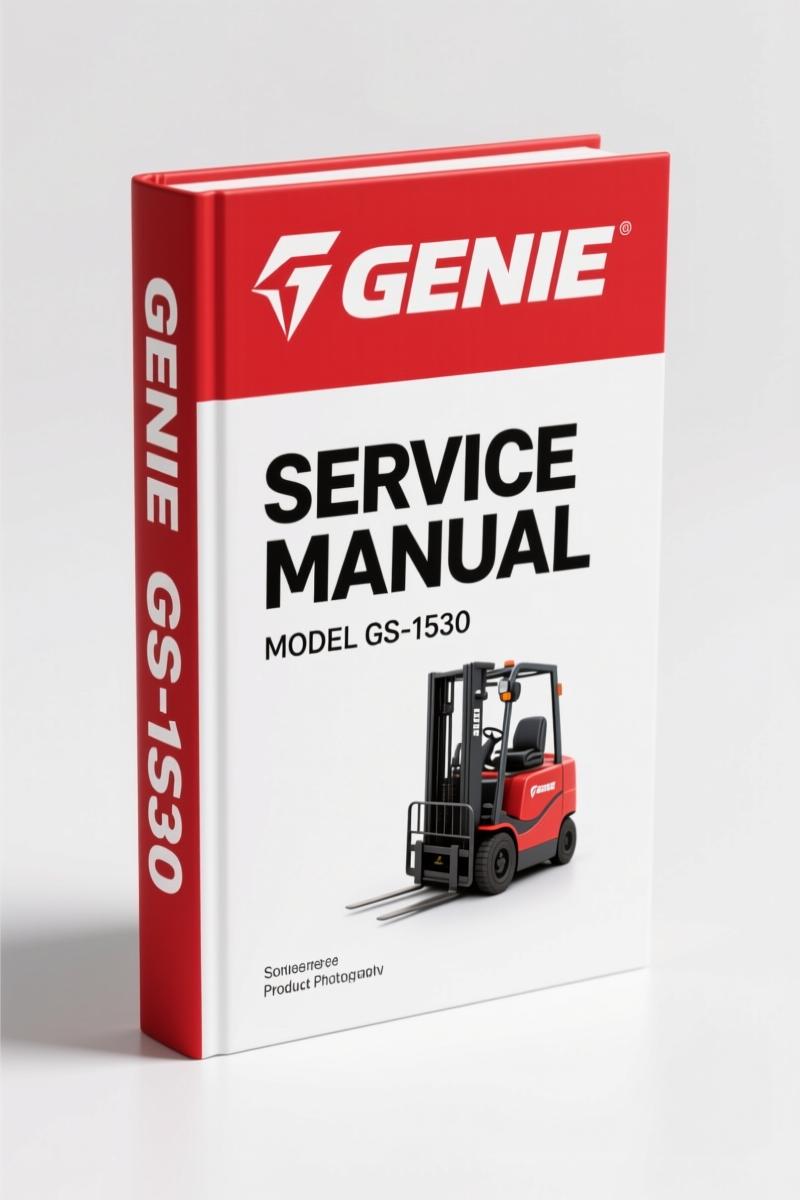
Genie GS-1530, GS-1930 Service Manual – Factory Specs for Aerial Work Platforms
Original price was: $62.80.$40.00Current price is: $40.00.
OEM Genie service manual for GS-1530 and GS-1930. 137 pages covering torque, fault codes, hydraulic specs.
Description
Genie GS-1530, GS-1930 Service Manual – Factory Specs for Scissor Lifts
You’ve got a lift that won’t raise, a code you can’t crack, or a customer waiting on a safety inspection. The last thing you need is a generic manual with values rounded to the nearest decimal and a wiring diagram that doesn’t match your serial number. That’s why this Genie GS-1530, GS-1930 Service Manual exists — 137 pages of Genie’s own print, not a third-party rehash. Section Two alone has the hydraulic hose and fitting torque specifications that will keep you from snapping a fitting or overtightening a seal. I’ve seen guys turn a $20 hose replacement into a $400 manifold repair because they guessed at the torque. Don’t be that guy.
Hydraulic Hose Torque Specs and Fluid Capacities
Section Two in this PDF gives you the machine specs, performance numbers, and the exact hydraulic oil capacity for both the GS-1530 and GS-1930. You want the charge pressure? It’s right there alongside the hydraulic hose and fitting torque specifications. These are not “typical” values — they’re Genie’s factory numbers from when the lift rolled off the line. If you’re rebuilding a function manifold or replacing a cylinder, you need these torque values before you touch a wrench. I keep a copy at the shop for that exact reason. The manual also includes performance specifications for drive speed in stowed and raised positions, so you can confirm your pump output without guesswork.
Scheduled Maintenance: Table B Procedures
Table B covers the hard stuff — batteries, electrical wiring, tire inspection (including castle nut torque), key switch test, emergency stop buttons, service horn, drive brakes, and drive speed tests. Procedure B-3 specifically calls out the castle nut torque for the wheels. That’s not something you want to fudge on a 3,000-pound machine. Every test has a pass/fail criteria straight from Genie’s engineering. The scheduled maintenance inspection report at the end of Section Three gives you a printable checklist that any tech can follow. If you’re running a shop, that report is your liability cover letter.
Does This Manual Cover the Fault Code Charts?
Yes. Section Five is titled Troubleshooting Flow Charts and Fault Codes. There are two separate fault code charts — one for machines before serial number 17408 (which this edition covers) and one for after. You also get a normal operation code chart. Then it walks you through 14 specific failure modes: “All Functions Will Not Operate,” “Pump Motor Will Not Operate,” “Platform Up Function Inoperative,” and so on. Each flow chart is decision-tree style. If you can read a multimeter and follow a “yes/no” path, you can isolate a bad contactor or a stuck valve without swapping parts. That alone can save a full day of diagnostic time on a GS-1930.
7 Repair Sections
Section Seven breaks the lift into seven component groups: Platform Controls, Platform Components, Scissor Components, Ground Controls, Hydraulic Pump, Manifolds, Steering Axle Components, and Non-steering Axle Components. Each section has its own procedure numbers (1-1 Platform Controller, 3-1 Scissor Assembly for GS-1530 before serial 632, etc.). The scissor assembly procedures are split by serial number — important because the lift cylinder geometry changed. The manual also includes exploded-view callouts and step-by-step disassembly. For example, procedure 6-2 covers Valve Adjustment on the Function Manifold. If you’ve ever had a lift that drifts down after being raised, that adjustment procedure is where you start.
Get the Right Torque Data
Torque specifications appear in multiple places — Section Two for hydraulics, B-3 for castle nuts, and the repair procedures for cylinder mounting bolts. Every spec is in foot-pounds or inch-pounds, imperial units as required. The manual also includes a hydraulic symbols legend and electrical schematics for three different serial number ranges. If you’re working on a unit between serial 6901 and 8931, the electrical schematic on page 73 is your map. Don’t rely on a photo you found online — this is the factory document.
Who Should Use This Manual
This is for the home-shop guy who bought a retired rental lift and needs to get it safe, and for the professional mechanic who bills by the hour. A real-world use case: you’re replacing a lift cylinder on a GS-1930. Without the manual, you guess the pin size and the hydraulic line torque. With it, you pull procedure 3-5, see the exact cylinder removal steps, and torque the fittings to spec the first time. The manual also includes a 30-day service procedure (A-11) for new machines — useful if you’re doing a full recommissioning.
Source Authenticity: Genie OEM vs Aftermarket
This is a Genie factory service manual, part number 39528, first edition third printing. It’s not a scanned Chilton or a user-uploaded copy from some forum. The copyright is 1997 by Genie Industries, and it covers the GS-1530 and GS-1930 for machines before serial number 17408. Aftermarket manuals often omit the serial number splits and use generic torque values that can cause leaks or structural failures. This one has Genie’s engineering revision history, including the second and third printings. You get the exact same document that Genie dealers use. If you need a later model, check the Genie GS Series 2014 Service Manual for updated specs.
Related Manuals and Parts Catalogs
For a deeper understanding of how transmissions work in other equipment, refer to the Manual Transmission article on Wikipedia. Also check out the Manual Transmission fundamentals page for general knowledge.
Frequently Asked Questions
- Is this manual specific to certain serial number ranges?
- Yes. This edition covers machines built before serial number 17408. The fault code charts in Section Five have separate listings for before and after that cut-off. The electrical schematics in Section Six are split into three serial ranges: before 6901, 6901 to 8931, and after 8931. If your GS-1530 or GS-1930 has a serial number above 17407, you need the later edition. The manual’s cover clearly states “(before serial number 17408)”. Always check your machine’s serial plate before buying.
- Does this manual include the GS-1930 or just the GS-1530?
- Both models are covered. The title reads “Genie GS-1530 & GS-1930 Service Manual.”
You’ve seen what a misapplied torque spec costs. You know that a wiring diagram from the internet is worth exactly what you paid for it. This manual gives you the factory procedures to get any job on a GS-1530 or GS-1930 done right the first time. Access the Factory Manual now and put it on your workbench — you’ll reference it on every job.
Additional information
| Brand | Genie |
|---|---|
| Language | English |
3 reviews for Genie GS-1530, GS-1930 Service Manual – Factory Specs for Aerial Work Platforms
You may also like…
-
Sale!
Genie GTH-3007, AGRI-730, GTH-2506, AGRI-625 2008 Service Manual
Original price was: $92.40.$60.00Current price is: $60.00. -
Sale!
Genie Z-34/22 2011 Service Manual – OEM Repair Specs
Original price was: $70.50.$50.00Current price is: $50.00. -
Sale!
Genie V-2470, V-2470RT Service Manual – OEM Specs & Torque Data
Original price was: $68.40.$45.00Current price is: $45.00. -
Sale!
Genie GTH-6025 2008 Service Manual – Factory OEM Repair Specs
Original price was: $90.35.$65.00Current price is: $65.00.
Related products
-
Sale!

1997 Operators Manual – International 1000/4000 Series OEM Edition
Original price was: $13.49.$9.99Current price is: $9.99. -
Sale!

Technical Manual – International DT 530 & HT 530 (118 Pages)
Original price was: $37.00.$25.00Current price is: $25.00. -
Sale!

1991 Operators Manual – International Truck OEM Specs (108 Pages)
Original price was: $13.63.$10.99Current price is: $10.99. -
Sale!
1991 Electrical Schematic – 112-Page OEM Wiring Diagram for International 1000-3000 Series
Original price was: $22.75.$17.50Current price is: $17.50.
Charles W. –
I am so happy with this manual. Immediate link after checkout process. Contains detailed schematics for Genie. Saves me hundreds of time.
John S. –
I am so happy with this purchase. It is very easy to read on my iPad without blur. Every spec sheet is provided for Genie GS1530,. Saves me a lot of time.
gearhead88 –
Outstanding! Quick access after checkout. It guided me to rebuild my Genie GS1530, transmission. Saves me hundreds of time.