
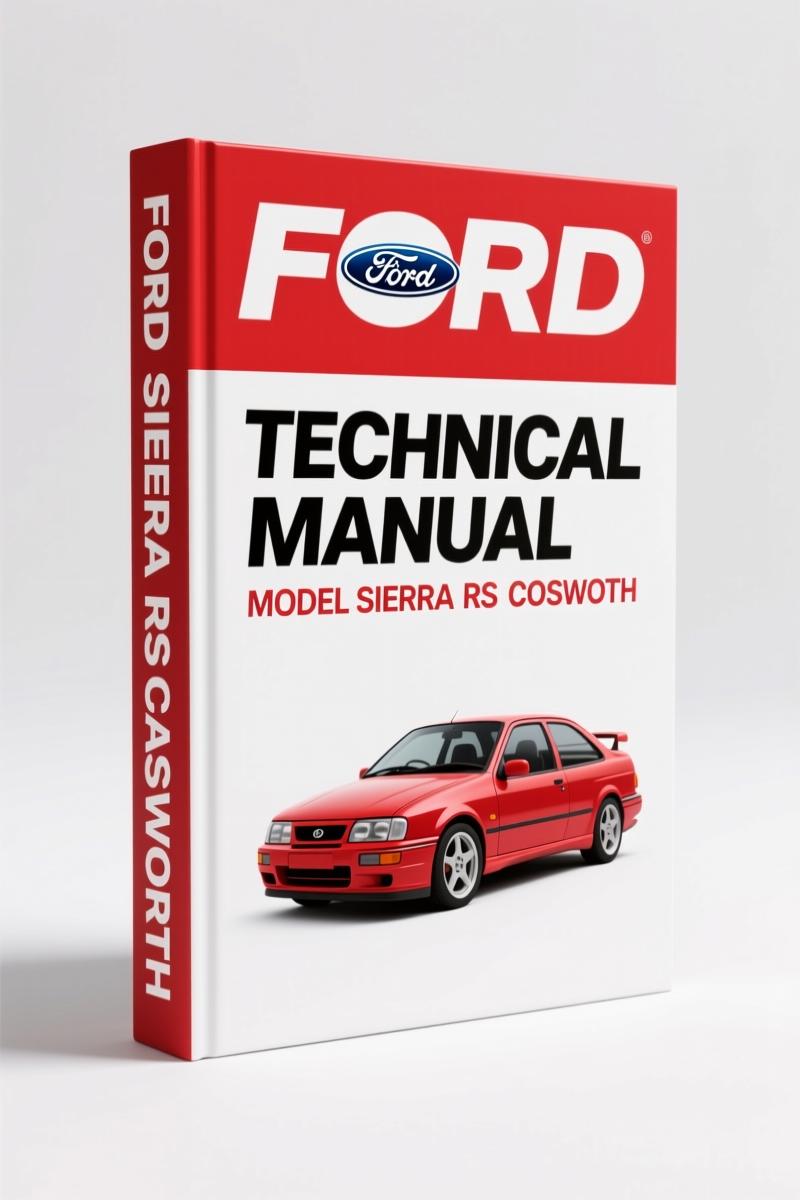
Ford Sierra RS Cosworth 1987 Technical Manual – 59-Page Factory Specs
Original price was: $32.63.$22.50Current price is: $22.50.
59-page factory technical manual for 1987 Ford Sierra RS Cosworth: engine management, fault finding charts, turbo boost specs, OEM data.
Description
Ford Sierra RS Cosworth 1987 Technical Manual
You’ve got a Sierra RS Cosworth on the lift and the factory manual is sitting somewhere in a filing cabinet at the dealer that closed ten years ago. Aftermarket PDFs give you a torque spec that doesn’t match the head bolts, and the wiring diagram colors are swapped. I’ve seen guys pull a turbo off because a third-party chart said the wastegate actuator was bad — turned out to be a bad ground on the engine management module. That’s time you don’t get back. This Ford Sierra RS Cosworth 1987 Technical Manual is the real deal: 59 pages of original Ford Vehicle System Test documentation, printed July 1987. It’s not a reprint, not some scanned copy that’s been OCR’d into oblivion. It’s the same manual a Ford master tech used in 1987 to diagnose the injection/ignition system on the 2.0L Cosworth variants. You want to fix it right the first time? Start here.
Description of System Operation (Page 2)
This manual opens with a breakdown of the electronically controlled injection/ignition system. The Sierra RS Cosworth uses a turbocharger and a new-for-1987 engine management module that takes inputs from sensors measuring air density, engine speed, throttle position, and coolant temperature. Page 2 shows the interaction between the module, control sensors, injectors, and ignition amplifier module. The text walks through why air-fuel ratio matters — too lean and you get detonation, too rich and you foul plugs and waste fuel. Ford engineers even included a chart of lambda (air-fuel ratio) effects on performance and emissions. That’s the kind of detail you need when you’re chasing a misfire on a car that’s tweaked the boost by a previous owner.
Special Tool Recognition and General Equipment (Page 4)
Before you start probing pins, this manual lists the breakout box, DVOM, fuel pressure gauge, and the specific Ford adapters you’ll need. It also flags the interior courtesy light delay fuse. I’ve seen more than one guy chase a phantom ground because he left that fuse in. Ford specifically warns: failure to remove the interior light delay fuse will cause erroneous resistance readings. Page 4 is where you’ll find that warning. Copy that page, tape it to your tool box.
Fault Finding Charts and Diagnosis (Pages 8–55)
This is the meat of the manual. Fault charts organized by symptom: engine cranks but won’t start, starts then dies, rough idle, low power, high fuel consumption. Each chart has a step-by-step decision tree with voltage and resistance specs. No guesswork — the chart tells you which pin to test and what value you should see. If you’re working on a car that’s been messed with, the charts also cover the boost pressure adjustment on page 56. That’s where you set the turbo boost pressure to the factory spec — not some forum number. Page 56 details the adjustment procedure with the correct tool and sequence. Don’t trust a YouTube video when you have the factory step.
Turbo Boost Pressure Adjustment (Page 56)
The manual dedicates a full procedure to adjusting the wastegate actuator rod length and checking boost pressure. It specifies the pressure gauge connection point and the allowable range. Overboost from a misadjusted actuator can crack the exhaust manifold or damage the turbo. Page 56 gives the exact boost spec in bar (convert to psi if you need to — Ford used metric). You get the whole process: warm engine, disconnect the vacuum hose, install gauge, run up to full load, adjust until the gauge reads the target. Simple when you have the right data.
Technical Data (Page 59)
Page 59 compresses all the critical numbers: injector resistance, fuel pump pressure, ignition timing, idle speed, throttle position sensor voltage, and engine management module pin voltages. Having these on a single page means you can check specs without flipping through the whole book. I keep a printout of page 59 in the service binder for every RS Cosworth that comes through my shop.
Why the Interior Courtesy Light Delay Fuse Matters
Ford put a note in the manual that’s easy to miss if you’re skimming: “When performing breakout box checks, in addition to ensuring all electrical loads are switched off, it is essential to remove the interior light delay fuse.” That fuse sits in the fuse box and keeps power to the interior lights for a few seconds after you close the door. If you don’t pull it, that tiny current path can cause the breakout box readings to drift by a few tenths of a volt. Enough to make you replace a perfectly good sensor. The manual calls it out. Aftermarket guides don’t.
Source Validity: OEM vs Aftermarket
This is Ford’s own document, published July 1987. The part number on the original file is Ford Sierra RS Cosworth 1987 Technical Manual en-15113014800. The only changes are the cover photo and the digital formatting. The content is an exact scan of the printed technical manual Ford sent to dealerships. There’s no translation error, no redrawn wiring diagram, no missing page. Compare that to an aftermarket manual that rewords “remove the interior light delay fuse” to “disconnect the battery” — and then you lose the radio code and the adaptive memory. OEM specificity saves you time and keeps the car stock.
Who Needs This Manual
DIY owners restoring a Sierra RS Cosworth. Shop technicians who see one of these once every few years and need accurate specs fast. Anyone who has ever tried to diagnose a no-start on a 1980s Ford turbo without factory data. This manual is for the home mechanic who reads the whole procedure before turning a wrench, not the one who skips to the torque spec and snaps a bolt. If you keep your car original, you need the factory boost pressure and the original injection system calibration. This is it.
You can find broader context on the era’s automotive technology at Automotive Industry Overview and specific transmission details at Manual Transmission.
Related manuals worth having on hand:
- Ford Sierra and Escort RS Cosworth Workshop Manual
- Ford Sierra RS Cosworth 1985 Service Manual – OEM Specs
- Ford Mondeo 2003 Technical Manual – OEM Factory Data
- Does this manual cover the fuel system?
- Yes, it covers the entire injection/ignition system.
- What is the most common mistake when using this manual?
- Forgetting to remove the interior courtesy light delay fuse before breakout box checks. That little fuse can introduce enough resistance to make a good sensor look bad. The manual warns you on page 2 and page 4, but many people skip those pages. I’ve wasted an afternoon chasing a false fault because of it. Pull the fuse, do the test, put the fuse back. That step alone can save you from replacing an engine management module that’s working fine.
Stop guessing with forum advice. Access the Factory Manual now.
Additional information
| Brand | Ford |
|---|---|
| Language | English |
3 reviews for Ford Sierra RS Cosworth 1987 Technical Manual – 59-Page Factory Specs
You may also like…
-
Sale!

Ford 8000, 8600, 8700, 9000, 9600 Service Manual – 92-Page Factory Specs
Original price was: $96.20.$65.00Current price is: $65.00. -
Sale!

Ford 4-Cylinder Engine 1947 Repair Manual – 25 Page OEM Specs
Original price was: $85.15.$65.00Current price is: $65.00. -
Sale!

Ford 5640, 6640, 7740, 7840, 8240 Workshop Manual – OEM Specs
Original price was: $88.40.$65.00Current price is: $65.00. -
Sale!

Ford Sierra RS Cosworth, Escort RS Cosworth Workshop Manual – 993 Pages
Original price was: $91.00.$65.00Current price is: $65.00.
Related products
-
Sale!
Acura NSX 1991 Service Manual – 1420 Pages OEM
Original price was: $102.05.$65.00Current price is: $65.00. -
Sale!

International 1000-3000 Series Operators Manual – 132 Pages of OEM Specs
Original price was: $14.40.$10.99Current price is: $10.99. -
Sale!

Technical Manual – International 6.0L Power Stroke FICM Diagnostics
Original price was: $29.80.$20.00Current price is: $20.00. -
Sale!

2006 Service Manual – International DT 466E, 530E Diesel Engine
Original price was: $67.50.$50.00Current price is: $50.00.
diy_master –
Superb resource! Instant access after checkout process. Contains precise schematics for Ford. Saved my weekend project! Thanks.
Richard G. –
This is just what I required. It is very easy to read on my laptop without losing quality. Contains clear schematics for Ford. Saved my repair job! Thank you.
William H. –
Excellent factory service manual. Quick access after checkout. A must-have for any Ford Sierra mechanic doing maintenance. Saves me a lot of dollars.