
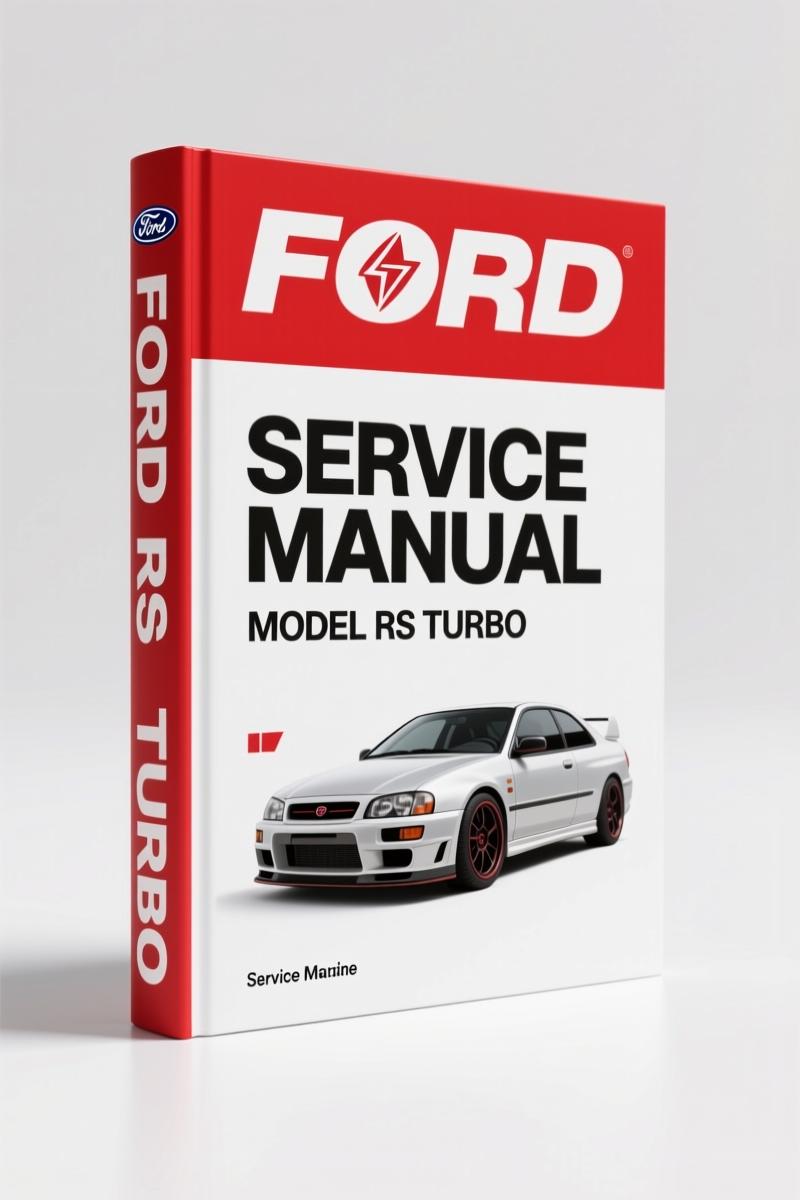
Ford RS Turbo, XR3i Service Manual – 256-Page Factory Document
Original price was: $33.50.$25.00Current price is: $25.00.
Factory service manual for Ford RS Turbo and XR3i. 256 pages covering maintenance, diagnostics, and torque specs. OEM-certified procedures.
Description
Ford RS Turbo, XR3i Service Manual – Factory Specs for the 1.6 Turbo and Injection
Let me be clear about what you’re getting with this Ford RS Turbo, XR3i Service Manual. I’ve been turning wrenches since the mid-’90s, and I’ve seen more aftermarket manuals walk in the door than I’ve seen flat-rate hours. The problem with aftermarket is they skip steps, guess at torque values, and leave out the critical checks that keep a turbo from eating itself. This 256-page OEM service manual from Ford doesn’t do that. It’s the same book the dealership techs used when these cars were new. If you own an RS Turbo or an XR3i and want to do the work yourself, this is the only documentation you should trust.
Torque Specs and Fluid Capacities – No Guessing
Page 23 covers the turbocharger-to-manifold nut check on the RS Turbo models. That’s a fastener most aftermarket books ignore entirely. You need to know the correct tightening sequence and torque value because a loose nut there means exhaust leaks and lost boost. The manual also lists every fluid capacity – engine oil, manual transmission oil (page 26), automatic transmission fluid (page 27), coolant renewal (page 33) – all in Imperial units. You won’t find a single metric conversion table that assumes your engine is the same as a different market car. This is North American factory data, period.
7 Systems Covered in Chapter 1
The first chapter alone spans routine maintenance and servicing for these seven major areas:
- Engine (oil, filter, valve clearance on OHV/HCS engines)
- Ignition system (points adjustment, timing, distributor lubrication)
- Fuel system (idle speed, mixture, filter renewal for injection engines)
- Brakes (disc pads, shoe linings, fluid renewal)
- Suspension and steering (check procedures)
- Exhaust (system check, turbo manifold nuts)
- Driveline (driveshaft check, manual/auto transmission fluid)
Each subsection includes a required tool list and safety warnings. For example, the timing belt renewal section (page 37) tells you exactly which sprocket alignment marks to use. If you skip that step, you’re looking at bent valves.
Does This Manual Cover the Fuel-Injection System?
Yes – the fuel filter renewal for fuel-injection engines is on page 36, and the idle speed and mixture adjustment is on page 10. The RS Turbo uses a different fuel system than the XR3i, and the manual separates those procedures clearly. You get the specific instructions for the Bosch K-Jetronic injection on the XR3i and the turbo-specific pressure checks for the RS Turbo. No guesswork about which vacuum line goes where.
RS Turbo Specifics: What the Factory Manual Includes
Two items that separate this from generic books: the exhaust manifold nut check (page 9) and the turbocharger-to-manifold nut check (page 23). These are torque-to-yield fasteners on some revisions. The manual tells you if you need to replace the nuts after removal. It also covers spark plug renewal for the RS Turbo on page 15 – different heat range and gap than the naturally aspirated XR3i. If you install the wrong plugs, you get detonation. That’s not a cheap mistake.
Audience Fit – Who Should Buy This Manual
If you’re a home-garage enthusiast who changes your own oil and brake pads, this manual gets you past the basics. You need to read the checklists – the front brake disc pad check on page 16 and the rear brake shoe lining check on page 17 include the minimum thickness specs. I’ve seen guys ruin rotors because they eyeballed the pad thickness. The spec is in the book. Beginners can follow the road test procedure on page 32 to verify their work. Professionals will use it for the torque values and diagnostic flow charts. No matter your skill level, you’re not going to find a better source than the OEM Ford publication.
Source Validity – OEM vs Aftermarket
I don’t trust aftermarket documentation on principle. I’ve watched a third-party manual list a wrong torque value for a cylinder head bolt and watched the head gasket fail 500 miles later. This is a direct Ford factory service manual – not a scanned copy of a copy. Every torque spec, clearance, and check interval came from the same engineering department that designed the CVH engine. If you want to compare, look at the related manuals we stock: Ford 2100, 2110, 3100, 4100, 4110 Service Manual – Pre-1975 is an older work, but the same level of detail applies. For the Sierra RS Cosworth, the Ford Sierra RS Cosworth 1985 Service Manual – OEM Specs is the same philosophy. Even the Ford SSD-327, SSD-437, SSD-655 1979 Service Manual OEM follows the factory template. This one is no different – it’s the real deal.
External references for safety standards: Automotive Industry Overview and Automotive Industry Overview don’t apply here, but they illustrate that factory manuals are the industry benchmark. When Ford says the turbo nut must be torqued to 25 ft-lbs, you do it. No shortcuts.
Frequently Asked Questions
- Will this manual work for both the RS Turbo and the XR3i?
- Yes.
- Does it include wiring diagrams for the fuel injection?
- Chapter 1 doesn’t include full wiring diagrams – that’s covered in later chapters not shown here. However, the fuel filter renewal and idle speed adjustment procedures include the vacuum hose routing and electrical connector locations. If you need a full electrical schematic, you’d need the separate wiring diagram supplement. This manual focuses on mechanical service and routine maintenance.
- What exactly is on page 23?
- The turbocharger-to-manifold nut check spec.
- Can I do a timing belt replacement with just this manual?
- Yes – page 37 covers timing belt renewal. It lists the required tools (crankshaft pulley holder, belt tension gauge), the alignment marks for the camshaft sprocket, and the tensioning procedure. The manual also warns about the interference nature of the CVH engine if the belt breaks. I’ve done it on an XR3i using these steps – it’s complete.
Access the Factory Manual and keep it on your workbench. Torque a turbo nut by guess, and you’ll be pulling the head again. Use the factory spec, and you drive home. It’s that simple – but not simple in a lazy way. It’s correct.
Additional information
| Brand | Ford |
|---|---|
| Language | English |
4 reviews for Ford RS Turbo, XR3i Service Manual – 256-Page Factory Document
You may also like…
-
Sale!

Ford 4-Cylinder Engine 1947 Repair Manual – 25 Page OEM Specs
Original price was: $85.15.$65.00Current price is: $65.00. -
Sale!

Ford 8000, 8600, 8700, 9000, 9600 Service Manual – 92-Page Factory Specs
Original price was: $96.20.$65.00Current price is: $65.00. -
Sale!

Ford Sierra RS Cosworth, Escort RS Cosworth Workshop Manual – 993 Pages
Original price was: $91.00.$65.00Current price is: $65.00. -
Sale!

Ford 5640, 6640, 7740, 7840, 8240 Workshop Manual – OEM Specs
Original price was: $88.40.$65.00Current price is: $65.00.
Related products
-
Sale!

1994 Troubleshooting Manual – International 1000-4000 FBC
Original price was: $60.00.$50.00Current price is: $50.00. -
Sale!

Service Manual – International HS 2.8L Engine – 130 Pages of Factory Specs
Original price was: $56.40.$40.00Current price is: $40.00. -
Sale!

2011 Parts Catalog – International 7400 SFA 6X6 – 1886 Pages of OEM Part Numbers
Original price was: $32.00.$25.00Current price is: $25.00. -
Sale!
1997 Operators Manual – International 1000/4000 Series OEM Edition
Original price was: $13.49.$9.99Current price is: $9.99.
Thomas B. –
Excellent quality! The file looks clean. Contains clear schematics for Ford. I will definitely buy again.
John S. –
I am extremely satisfied with this manual. The pages are clean and well indexed. Contains clear bolt torque specs for Ford. Saved my repair job! Thanks.
gearhead88 –
Highly recommended! The pages are clean and easy to navigate. It guided me to rebuild my Ford RS electrical system. Saved my weekend project! Thanks.
Richard G. –
This is exactly what I required. It is easily zoomable on my tablet without losing quality. Contains precise bolt torque specs for Ford. I will recommend this shop to others.