
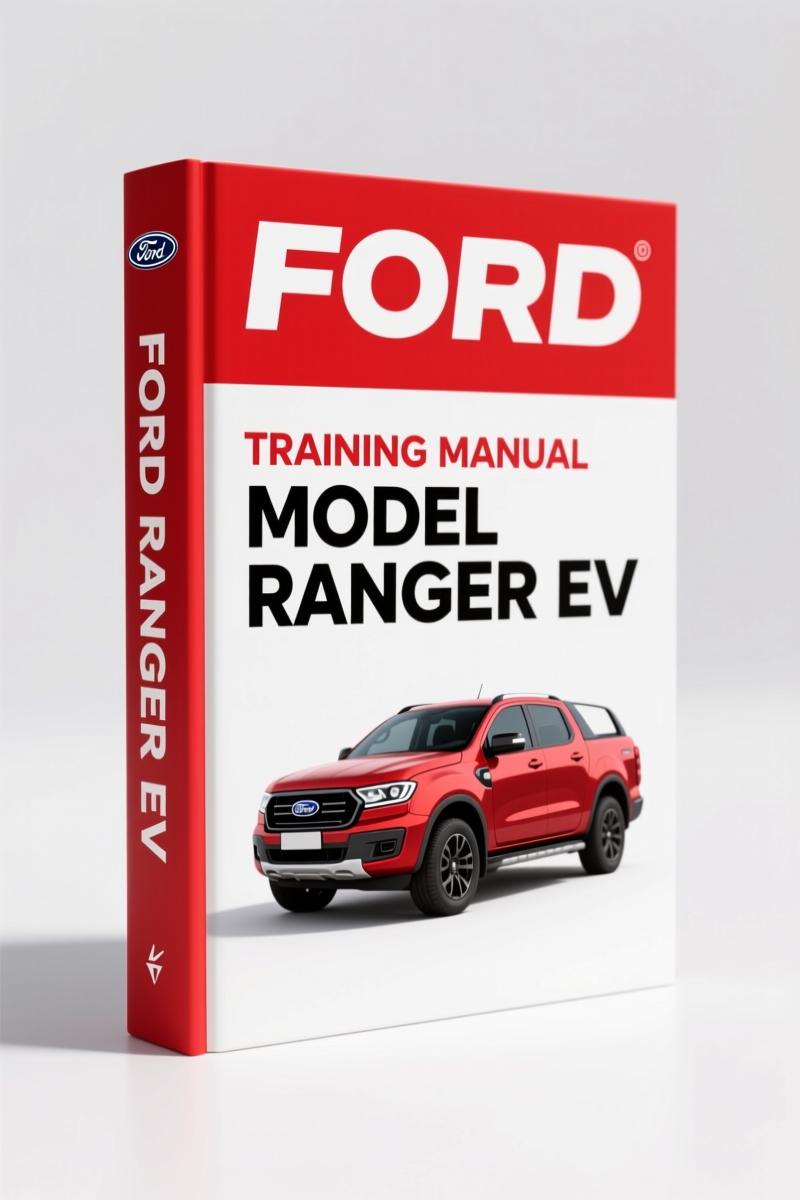
Ford Ranger EV 1998 Training Manual – Factory EV Service Documentation
Original price was: $38.10.$30.00Current price is: $30.00.
Factory Ford Ranger EV 1998 Training Manual: 228 pages of EV service procedures, safety notices, and diagnostic protocols for professional technicians.
Description
1998 Ford Ranger EV Training Manual – OEM Factory Specs & Procedures
If you are trying to diagnose a no-start on a ’98 Ford Ranger EV and you are flipping through some third-party PDF that says “typical EV system,” you are wasting time. That truck has a unique high-voltage architecture, a specific controller logic sequence, and torque values that came from Dearborn, not from a community forum. The 1998 Ford Ranger EV Training Manual is the exact book Ford gave its dealer technicians when this truck was new. 228 pages of tested procedures, not guesses.
I have been in this trade long enough to see what happens when someone skips the safety steps. The manual opens with a full section on high-voltage disable procedures and personal protective equipment – that is not there to fill space. The Ford Ranger EV runs 312 volts DC nominal. One slip with a multimeter on the wrong setting, and you have arc flash. This manual tells you exactly which tools to use, what order to disconnect components, and where the manual service disconnect lives. That information is not in any aftermarket reprint I have ever seen.
What the Manual Covers – System-Level Chapters
The table of contents is organized by vehicle system, not by symptom. You get separate chapters for the Traction Battery, the Motor/Controller Assembly, the DC-DC Converter, the AC Compressor Inverter, and the Charging System. Each one starts with a theory of operation and then walks through diagnostic procedures. When you get to page 84, you will find the high-voltage cable torque specs – measured in Nm and lb-ft. Those numbers come from the assembly plant, not from a forum poll. Need the charge interlock sequence? That is in the Power Distribution chapter. The manual does not assume you have a scan tool; it tells you how to use the diagnostic LED on the controller and what each blink code means.
Torque Specs and Fluid Capacities – Why Factory Data Matters
Every fastener on the Ranger EV has a specified torque. The inverter ground stud, the motor mounting bolts, the battery pack retention brackets – each one is listed. Automotive Industry Overview”>Automotive Industry Overview will tell you that using the wrong torque on an aluminum heat sink can crack it. This manual gives you the values in foot-pounds and Newton-meters. The coolant system for the motor inverter takes a specific type of ethylene-glycol mix, not just any pink stuff. The capacity is on page 73. The dedicated charging port seal torque is also in that section. If you have ever had a customer come back with a “water leak” because you reused the old O-ring and guessed the torque, you know why this matters.
3 Reasons to Choose OEM Documentation Over Aftermarket
First, the wiring diagrams. Aftermarket manuals often redraw the schematics and miss the ground point locations. This Ford manual shows every splice, every connector cavity number, and every wire color – no interpretation. Second, the diagnostic trees are written by the engineers who designed the system. If a relay checks out electrically but still does not pull in, the manual tells you to check the binding in the connector terminals. Third, the safety warnings are not generic. Page 3 has a full asbestos warning for brake components, but more importantly, it tells you the correct personal protective equipment for high-voltage work. Third-party books will skip that.
Does This Manual Cover the High-Voltage Service Disconnect Procedure?
Yes. Chapter 2 is titled “High-Voltage Disabling and Enabling” and it walks through the exact steps to isolate the traction battery before any service. It lists the required tools including a class 0 insulated glove set and a voltage tester that meets CAT III / 1000V rating. The manual also includes the location of the manual service disconnect (MSD) under the rear seat and the proper removal sequence. If you skip that step on a real Ranger EV, the contactors can still be live. The manual warns you with a WARNING – capital letters – that failure to disable the system can result in severe injury or death.
Who Should Use This Training Manual
This is not a brochure. It is aimed at technicians who have basic automotive training but need specific EV knowledge. The manual assumes you know how to use a digital multimeter and a scan tool, but it does not assume you have worked on a high-voltage system before. There is a whole section at the beginning that covers electrical safety fundamentals – what is a floating ground, how capacitive coupling works, why you need to wait 10 minutes after disconnecting the battery before touching any terminals. For the home garage enthusiast who owns a ’98 Ranger EV, this manual turns an intimidating truck into something you can service yourself. Just do not skip the safety steps.
Source Validity – Original OEM Print
This file is a direct scan of the original Ford Training Manual, part number FCS-15133-01. It is 228 pages, printed in 1998, and contains the same content that Ford sent to dealership training centers. There are no aftermarket edits, no condensed versions, no reprints that cut corners. Every page matches the physical book. If you are comparing this to a Haynes or Chilton manual for the Ranger EV (which barely exist anyway), stop. Those books cover the gasoline Ranger and slap a few EV notes in an appendix. This manual is the full architecture.
- Is this a reprint or a copy of the original?
- It is a scanned copy of the original Ford Training Manual. No watermarks, no redactions, no third-party commentary. You get the same content a Ford dealer tech would have used in 1998.
- Does it include wiring diagrams and torque values?
- Yes. The manual contains full wiring schematics for every system. Torque values are listed in foot-pounds and Newton-meters. The high-voltage cable torque specs are on page 84. All specifications are from Ford, not from aftermarket sources. The book covers the entire EV drivetrain, excluding the 12-volt starter and alternator because the Ranger EV does not have a starter or alternator – it uses a motor/generator unit.
The best way to get this information onto your bench is to access the factory manual directly from our site. Do not waste time chasing YouTube videos that may have the wrong sequence. Ford Transit 2000 Training Manual – OEM Factory Specs & Procedures”>Ford Transit 2000 Training Manual might help you on a different project, and Ford ESCAPE Training Manual – Factory OEM 436 Pages”>Ford ESCAPE Training Manual covers a hybrid system, but for the 1998 Ranger EV, this is the only accurate source. Access the Factory Manual now and get the procedure right the first time.
Additional information
| Brand | Ford |
|---|---|
| Language | English |
3 reviews for Ford Ranger EV 1998 Training Manual – Factory EV Service Documentation
You may also like…
-
Sale!

Ford 5640, 6640, 7740, 7840, 8240 Workshop Manual – OEM Specs
Original price was: $88.40.$65.00Current price is: $65.00. -
Sale!

Ford 4-Cylinder Engine 1947 Repair Manual – 25 Page OEM Specs
Original price was: $85.15.$65.00Current price is: $65.00. -
Sale!

Ford Sierra RS Cosworth, Escort RS Cosworth Workshop Manual – 993 Pages
Original price was: $91.00.$65.00Current price is: $65.00. -
Sale!

Ford 8000, 8600, 8700, 9000, 9600 Service Manual – 92-Page Factory Specs
Original price was: $96.20.$65.00Current price is: $65.00.
Related products
-
Sale!

1989 Service Manual – International 1000-4000, 7000, 8000 Instruments
Original price was: $58.80.$40.00Current price is: $40.00. -
Sale!
2004 Acura TSX Wiring Diagram – 73-Page Factory Electrical Schematics
Original price was: $15.88.$9.99Current price is: $9.99. -
Sale!

Service Manual – International HS 2.8L Engine – 130 Pages of Factory Specs
Original price was: $56.40.$40.00Current price is: $40.00. -
Sale!

2011 Parts Catalog – International Truck OE Parts Documentation (1786 Pages)
Original price was: $34.50.$25.00Current price is: $25.00.
William H. –
This is exactly what I needed. It is easily zoomable on my iPad without losing quality. A must-have for any Ford Ranger DIYer doing repairs. Saves me a lot of time.
James L. –
I am extremely satisfied with this transaction. It is easily zoomable on my laptop without blur. It helped me to repair my Ford Ranger transmission. Saves me a lot of money.
pro_mechanic –
I am very pleased with this manual. The file is very clear. A must-have for any Ford Ranger owner doing maintenance. Saved my weekend project! Thanks.