
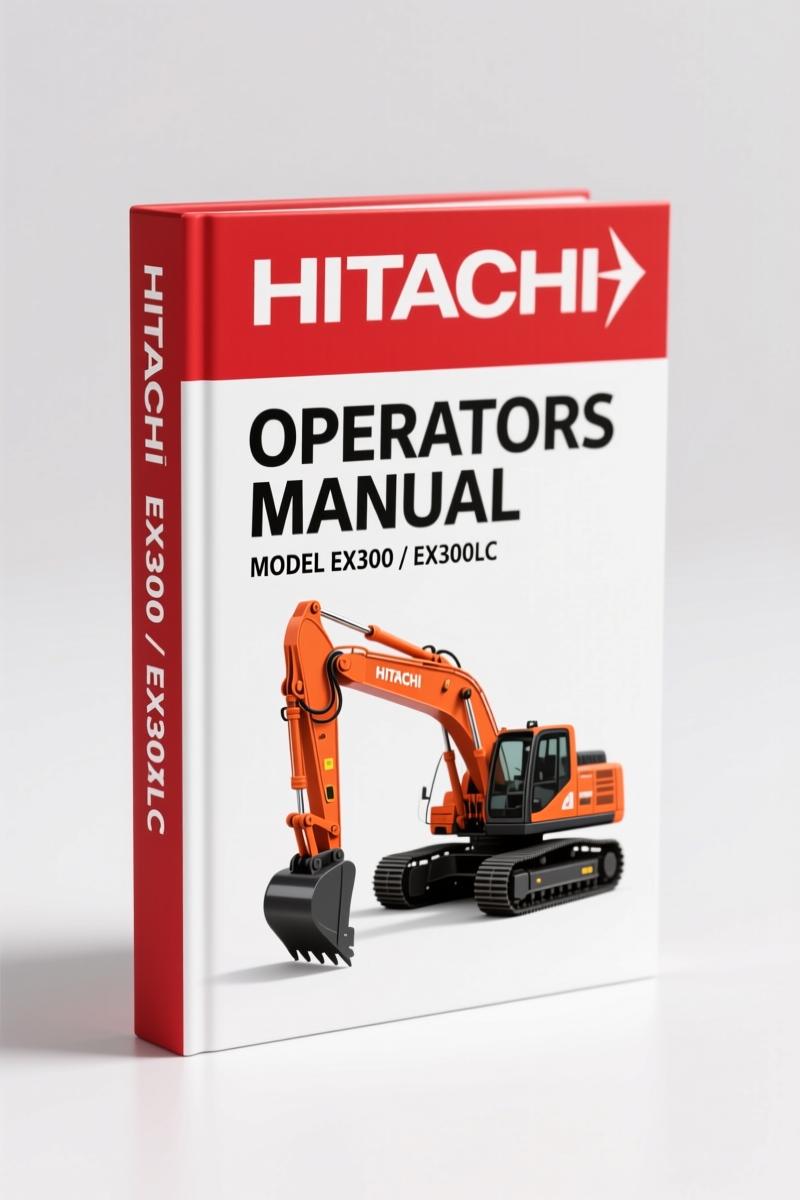
Fiat-hitachi EX300, EX300LC, EX300H, EX300LCH Technical Manual – 852 Pages
Original price was: $45.60.$30.00Current price is: $30.00.
OEM technical manual for Fiat-hitachi EX300, EX300LC, EX300H, EX300LCH. 852 pages of factory procedures, wiring diagrams, and specifications.
Description
Fiat-hitachi EX300, EX300LC, EX300H, EX300LCH Technical Manual – 852 Pages of Factory Specs
You’ve got a machine down, the customer is breathing down your neck, and you’re staring at a hydraulic line you don’t recognize. The aftermarket PDF you obtained last week gave you a torque spec that was off by 30 ft-lbs – you know because you had to redo the job. That’s exactly why the Fiat-hitachi EX300, EX300LC, EX300H, EX300LCH Technical Manual exists. 852 pages of the same material the Hitachi factory techs use. No guesswork. No interpolated drawings from a third-party publisher. This is the real thing.
Manual Composition: Two-Part Structure for Field Work
This manual is split into two color-coded portions. Green tabs for the T/M (Technical Manual) section – that’s where you’ll find operational performance tests, troubleshooting procedures, and system activation info. Yellow tabs for the W/M (Workshop Manual) portion – covers maintenance standards, removal/installation, and assemble/disassemble steps. Each page is numbered with a section and group number so you can flip directly to the right procedure without thumbing through 800 pages. If you’ve ever lost a day chasing a wiring fault because the manual grouped everything under ‘Electrical’, you’ll appreciate the organization. The T/M portion alone covers redelivery and delivery checks, all device operations, and step-by-step troubleshooting. The W/M portion gives you the actual bolt-by-bolt repair data.
Safety Alert System: What the Symbols Mean
Hitachi uses three distinct warnings in this manual: CAUTION (personal injury or death if ignored), IMPORTANT (machine damage if skipped), and NOTE (supplementary technical info). The safety alert symbol appears next to component weights and lifting instructions. If you’ve ever had a hydraulic pump slip off a hoist because the manual didn’t flag the weight, you know why this matters. Every procedure in this manual that carries a risk has the corresponding symbol. No generic “be careful” language – specific hazards are spelled out. For example, when working near the swing drive, the manual calls out the potential for pinch points and hydraulic oil temperature. That’s the kind of detail that keeps a technician safe on a Friday afternoon when fatigue sets in.
Page Numbering System – Why It Matters
Each page carries a code like T 01-03-05. The first letter tells you which portion (T or W). The first number is the group, second is the section, third is the consecutive page within that group. If you’re looking for the charge pressure test on the EX300, you don’t scan the whole book – you look for group 01 (Engine) or group 03 (Hydraulic) depending on what the troubleshooting tree says. This manual was designed for a tech who needs to find data fast, not read a novel. The table of contents at the front lists every group and section, so you can bookmark the pages you need before the job starts. I’ve used manuals with ten different numbering schemes over 28 years. Hitachi’s system is one of the cleanest for cross-referencing between the T/M and W/M sections.
Units Used – SI vs Imperial for North American Shops
This factory manual uses SI units (Newton-meters, bar, Celsius). If you work in a shop that uses ft-lbs and psi, you’ll need a conversion chart handy. The specs are all original Hitachi data – no rounding errors from aftermarket conversions. I keep a laminated conversion card taped to my toolbox. The manual does include some MKSA system units as secondary references, but it’s not a dual-unit document. Don’t let that stop you. The accuracy of the OEM data is worth the extra mental arithmetic. You can find conversion tables online or in any good machinist’s handbook. The key is that when this manual says “torque the head bolts to 245 Nm”, that’s the number the Japanese factory engineers validated. Not a guess from a third-party compiler.
Audience Fit: Who Should Use This Manual
Hitachi wrote this for an experienced technician. The introductions states it clearly: “This manual is written for an experienced technician to provide technical information needed to maintain and repair this machine.” If you’re a home garage enthusiast who has rebuilt a small engine but never touched a 30-ton excavator, this book will overwhelm you. It does not include the operator’s manual, parts catalog, or engine operation manual – those are separate references. What it does include is the exact diagnostic procedures, overhaul tolerances, and hydraulic pressure settings used by Hitachi dealer techs. If you’re running a six-bay shop and one of your guys is new to excavators, pair this manual with the operator’s manual and spend a day walking through the test procedures. The troubleshooting section alone will cut diagnostic time in half once you learn the sequence.
Source Validity: OEM vs Aftermarket Documentation
I have a standing rule in my shop: if a job requires disassembly of a major component – pump, final drive, swing motor – I use only the factory manual. Aftermarket manuals often merge data from multiple model years or omit the safety warnings. This document comes from Hitachi Construction Machinery Co., Ltd., Technical Document Center in Japan. The phone number is printed on the intro page if you have questions (though I doubt many of us will call Japan). The 852 pages are scanned from the original print, not a re-typed version. That’s important because torque tables and wiring diagrams lose accuracy when OCR software misreads a decimal point. This PDF is a direct scan of the bound manual. You get the original yellow and green tab separators, the handwritten corrections, and the original page numbers. If you need the HITACHI EX300 Series Excavator Parts Catalog to cross-reference part numbers, we carry that too. For the engine specifics, you may also want the HITACHI EX300 Series Parts Catalog or the Hitachi Excavator Parts Catalog P/N PI5M-I-I. These are companion documents, not substitutes. For general transmission theory, you can refer to external resources like Manual Transmission but for the EX300’s specific power train, stick to this book.
FAQ – Common Questions About the EX300 Technical Manual
- Does this manual cover the EX300H and EX300LCH?
- Yes. The title includes EX300, EX300LC, EX300H, and EX300LCH. All four models share the same base chassis and major systems; the H variants have different undercarriage dimensions and some hydraulic line routing. The manual notes these differences in the appropriate sections.
- What torque specifications are listed in the manual?
- The manual lists all factory torque values in SI units (Nm). Includes cylinder head bolts, main bearing cap bolts, swing motor mounting bolts, and all hydraulic fitting torques. The specs are grouped by component in the W/M section. No values are omitted – every fastener that requires a torque value is called out.
- Is this the same as a parts catalog?
- No. This is the technical manual (T/M + W/M). The parts catalog is a separate document that lists every part number with exploded diagrams. You need both for a complete rebuild. The technical manual tells you how to take it apart and put it back together; the parts catalog tells you what to order.
- Can a beginner use this manual to rebuild an EX300 engine?
- Not recommended. The manual assumes you know how to use a micrometer, interpret hydraulic schematics, and perform pressure tests. If you have supervised experience on heavy equipment, you can follow the steps. But the manual does not teach fundamentals – it delivers the data. Pair it with Hitachi’s training material or an experienced mentor.
You’ve seen what happens when you rely on a forum post or a copy-pasted spec sheet. A mismatched torque value can warp a cylinder head or blow a seal. This manual eliminates that risk. It’s the same 852 pages the Hitachi dealer uses. If you’re working on an EX300, EX300LC, EX300H, or EX300LCH, stop chasing bad information. Access the Factory Manual and get the job done with the right numbers the first time.
Additional information
| Brand | Fiat-hitachi |
|---|---|
| Language | English |
4 reviews for Fiat-hitachi EX300, EX300LC, EX300H, EX300LCH Technical Manual – 852 Pages
You may also like…
-
Sale!
Fiat-hitachi ZAXIS 200-3, 210H-3, 210K-3, 210N-3, 240-3 2006 Troubleshooting Manual
Original price was: $85.80.$65.00Current price is: $65.00. -
Sale!
Fiat-hitachi 850-3 2006 Troubleshooting Manual – 588 Pages OEM
Original price was: $91.00.$65.00Current price is: $65.00. -
Sale!
Fiat-hitachi ZAXIS 650LC-3, 670LCH-3 2006 Troubleshooting Manual – 586 Pages
Original price was: $82.55.$65.00Current price is: $65.00. -
Sale!
Fiat-hitachi ZAXIS 330-3 2006 Troubleshooting Manual – 633 Pages
Original price was: $103.35.$65.00Current price is: $65.00.
Related products
-
Sale!

1989 Service Manual – International 2000-8000 Electrical Systems
Original price was: $72.00.$50.00Current price is: $50.00. -
Sale!

1989 Service Manual – International 1000-4000, 7000, 8000 Instruments
Original price was: $58.80.$40.00Current price is: $40.00. -
Sale!
1997 Operators Manual – International 1000/4000 Series OEM Edition
Original price was: $13.49.$9.99Current price is: $9.99. -
Sale!

Service Manual – International HS 2.8L Engine – 130 Pages of Factory Specs
Original price was: $56.40.$40.00Current price is: $40.00.
Thomas B. –
This is just what I required. The document is very clear. A must-have for any Fiat-hitachi EX300, mechanic doing repairs. Saved my repair job! Thanks.
pro_mechanic –
Excellent quality! It is very easy to read on my tablet without blur. It assisted me to fix my Fiat-hitachi EX300, engine. Saves me hundreds of money.
David K. –
Perfect workshop guide. The PDF quality is excellent. A must-have for any Fiat-hitachi EX300, DIYer doing maintenance. Worth every penny.
Charles W. –
Outstanding! It is easily zoomable on my laptop without blur. A must-have for any Fiat-hitachi EX300, owner doing maintenance. Saves me a lot of dollars.