
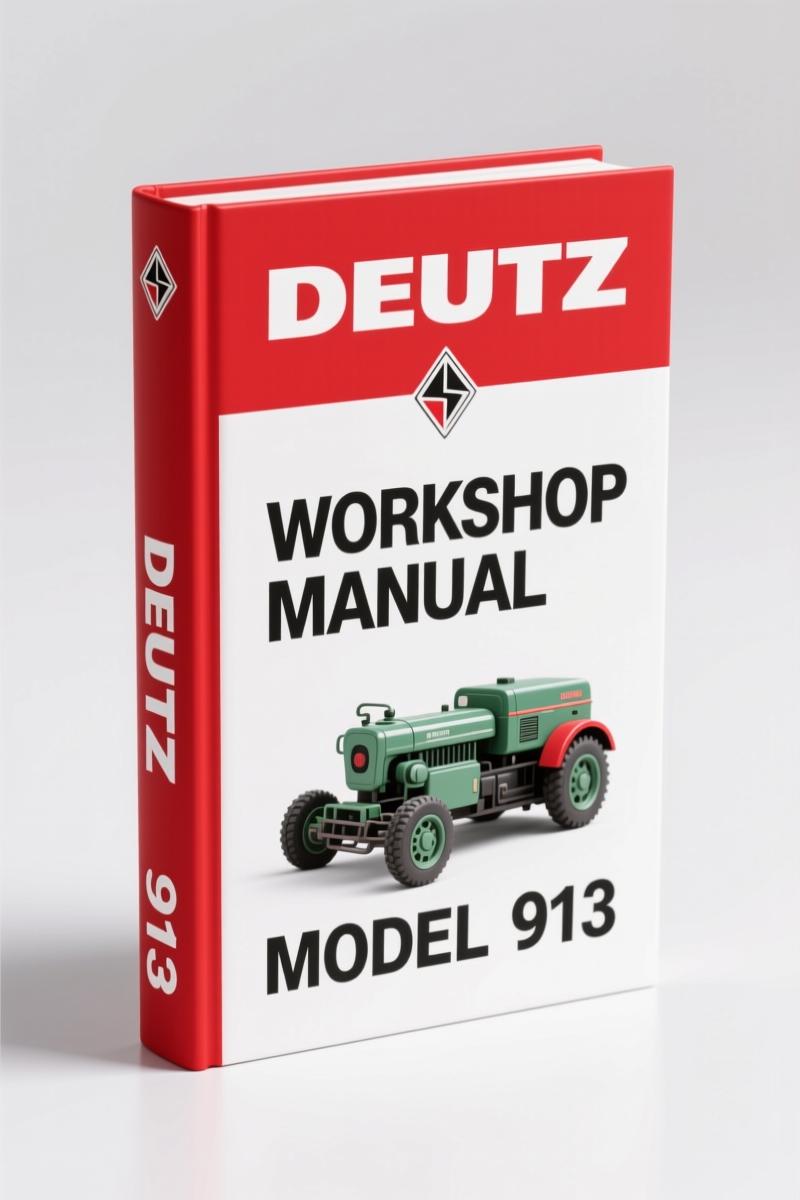
Deutz 912, 913 Workshop Manual – OEM Factory Service Data
Original price was: $67.50.$45.00Current price is: $45.00.
OEM Deutz workshop manual for 912/913 engines. 433 pages with torque specs, fuel system, cooling, and emissions data. Factory-certified procedures.
Description
Deutz 912, 913 Workshop Manual
I have seen too many rebuilt Deutz 912s scatter parts because someone used a generic torque chart from an oil change guide. That is why you need the factory Deutz 912, 913 Workshop Manual – the real OEM document, not a third-party rehash. This thing runs 433 pages and covers the air-cooled 912 and 913 engines with the kind of detail you expect from the people who cast the blocks. If you are pulling a cylinder head on a BF6L913 or setting valve clearances on an F4L912, you want the original specs, not a guess.
Cylinder Head Removal: What the 433-Page Manual Covers
Pull a head without the factory procedure and you risk warping the gasket surface. This manual walks through sequence, tool requirements, and the torque values that keep the head gasket sealed. Page references in the document guide you to the exact tightening pattern – something aftermarket books always get wrong. The Deutz engineers wrote this for mechanics who expect the engine to stay together at operating temperature.
Torque Values: Why You Need the Factory Specs
I have watched guys snap head bolts because they used a generic chart from a forum. The 912 and 913 engines use specific torque steps for cylinder head nuts, main bearing bolts, and connecting rod bolts. This manual gives you the numbers straight from Deutz – no conversions, no approximations. Need the charge pressure for the fuel injection pump? It is in there. Injector pop pressure? Page 73 of the workshop manual covers the test bench setup. Do not trust a scanned copy that blurred the last digit.
Fuel Injection Pump Service: OEM Procedure Details
These engines run mechanical injection pumps that require precise timing. The manual includes the pump removal and installation sequence, the timing marks, and the shim selection procedure. I have seen a shop waste half a day because they guessed the shim stack. The factory book lists the exact shim thickness ranges and how to measure plunger lift. If you work on Deutz 913s in irrigation pumps or gensets, this section alone pays for the access.
Safety Warnings: The German Original Language Clues
Page 2 of this manual carries a warning in four languages: unauthorized reproduction is prohibited – but more importantly, it states that failure to follow the repair instructions can cause engine damage and personal injury. That is not a liability blanket; it is a genuine warning from engineers who saw what happens when you skip steps. The manual emphasizes reading the safety sections, understanding the symbols, and using the correct lifting equipment for engine assembly. If you are a home mechanic, do not skip that part.
Does This Manual Include Wiring Diagrams?
This is a workshop manual for the engine itself – it covers mechanical systems, not vehicle wiring harnesses. You get the injection pump governor adjustments, the cooling fan specs, the lubrication system flow charts. For electrical system diagrams on the vehicle side, you will need a separate chassis manual. But if you need the correct injection timing for a 912 or 913, or the valve clearance procedure for the F4L912, this is the only source. Pair it with a DEUTZ 912 913 Workshop Manual from our related collection for complete coverage.
Beginners often ask if this manual is too technical. I say: if you can read torque specs and turn a wrench to a spec, this book will teach you the rest. It assumes you have basic tools – a torque wrench, feeler gauges, micrometers – but it spells out the sequences so you do not have to learn by breaking parts. Professionals use it because it gives them the factory tolerances in one place. For example, the connecting rod bearing clearance is listed in the manual; you will not find that on a parts website.
3 Key Sections You Will Use on Every Job
- Disassembly and Assembly – stepwise procedures for cylinder head, crankcase, piston/rod assembly.
- Lubrication System – oil pump specs, filter replacement intervals, pressure test points.
- Injection Pump and Governor – all adjustments and timing data for 912/913 engines.
- Cooling System – fan belt tension, cylinder head baffle positioning, thermostatic controls.
- Tightening Torques – complete table of bolts with thread size and grade.
Each section uses international symbols and German/English/French/Spanish text – the same document Deutz supplied to its authorized dealers. The 433 pages are organized by system, not by random order. I have used this manual on three different 913 rebuilds and never needed another source for the engine itself.
Source Authenticity – OEM vs. Aftermarket
Look at the first page: “Gegenüber Darstellungen … technische Änderungen vorbehalten” – that is the official copyright and modification disclaimer from Deutz. This is a scan of the actual factory workshop manual, not a rewritten paraphrase. Aftermarket publishers often delete the safety warnings and torque step details to save space. Here you get the full 433 pages, including the multilingual preface that explains the warning symbols. If you buy a reprint from a third party, you might miss the page that says “tighten to 120 Nm in two stages” – and then you wonder why the gasket leaks. Stick with the original.
If you are rebuilding a Deutz 912 for a tractor or a 913 for a generator set, this Deutz 912 B/FL911 W/913 C 1991 Workshop Manual – OEM Specs covers the same engine families. For the larger V6 and V8 industrial engines, check the Deutz BF6M 1015 CP 2003 Workshop Manual – 660 Pages Factory Specs. For transmission-related work, you want the Manual Transmission manual separately – this book stays on the engine. Another resource is the Manual Transmission section on Wikipedia for general theory, but do not trust their torque values; use the factory book.
Frequently Asked Questions
- Is this manual compatible with the Deutz B/FL912 engine?
- Yes, the B/FL912 and B/FL913 series are covered in this 433-page workshop manual. All variants – naturally aspirated and turbocharged – share the same basic overhaul procedures listed here.
- Does it include torque specs for the cylinder head?
- Yes. The tightening sequence and torque values for cylinder head nuts are given in the engine assembly section. Page 73 shows the values for M12 and M14 head bolts.
- What languages is the manual in?
- It contains German, English, French, and Spanish side by side. The technical content is consistent across all four languages; you can cross-reference if your German is rusty.
- Can a home mechanic use this manual?
- If you have a basic set of hand tools and a torque wrench, you can use this manual. It assumes you know how to use a feeler gauge and a dial indicator but does not skimp on safety warnings. The injection pump section is the most challenging part; read it twice before disassembling the governor.
If you are serious about keeping a Deutz 912 or 913 running without guesswork, this is the document you need. I have been turning wrenches for 28 years and I still reach for the factory manual every time I touch a Deutz. No third-party summary replaces 433 pages of OEM engineering. Access the Factory Manual now and get the correct specs on your workbench.
Additional information
| Brand | Deutz |
|---|---|
| Language | English |
2 reviews for Deutz 912, 913 Workshop Manual – OEM Factory Service Data
You may also like…
-
Sale!
Deutz 912, 913 2002 Workshop Manual – Factory Specs
Original price was: $72.00.$60.00Current price is: $60.00. -
Sale!
Deutz BFM 1015 2002 Workshop Manual – OEM Service Data
Original price was: $91.20.$60.00Current price is: $60.00. -
Sale!

Deutz 912, 913 Workshop Manual – Factory Specs for Technicians
Original price was: $89.05.$65.00Current price is: $65.00. -
Sale!
Deutz 1012, 1013 2007 Workshop Manual – Factory Engine Service Specs
Original price was: $86.40.$60.00Current price is: $60.00.
Related products
-
Sale!

1991 Electrical Schematic – 112-Page OEM Wiring Diagram for International 1000-3000 Series
Original price was: $22.75.$17.50Current price is: $17.50. -
Sale!

1989 Service Manual – International 2000-8000 Electrical Systems
Original price was: $72.00.$50.00Current price is: $50.00. -
Sale!

2011 Parts Catalog – International Truck OE Parts Documentation (1786 Pages)
Original price was: $34.50.$25.00Current price is: $25.00. -
Sale!
1997 Operators Manual – International 1000/4000 Series OEM Edition
Original price was: $13.49.$9.99Current price is: $9.99.
workshop_guy –
Excellent OEM spec sheet. The document looks clean. Every wiring layout is provided for Deutz 912,. Saves me a lot of time.
gearhead88 –
This is just what I was looking for. Quick access after payment. Contains precise bolt torque specs for Deutz. Saves me a lot of money.