
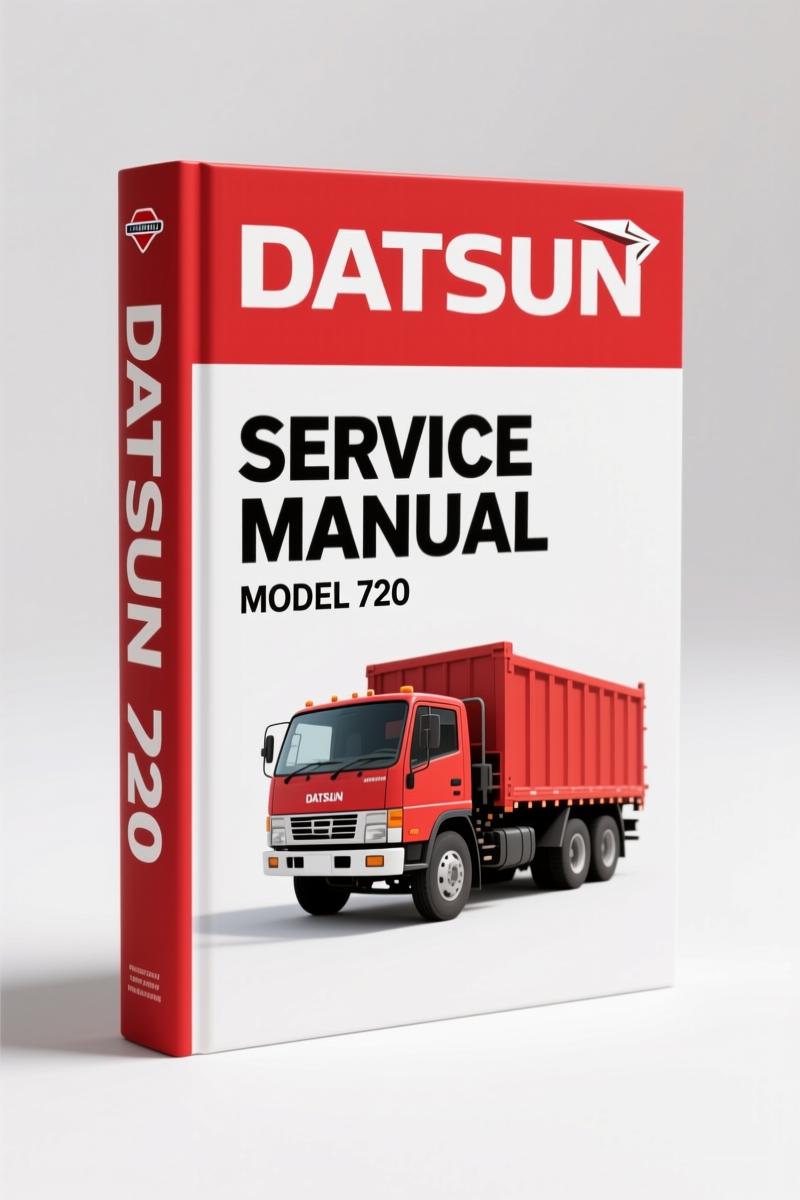
Datsun 720 1981 Service Manual – 111-Page OEM Factory Specs
Original price was: $23.83.$14.99Current price is: $14.99.
111-page OEM service manual for the 1981 Datsun 720. Factory torque specs, emissions data, and repair procedures for certified technicians.
Description
Datsun 720 1981 Service Manual – What You Actually Need to Fix It Right
Let me tell you straight: I’ve seen more Datsun 720s come through my bay with stripped threads, swapped parts, and mis-timed engines than I care to count. Every single one of those screw-ups traces back to somebody using a photocopied aftermarket manual or guessing the spec. If you’re working on a 1981 Datsun 720 – or any 720 series – and you don’t have the factory Datsun 720 1981 Service Manual on your bench, you’re playing roulette with your time and your parts. This thing is 111 pages of what the engineers wrote, not what some third-party reprint guy thought was close enough. It covers everything from the L-series engine to the transfer case, and it gives you the actual tightening torque for standard bolts on page GI-8 – not a generic chart.
I’ve been turning wrenches since before most of you were born, and I still reach for the factory manual before I crack a bolt on a vintage Datsun. Aftermarket manuals leave out the critical steps: the torque sequence for the intake manifold, the exact bleed procedure for the brake system, the Z24 engine timing marks. This one doesn’t. It’s the same manual Nissan printed for their dealers in 1981. That’s the only thing you should trust.
Engine Mechanical Section – What’s Inside and Why It Matters
The ENGINE MECHANICAL (EM) chapter is where you live if you’re rebuilding or resealing. It covers the cylinder head, timing chain, pistons, rings, and valve train. But what sets this apart from aftermarket junk is the inclusion of the factory tolerance ranges. For example, the manual tells you the piston ring end gap spec and the correct direction for the oil ring expander – details that get lost in reprints. If you skip that, you’ll burn oil within 5,000 miles. The manual also lists the special service tools you need, like the valve spring compressor and the piston ring compressor. You can read the tool list on page GI-8 in the GENERAL INFORMATION section. Don’t start the job without checking that list.
Cooling and Lubrication Systems – Factory Flow Data
One of the biggest headaches on the 720 is overheating from a misdiagnosed water pump or a thermostat that opens too late. The ENGINE LUBRICATION & COOLING SYSTEMS (LC) chapter gives you the coolant capacity in Imperial quarts, the thermostat opening temperature, and the oil pump clearances. It also includes the removal and installation procedure for the water pump, with the correct torque for the housing bolts. I’ve seen shadetree guys snap those bolts because they used a generic torque value. The factory manual says 12-15 ft-lbs for the M6 bolts. That’s the difference between a leak and a broken bolt.
Fuel System and Emission Control – Don’t Guess the Vacuum Lines
On a 1981 720, the FUEL (EF) and EMISSION CONTROL SYSTEM (EC) sections are critical. These trucks had complex vacuum routing for the California and federal emissions. If you hook one line wrong, the engine runs like garbage and you fail smog. The manual includes diagrams for the vacuum hose routing and the throttle position sensor adjustment. It also covers the fuel pump pressure test procedure and the carburetor overhaul steps. I’ve used this exact section to get a 720 that had been sitting for ten years back on the road. The factory manual saved me three hours of tracing vacuum lines.
Transmission and Drivetrain – Clutch, Manual, Auto, and Transfer
The CLUTCH (CL), MANUAL TRANSMISSION (MT), AUTOMATIC TRANSMISSION (AT), and TRANSFER (TF) chapters give you the full disassembly and assembly procedures. For the 5-speed manual, you get the shift fork clearance specs and the bearing preload values. If you’ve ever tried to rebuild a Nissan 5-speed without the factory measurements, you know you’ll end up with gear noise or a locked-up box. The manual also covers the propeller shaft and differential carrier (PD), with the correct pinion bearing preload and backlash specs. For more background on manual transmission theory, see Manual Transmission”>Manual Transmission on Wikipedia – but don’t rely on general info for your rebuild. Stick to the OEM data.
Brake System – Factory Bleeding Sequence and Torque
The BRAKE SYSTEM (BR) chapter is short but dense. It gives you the disc brake pad thickness limit, the drum brake shoe adjustment, and the master cylinder overhaul steps. Most importantly, it includes the brake line torque specs and the bleeding sequence for the dual-circuit system. If you bleed in the wrong order, you’ll trap air and get a soft pedal. I’ve seen it happen. The factory manual says: right rear, left rear, right front, left front. Don’t argue with it.
Why OEM Documentation Beats Aftermarket Reprints
Look, I’ve got a stack of aftermarket manuals I’ve pulled out of junked trucks. They leave out pages, they use generic torque charts, and they often have wiring diagrams that are wrong for the specific year. The 1981 Datsun 720 had a different wiring scheme than the 1982 model – the electrical system (EL) section in this OEM manual shows the exact connector pinouts and color codes for the 1981 truck. If you try to use a reprint, you’ll chase ghosts. The factory manual also includes the QUICK REFERENCE INDEX on page 1 so you can find any section in seconds. For other Datsun models, check out Datsun 280ZX 1983 Service Manual – OEM Factory Specs or Datsun 280ZX 1981 Service Manual – Factory OEM Specs. If you need the brake system data for other Datsuns, see Datsun 240Z Brake System Service Manual Excerpt. For a broader look at automotive repair standards, Automotive Industry Overview offers background, but stick to factory docs for your own work.
- Does this manual cover the 1982 Datsun 720?
- This is the 1981 service manual, but it covers the 720 series up to early 1982 production. The 1982 model year manual is a separate document. If you have a late 1982, get the correct year.
- Are the torque values in Imperial units?
- Yes. The manual gives SI (metric) primary with Imperial foot-pounds and inch-pounds listed alternately. For standard bolts, page GI-8 has a tightening torque table in both.
- What’s the difference between this and a reprint?
- This is a scanned original from Nissan Motor Co., Ltd., with all 111 pages intact. Reprints often omit the foldout wiring diagrams, skip the special service tool list, or use blurry copies. This PDF is clean and complete.
- How do I find the clutch adjustment specs?
- Go to the CLUTCH (CL) section. It lists the pedal free play, pushrod clearance, and release bearing clearance. The manual also includes the removal and installation steps for the clutch cover and disc. No guessing needed.
If you’re ready to stop wasting time on wrong specs and start turning bolts with confidence – confidence that comes from the same data Nissan service bays used in 1981 – then Access the Factory Manual. It’s the only way to keep that old 720 on the road without creating new problems.
Additional information
| Brand | Datsun |
|---|---|
| Language | English |
2 reviews for Datsun 720 1981 Service Manual – 111-Page OEM Factory Specs
You may also like…
-
Sale!
Datsun 1600, 2000 Service Manual – 388 Pages of OEM Specs
Original price was: $70.20.$45.00Current price is: $45.00. -
Sale!
Datsun 1000, 1200 Workshop Manual: Factory Specs for A10 & A12 Engines
Original price was: $61.20.$45.00Current price is: $45.00. -
Sale!
Datsun 280-Z 1975 Troubleshooting Manual – OEM Fuel Injection Guide
Original price was: $85.80.$65.00Current price is: $65.00. -
Sale!
Datsun 510 Service Manual – 249 Pages of OEM Factory Specs
Original price was: $55.35.$45.00Current price is: $45.00.
Related products
-
Sale!

1994 Troubleshooting Manual – International 1000-4000 FBC
Original price was: $60.00.$50.00Current price is: $50.00. -
Sale!
2004 Acura TSX Wiring Diagram – 73-Page Factory Electrical Schematics
Original price was: $15.88.$9.99Current price is: $9.99. -
Sale!

2012 Service Manual – Body Builder Electrical Systems 480 Pages
Original price was: $48.28.$34.00Current price is: $34.00. -
Sale!
1992 Electrical Schematic – OEM Wiring Diagrams for International 1000-3800
Original price was: $24.48.$18.00Current price is: $18.00.
John S. –
Perfect workshop guide. The text is searchable and easy to navigate. It assisted me to rebuild my Datsun 720 transmission. I will definitely buy again.
gearhead88 –
Highly recommended! The PDF quality is excellent. It helped me to repair my Datsun 720 electrical system. Saved my repair job! Thank you.