
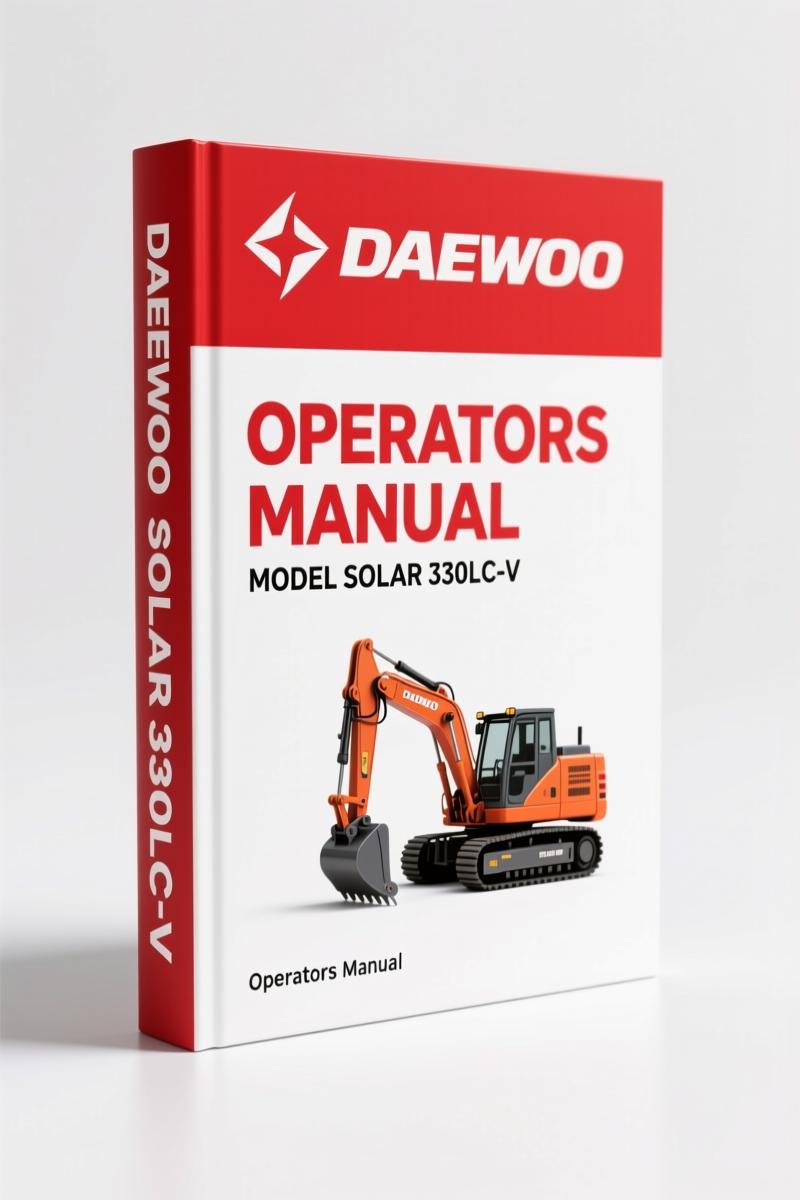
Daewoo Solar 330LC-V 1998 Operators Manual – OEM Specifications
Original price was: $12.59.$8.99Current price is: $8.99.
OEM operators manual for Daewoo Solar 330LC-V (1998). 184 pages: safety labels, controls, maintenance schedules, troubleshooting. Factory spec data.
Description
Daewoo Solar 330LC-V 1998 Operators Manual – 184 Pages of Factory Procedure
Let me be straight with you. If you’re running a Solar 330LC-V, this is the document you need on your tablet or printed out, not some aftermarket PDF that guesses at lubricant grades. I’ve seen guys stack shims wrong on buckets because they used a third-party translation. That costs time and parts. This Daewoo Solar 330LC-V 1998 Operators Manual is the original factory document from Daewoo, printed July 1998, covering serial number 0001 and up. 184 pages, no fluff, no reprints. It’s the same binder that came with the machine when it left the line.
Before I get into the chapters, understand that this manual is built for an operator or a tech who respects the machine. It assumes you have the right tools – torque wrenches, pressure gauges, the works. If you’re a home-garage guy with a socket set and a hammer, you need to read the safety section first. Page 1-3 lists General Safety Essentials that will keep you alive when you’re under a swing gear. The manual does not take shortcuts, and neither should you.
Safety Essentials: Know Where the Labels Are
The first 26 pages of this manual are pure safety – and that’s not padding. Daewoo made these excavators with multiple safety systems, and the manual tells you exactly where every safety label is located on the machine. See page 1-4 for the exact location diagram. If a label is worn or missing, you order the replacement from your dealer, not from eBay. The section also covers lifting in digging mode, work-site precautions, and the rated lift capacity tables. Those tables are your legal protection if you ever lift a pipe on a jobsite. Ignore them and you risk tip-over.
Operating Controls: Where the Levers and Panels Live
Chapter 2 is all about the operator’s cab. It details the component locations – every switch, every panel, even the stereo and ashtray. The manual includes the Mode Selection Switches, the Heater and A/C Control Panel, and the Emergency Glass Breaking Tool location. If you’ve ever had an excavator cab fill with smoke and couldn’t find the glass breaker, you’ll appreciate that detail. The seat adjustment procedure includes specs for seat belt tension – not something you can guess. Daewoo Solar 330LC-V Shop Manual”>The shop manual covers deeper repair, but this operators manual gives you the day-to-day control operation.
Operation: From Startup to Towing
The Operation section explains how to handle a new excavator – break-in procedures, starting and stopping the engine, safety lever operation, travel, operating instructions, towing procedure, and hydraulic breaker usage. There’s a specific procedure for towing a Solar 330LC-V that involves venting the hydraulic system. If you tow it without that step, you’ll blow seals. The manual also covers parking and shutdown in cold weather – important for Texas winter mornings when temps drop below freezing in San Antonio. Daewoo Solar 130LC-V to 250LC-V 2001 Service Manual – OEM Shop Manual”>For other models, check the 130-250LC-V service manual.
Inspection, Maintenance and Adjustment – The Meat of the Manual
This is the longest chapter, covering preliminary machine setup for maintenance, a table of recommended lubricants (with Daewoo-approved grades), and maintenance intervals from every 10 hours up to 4000 hours / biennial service. Each interval has a checklist: 10-hour daily service includes greasing track adjusters, checking engine oil level, inspecting bucket teeth. The 500-hour service includes fluid sampling. The 4000-hour service includes checking accumulator charge pressure – that spec is in the hydraulic system section. There’s also a dedicated section on bolt and nut inspection, including torque sequences for track and bucket hardware. Daewoo Solar 400LC-V 1998 Operators Manual – Factory Specs & Safety”>For the bigger 400LC-V, see that manual.
The bucket shimming procedures are critical. I’ve seen a machine lose a bucket pin because the shims were stacked wrong. This manual shows the order and thickness ranges – no guesswork. Track tension adjustment is also detailed with measurement specifications in inches/millimeters and pressure in psi/bar. Maintenance in special conditions (salt water, dusty, extreme temps) gets its own subsection. And long-term storage procedures – if you put the machine away wet, you’ll rot the hydraulic lines. Follow the manual.
7 Systems Covered in Troubleshooting
The troubleshooting chapter covers the five main systems: Engine, Hydraulic System, Swing System, Electrical System, and Travel System. Each one lists symptoms, probable causes, and corrective actions – all factory-tested. For example, if the swing motor won’t engage, the manual tells you to check the pilot pressure, solenoid valve, and brake release. It doesn’t say “check wiring” – it gives you the pressure spec and the connector pin numbers. If you need to understand the engine basics, Internal Combustion Engine”>an external resource on ICE fundamentals can help, but this manual is specific to the Daewoo S6B engine.
Specifications chapter includes standard specification tables for the Solar 330LC-V: engine power, hydraulic pump flow, operating weight, ground pressure, swing speed, travel speed. Working range diagrams show reach, digging depth, dumping height. The index at the back makes it fast to find anything.
Who This Manual Is For
This is for the owner-operator who runs the machine every day, for the mechanic who services a fleet of excavators at a rental yard, and for the safety manager who needs proof of correct procedures. If you’re a beginner working on your own machine, you need to read the safety section completely before turning the key. The manual assumes you know how to use tools, but it teaches you the machine-specific steps. If you’re a professional, you’ll use this to avoid billing hours on guesswork. Manual Transmission”>Transmission concepts don’t apply here (the Solar uses hydrostatic travel), but the troubleshooting logic works the same way.
Source Validity – Why OEM Matters
I’ve worked with reprints that had torque values off by 10%. That’s enough to crack a cylinder head. This manual is the original factory document from Daewoo – copyrighted 1998, part number 2022-7166E. Every spec comes from their engineering department, not from a third party guessing at conversions. The table of recommended lubricants, the maintenance intervals, the switch functions – all verified by Daewoo. Aftermarket manuals that combine multiple models into one generic book are dangerous. This is specific to the Solar 330LC-V (serial 0001 up). Don’t trust anything else under the hood.
Frequently Asked Questions
- Does this manual cover the engine overhaul procedure?
- No. This is an operators manual – it covers daily operation, controls, and maintenance intervals. For engine disassembly or internal repairs, you need the shop manual for the Solar 330LC-V [LINK_ID_REL_0].
- Can I use this manual for a 1999 model year?
- Yes, as long as the serial number is within the range covered (0001 and up). Daewoo made only minor changes after this publication. Check your machine serial plate against the manual’s serial range – if it’s earlier than 1998, find the matching manual.
- Is there a diagram of the hydraulic system pressure test points?
- Yes. The Inspection, Maintenance and Adjustment section under “Venting and Priming Hydraulic System” shows test port locations for pilot pressure, main pump pressure, and relief valve settings. Pressure values are listed in psi and bar, but you need a gauge rated at 6000 psi minimum.
- How do I know if my excavator has the correct track tension?
- The manual gives a measurement procedure: lift the track, check the sag at the midpoint. Sag should be between 1.5 and 2.0 inches with the machine on level ground. Use the track tension relief valve (described on page [DATA NEEDED] of the maintenance section). Don’t over-tension – it wears sprockets and idlers faster.
This manual belongs on your bench next to the parts catalog. Every time you do a 250-hour service, pull out the checklist. When you run into a no-crank diagnostic, go to the troubleshooting section. You’re paying for 184 pages of factory engineering that eliminates guesswork. Don’t waste your time with photocopies. Access the Factory Manual – the genuine OEM PDF with all safety labels, torque tables, and maintenance schedules intact.
Additional information
| Brand | Daewoo |
|---|---|
| Language | English |
2 reviews for Daewoo Solar 330LC-V 1998 Operators Manual – OEM Specifications
You may also like…
-
Sale!
Daewoo Solar 175LC-V 2003 Workshop Manual – 686 Pages OEM Spec
Original price was: $83.85.$65.00Current price is: $65.00. -
Sale!
Daewoo Solar 220LC-III Workshop Manual – 329 Pages Factory Specs
Original price was: $91.00.$65.00Current price is: $65.00. -
Sale!
Daewoo Solar 250LC-V 2000 Workshop Manual – 567 Pages, OEM Specs
Original price was: $84.50.$65.00Current price is: $65.00. -
Sale!
Daewoo Solar 130LC-V Workshop Manual – 558 Pages | OEM Factory Specs
Original price was: $102.70.$65.00Current price is: $65.00.
Related products
-
Sale!

1989 Service Manual – International 2000-8000 Electrical Systems
Original price was: $72.00.$50.00Current price is: $50.00. -
Sale!

1989 Service Manual – International 1000-4000, 7000, 8000 Instruments
Original price was: $58.80.$40.00Current price is: $40.00. -
Sale!
International 1000-3000 Series Operators Manual – 132 Pages of OEM Specs
Original price was: $14.40.$10.99Current price is: $10.99. -
Sale!

Technical Manual – International DT 530 & HT 530 (118 Pages)
Original price was: $37.00.$25.00Current price is: $25.00.
diy_master –
Great OEM spec sheet. Quick access after payment. A must-have for any Daewoo Solar owner doing maintenance. Saves me hundreds of time.
workshop_guy –
I am very pleased with this manual. It is very easy to read on my tablet without losing quality. Contains clear bolt torque specs for Daewoo. Great value for money.