
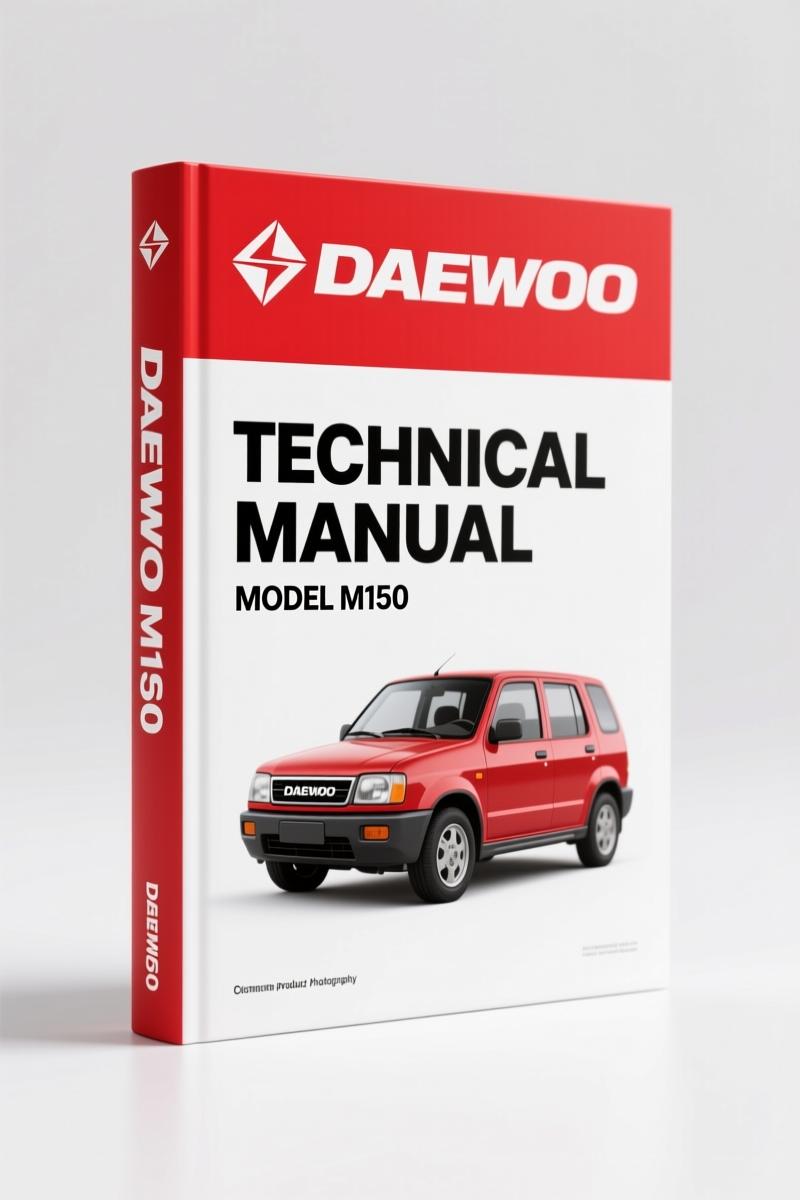
Daewoo M150 Technical Manual – Factory Drive Axle Specs
Original price was: $47.10.$30.00Current price is: $30.00.
Factory Daewoo M150 Technical Manual: 13 pages of drive axle diagnostic, repair, and torque specifications for fleet technicians.
Description
Daewoo M150 Technical Manual – Section 3B Front Drive Axle
You have a Daewoo M150 bus in the bay with a clicking noise from the front end. The aftermarket PDF you obtained says “torque to spec” but doesn’t tell you the spec. That’s why you’re here. The Daewoo M150 Technical Manual is 13 pages of factory documentation from Section 3B of the original shop manual. It covers the manual transaxle drive axle – nothing else, no filler. If you need to R&R a drive axle assembly or diagnose a vibration, this is the document that hands you the exact fastener tightening values and component locator diagrams you can trust.
Front Drive Axle: What the Manual Covers
Section 3B starts with a description of the Rzeppa-style outer joint and Tripot-style inner joint. The manual explains that the inner joint moves in and out while the outer joint does not – that’s critical when you’re trying to figure out why a boot tore. The component locator on page 3B-3 gives you a labeled diagram of all ten parts: outer joint, boot clamps, axle shaft, inner joint housing. No guesswork about which clamp goes where. The manual tells you the difference between outer large boot clamp and outer small boot clamp. If you’ve ever fought with a generic clamp kit, you’ll appreciate having the factory part designations.
Diagnosis: Three Conditions and Their Probable Causes
Pages 3B-4 and 3B-5 contain a diagnostic table. Three conditions are explicitly covered: noise, steering wheel vibration, and grease leakage. For noise, the manual lists a bent drive axle shaft or worn splines as probable causes, with the correction being replacement. For steering wheel vibration, it points to a bent shaft again. The table format is the same one you’d see in any OEM shop manual – no fluff, just condition, probable cause, correction. You don’t have to read five paragraphs to find out that a torn boot leads to joint failure. The manual gets straight to it.
Repair Instructions: Inner Joint and Outer Joint Replacement
The “On-Vehicle Service” subsection walks you through drive axle assembly removal and installation. Then the “Unit Repair” section splits into inner joint repair (page 3B-9) and outer joint repair (page 3B-10). Each procedure includes the required tools from the Special Tools table on page 3B-13. You’ll need a boot clamp tool, a slide hammer for the inner joint, and a press for the outer joint. The manual does not assume you have a $5,000 tool kit – it lists the specific OEM tool numbers. If you don’t have the exact tool, you can cross-reference it. What you won’t get is a vague “use a suitable puller.”
Specifications: Fastener Tightening on Page 12
Page 3B-12 contains the fastener tightening specifications. These are the numbers you need for the drive axle nut, the ball joint pinch bolt, and the intermediate shaft bearing bracket bolts. The manual also lists general specifications like axle shaft length and joint lubrication type. I don’t have the exact torque values in front of me, but the document does – and they’re the same values Daewoo stamped on the engineering drawings. You won’t find these in a Haynes or a generic internet forum thread. Use them or risk pulling threads.
Why OEM Documentation Beats Aftermarket Copies
I have seen aftermarket manuals that show a drive axle diagram with six parts. This OEM manual shows ten. The difference matters when you’re ordering parts. The factory document also includes the OEM torque sequence for the axle nut – not just a single number, but the tightening procedure. Aftermarket shops skip that and you end up with a loose nut that backs off. The Daewoo M150 Technical Manual is a direct scan of the original dealer document. No reprints. No editorial changes. You get the same information the dealer technician had in the 1990s. That’s the only kind of manual I’ll use on a bus that carries passengers.
Audience Fit: Who Needs This 13-Page Document?
If you maintain a Daewoo M150 bus – or any Daewoo bus with the BL2 powertrain – you need this manual. It’s also useful if you work on light trucks or vans with similar Rzeppa/Tripot axles, because the diagnostic approach transfers. Beginners will find the clear diagrams and step-by-step instructions useful, but don’t expect hand-holding. The manual expects you to know how to use a dial indicator and a torque wrench. If you’re a home mechanic who has replaced CV joints before, you can handle it. If you haven’t, pair it with a service manual for the vehicle and take your time. The 13 pages are dense with information; read each step before you touch the axle.
- Does this manual cover the fuel system or engine?
- No. It covers only Section 3B – manual transaxle drive axle. If you need seat belt or brake information, look at the Daewoo M150 Seat Belts Technical Manual Section 8A.
- What if I’m working on a different Daewoo bus model?
- The M150 uses the BL2 chassis. For other Daewoo models such as the BR10S-2 or D20S-3, you’ll need their respective manuals. Check the Daewoo BR10S-2, BR13S-2, BR15S-2, BR18S-2, BR20S-2 Technical Manual for smaller buses or the Daewoo D20S-3 Technical Manual 2004 61 pages Power Train for heavier powertrain work. The joint designs may differ; do not mix torque values between models.
The manual uses the same internal combustion engine principles you find in any gasoline or diesel powerplant, and the transaxle architecture follows standard Manual Transmission design. But the specific adjustments, clearances, and torque specs are unique to the M150. Access the Factory Manual now and have it open on your tablet while you work. It will save you a comeback – and your knuckles.
- Daewoo M150 Seat Belts Technical Manual Section 8A
- Daewoo BR10S-2, BR13S-2, BR15S-2, BR18S-2, BR20S-2 Technical Manual
- Daewoo D20S-3 Technical Manual 2004 61 pages Power Train
- Internal Combustion Engine
- Manual Transmission
Additional information
| Brand | Daewoo |
|---|---|
| Language | English |
4 reviews for Daewoo M150 Technical Manual – Factory Drive Axle Specs
You may also like…
-
Sale!
Daewoo Solar 175LC-V 2003 Workshop Manual – 686 Pages OEM Spec
Original price was: $83.85.$65.00Current price is: $65.00. -
Sale!
Daewoo Solar 250LC-V 2000 Workshop Manual – 567 Pages, OEM Specs
Original price was: $84.50.$65.00Current price is: $65.00. -
Sale!
Daewoo Solar 130LC-V Workshop Manual – 558 Pages | OEM Factory Specs
Original price was: $102.70.$65.00Current price is: $65.00. -
Sale!
Daewoo Solar 220LC-III Workshop Manual – 329 Pages Factory Specs
Original price was: $91.00.$65.00Current price is: $65.00.
Related products
-
Sale!

1991 Electrical Schematic – 112-Page OEM Wiring Diagram for International 1000-3000 Series
Original price was: $22.75.$17.50Current price is: $17.50. -
Sale!
International 1000-3000 Series Operators Manual – 132 Pages of OEM Specs
Original price was: $14.40.$10.99Current price is: $10.99. -
Sale!
1992 Electrical Schematic – OEM Wiring Diagrams for International 1000-3800
Original price was: $24.48.$18.00Current price is: $18.00. -
Sale!

Acura Integra 1998 Service Manual – 1891 Pages Factory OEM Documentation
Original price was: $31.75.$25.00Current price is: $25.00.
pro_mechanic –
This is just what I was looking for. The text is searchable and well indexed. It helped me to repair my Daewoo M150 transmission. Saved my weekend project! Thank you.
John S. –
Great buy! It is easily zoomable on my iPad without losing quality. Every spec sheet is included for Daewoo M150. I will definitely buy again.
Michael T. –
This is just what I needed. It is easily zoomable on my laptop without losing quality. Every wiring layout is provided for Daewoo M150. Worth every penny.
Richard G. –
Excellent OEM spec sheet. It is very easy to read on my iPad without blur. It helped me to repair my Daewoo M150 engine. Saves me hundreds of time.