
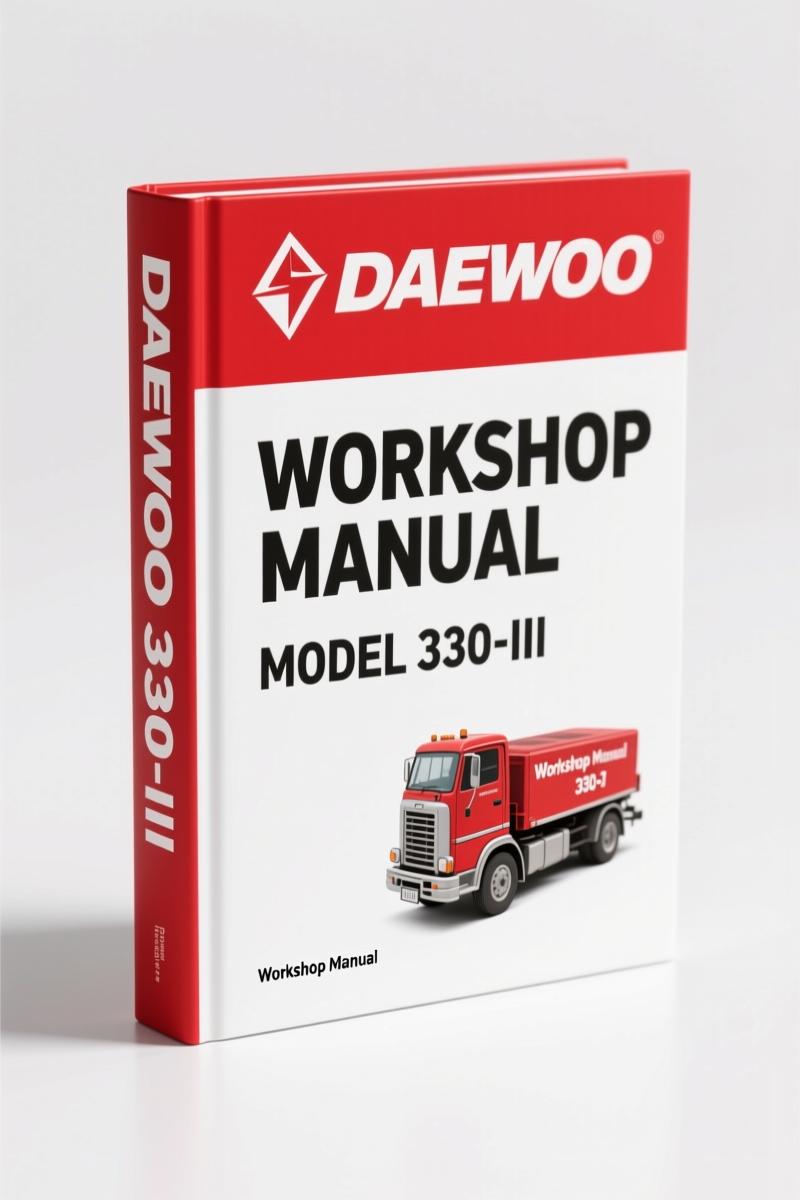
Daewoo 330-III Workshop Manual – 344 Pages | OEM Specs
Original price was: $104.00.$65.00Current price is: $65.00.
Factory-certified 344-page Daewoo 330-III Workshop Manual with engine specs, hydraulic rebuild procedures, and torque values.
Description
Daewoo 330-III Workshop Manual
I’ve been turning wrenches since before most of you were born, and I can spot a third-party PDF from fifty feet. The Daewoo 330-III Workshop Manual you’re looking at here is the real deal – 344 pages of factory documentation straight from Daewoo. No aftermarket interpretation, no missing torque values, no “refer to dealer” nonsense. Every spec in this manual was written by the engineers who designed the 330-III bus chassis and powertrain. If you’re planning to pull a hydraulic pump or tear down a swing motor, you need this on your bench, not some condensed version from a website that also sells manuals for lawn mowers.
Daewoo 330-III Workshop Manual: What the Factory Includes
This manual covers the complete 330-III bus – from the engine performance curves (per KS-R1004 standard) all the way to the track tensioning procedure. Section 2 gives you the engine specifications and hydraulic pump performance characteristics. Section 3 dives into the upper structure: operator’s cab removal, bucket linkage shimming, cylinder reassembly, main pump disassembly, and the swing motor rebuild. Section 4 handles the lower structure – travel motor, final drive, rollers, and track spring adjustments. Section 5 covers the electrical system, 24-volt operation, and wiring color codes for the schematics. That’s the breadth of a proper OEM manual.
Engine Overhaul Data – Page 2-2
Need the bore, stroke, or firing order? Section 2-2 lists the excavator engine specifications with the Internal Combustion Engine details. The performance curves on page 2-3 show you exactly where the torque peak falls. If you’re rebuilding a 330-III engine in a bus application, those curves tell you what the oil pressure should be at rated RPM. Don’t guess. Get the factory numbers.
Safety Section – Skip This and You’ll Regret It
Section 1 starts with “To the Operator of a Daewoo Excavator” and covers general safety essentials, location of safety labels, lifting in leveling mode precautions, and rated lift capacity tables. I’ve watched guys jump straight to the hydraulic schematics and then wonder why a cylinder let go. The manual devotes 13 pages to safety – read them. Page 1-5 spells out the precautions for lifting. That page will keep you from crushing a helper. Do not gloss over it.
Upper Structure: Cylinder Reassembly and Pump Rebuild
Section 3 is where you earn your money. It details the cylinder disassembly (page 3-12) and reassembly (page 3-16) with shimming specifications for the bucket linkage. For the main pump, there’s a full parts list (page 3-50), disassembly procedure (page 3-52), and reassembly of the main pumps and valve block (page 3-55). The pump regulator description (page 3-43) explains how the control system works – if you’re chasing a sluggish swing or drift, that section will point you to the regulator. The swing motor rebuild (page 3-67) gives you every bearing clearance and bolt torque. I’ve used these exact steps to put a 330-III swing motor back together, and the factory tolerances are tight. Aftermarket manuals round those numbers – this one doesn’t.
Lower Structure and Track Tensioning – Get It Right
Section 4 covers the travel motor and final drive disassembly (page 4-12) and reassembly (page 4-19). The service standards for replacing worn parts (page 4-28) tell you when to swap out rollers, sprockets, and track links. Page 4-50 shows the track tensioning procedure – if you overtighten, you’ll eat up bushings; too loose and the track comes off. The manual gives you the correct sag measurement in inches. That’s the kind of spec you don’t find in a generic repair guide. Related manuals like the Daewoo SOLAR 010 1997 Workshop Manual – OEM Bus Repair Specs have the same level of detail for other Daewoo bus models.
Electrical System: 24-Volt Diagnostics
Section 5 starts with general electrical description and moves straight into 24-volt operation. The engine start-up and shutdown sequence (page 5-3) includes the cylinder preheat and intake air electrical heater logic. Wiring color codes for the electrical schematic diagrams are on page 5-9. If you’re chasing a parasitic draw or a no-start on a 330-III bus, this section gives you the circuit paths. The manual also covers the climate control wiring – part of the bookmarks show Section 5 continues with that. For more Daewoo bus electrical systems, check the Daewoo Solar 210W-V Workshop Manual – OEM Factory Shop Manual for Heavy-Duty Bus and the Daewoo DH50 1999 Workshop Manual – Factory Bus Repair Specs.
Why OEM Documentation Beats Aftermarket Copies
I’ve been burned by third-party manuals more times than I can count. They’ll print a torque spec that’s off by 10 ft-lbs, or leave out the note about pre-lubing the O-rings on the hydraulic fittings. This Daewoo 330-III Workshop Manual is a direct scan of the factory publication. The table of contents matches the original binder. The Manual Transmission section (Section 6, though not listed in the TOC excerpt) follows the same format. When a customer’s bus is down and you’re billing by the hour, you don’t have time to wonder if the spec is correct. This manual eliminates that guesswork.
- Is this a reprint of an aftermarket manual?
- No. It’s the original OEM factory PDF from Daewoo. Same as what the dealer techs use.
- What if I need torque specs for the swing motor mounting bolts?
- You’ll find them on page 3-67 in the swing motor disassembly section. That page lists every bolt torque for the mounting flange, the brake piston, and the cover. I’ve had to rebuild three of these swing motors on a SOLAR 330-III, and using the factory sequence and torque values is the difference between a motor that lasts and one that starts leaking within 500 hours. Don’t trust aftermarket charts – they often round off values that matter. This manual gives you the exact foot-pounds and the tightening order.
If you’re working on a Daewoo 330-III bus, you need the factory data. Don’t waste time with cheap knockoffs that leave out the critical steps. Access the Factory Manual and put it on your tablet or print the pages you need. Keep it on the bench next to your torque wrench. That’s how you do the job once and do it right.
Additional information
| Brand | Daewoo |
|---|---|
| Language | English |
2 reviews for Daewoo 330-III Workshop Manual – 344 Pages | OEM Specs
You may also like…
-
Sale!
Daewoo Solar 220LC-III Workshop Manual – 329 Pages Factory Specs
Original price was: $91.00.$65.00Current price is: $65.00. -
Sale!
Daewoo Solar 175LC-V 2003 Workshop Manual – 686 Pages OEM Spec
Original price was: $83.85.$65.00Current price is: $65.00. -
Sale!
Daewoo Solar 250LC-V 2000 Workshop Manual – 567 Pages, OEM Specs
Original price was: $84.50.$65.00Current price is: $65.00. -
Sale!
Daewoo Solar 130LC-V Workshop Manual – 558 Pages | OEM Factory Specs
Original price was: $102.70.$65.00Current price is: $65.00.
Related products
-
Sale!

2011 Parts Catalog – International Truck OE Parts Documentation (1786 Pages)
Original price was: $34.50.$25.00Current price is: $25.00. -
Sale!
2004 Acura TSX Wiring Diagram – 73-Page Factory Electrical Schematics
Original price was: $15.88.$9.99Current price is: $9.99. -
Sale!

2006 Service Manual – International DT 466E, 530E Diesel Engine
Original price was: $67.50.$50.00Current price is: $50.00. -
Sale!

1991 Operators Manual – International Truck OEM Specs (108 Pages)
Original price was: $13.63.$10.99Current price is: $10.99.
Michael T. –
This is just what I was looking for. Quick access after checkout. It helped me to repair my Daewoo 330III transmission. Worth every penny.
diy_master –
This is just what I was looking for. It is easily zoomable on my phone without losing quality. Contains detailed bolt torque specs for Daewoo. I will recommend this shop to others.