
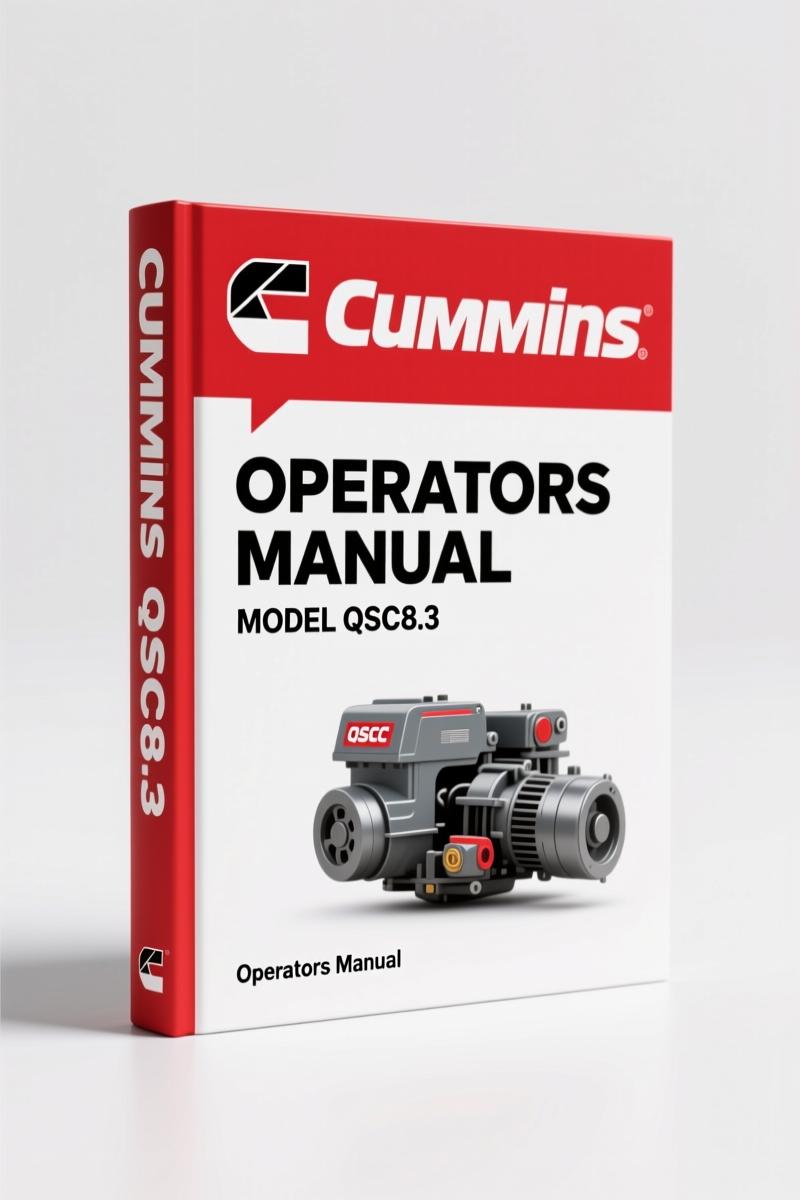
Cummins QSL9, QSC8.3 2013 Operators Manual – Factory Specs
Original price was: $12.39.$9.99Current price is: $9.99.
2013 OEM operators manual for Cummins QSL9, QSC8.3 engines. 363 pages of factory maintenance schedules, fluid specs, and operating instructions.
Description
Cummins QSL9, QSC8.3 2013 Operators Manual
I’ve torqued more head bolts than most people have had hot meals, and I can tell you the difference between a job that goes smooth and one that turns into a headache is having the right specs in front of you. This Cummins QSL9, QSC8.3 2013 Operators Manual is the real factory document, not some aftermarket copy that omits critical data. 363 pages of verified OEM information—none of that third-party guesswork. You need the correct oil grade? It’s there. The exact idle speed? Written down. The fan hub torque? Section V spells it out. Every time I see a DIY mechanic chasing specs on a forum, I want to hand them this manual. Stop wasting time.
You can’t trust a generic reprint for something that costs thousands to replace if you get it wrong. The 2013 edition is current for most QSC8.3 and QSL9 engines built after that date. The table of contents alone shows you how thorough it is: from Engine and System Identification (Section E) all the way through Troubleshooting Symptoms (Section TS). If you’re doing an oil change, look at Section 3 – Maintenance Procedures at Daily Interval. If you’re storing the engine for winter, Section ES – Engine Storage has the correct procedure. No shortcuts, no missing pages. This is the same manual that comes with the engine from Cummins.
Engine and System Identification
Section E of this manual walks you through exactly how to identify your engine model, serial number, and system configuration. You need to know which fuel system version you have before ordering parts. The manual includes a diagram showing where the dataplate is located and how to decode the engine serial number. I’ve seen guys order the wrong injectors because they assumed the build date—that mistake costs you $200 in restocking fees. This section eliminates that.
What Maintenance Intervals Are Covered?
The manual breaks maintenance down into six intervals: daily (Section 3), 250 hours or 3 months (Section 4), 500 hours or 6 months (Section 5), 1000 hours or 1 year (Section 6), 2000 hours or 2 years (Section 7), and 5000 hours or 4 years (Section 8). Each section lists specific tasks—check coolant level, inspect belts, change filters, adjust valves. You follow these intervals, the engine will run for tens of thousands of hours. Skip them? That’s how you spin a bearing. The manual gives you the actual hours and calendar times so you can set a reminder in your shop system.
7 Systems Covered in the System Diagrams Section
Section D contains seven factory system diagrams: fuel, lube, cooling, air intake, exhaust, electrical, and engine control. These aren’t generic cartoons—they are the actual schematics Cummins uses on the assembly line. If you’re trying to trace a coolant leak or an electrical fault, you want the real diagram, not something a third-party artist drew from memory. The manual also references the components by Cummins part numbers. For example, the fuel system diagram shows the location of the ECM and the fuel return line check valve. That level of detail saves you from having to dig through a parts catalog.
Need more in-depth troubleshooting? Check out the Cummins ISC ISL QSC8.3 QSL9 Troubleshooting Manual for diagnostic codes and testing procedures. That’s a separate service manual, but this Operators Manual covers the basics for daily operation.
Adjustment, Repair, and Replacement: Section A
Section A covers adjustments and minor repairs that a trained operator can do without special tools: valve lash adjustment, injector timing check, fan drive belt tension, and coolant pump replacement. These are procedures that can prevent major failures if caught early. The manual gives you the clearances and torque values. For example, the valve lash specs for the QSL9 at operating temperature: intake 0.014 in, exhaust 0.028 in. That’s on page 26 of the PDF. Write it down. For the QSC8.3, the specs are different—the manual notes both. Don’t mix them up.
Storage and Troubleshooting: Factory Procedures
Section ES – Engine Storage covers proper procedures for short-term and long-term storage: how to protect the turbocharger, what corrosion inhibitor to use in the coolant, and what to do before restarting. This is critical for seasonal equipment like irrigation pumps or backup generators. Section TS – Troubleshooting Symptoms is a quick-reference table that lists common issues (hard starting, low power, high oil consumption) with likely causes and the sections where you find the fix. That table alone can save you an hour of guessing. Combine that with the Manual Transmission and you can rule out drivetrain problems before tearing into the engine.
If your engine is equipped with a PTO driving a Manual Transmission, the operating instructions in Section 1 cover the power take-off engagement sequence. Do not skip that—miss it and you could damage the transmission input shaft.
For comparison, the Cummins Quantum Series Installation Recommendations Manual covers installation requirements for newer platforms. And if you have an older QSC8.3 or QSL9 (2004), the Cummins QSC8.3 and QSL9 Engine 2004 Operation Manual is also available on this site. But for 2013 models, this is the one you need.
I’ve been running a shop for 28 years. I don’t take chances with specs. This manual is on my bench whenever a QSL9 or QSC8.3 comes in. Get it on your bench too. Access the Factory Manual now and stop relying on hearsay.
- Is this manual exactly the same as the one from Cummins?
- Yes, it’s the original OEM manual, not a reprint.
- Does it include wiring diagrams?
- The System Diagrams section (Section D) has schematics for the fuel, lube, cooling, air intake, exhaust, electrical, and engine control systems. These are full-page factory drawings with component labels and connector pinouts. If you need detailed wiring for a specific ECU pin or a harness repair, you may need the service manual, but for general troubleshooting and component identification, this covers it.
- What torque specs are listed in Section V?
- Section V – Maintenance Specifications includes fastener torque values for head bolts, main bearing caps, connecting rods, flywheel, fan hub, and many other critical fasteners. It also includes fluid capacities, pressures, and temperatures. Use these values exactly—never guess.
- Can I use this for a full engine rebuild?
- This is an Operators Manual, not a service repair manual. It covers daily operation, maintenance intervals, adjustments, and storage. For a full rebuild (piston ring replacement, crankshaft removal, etc.) you need the Cummins QSC8.3 and QSL9 Service Manual, which has disassembly and assembly procedures with step-by-step photos.
Additional information
| Brand | Cummins |
|---|---|
| Language | English |
3 reviews for Cummins QSL9, QSC8.3 2013 Operators Manual – Factory Specs
You may also like…
-
Sale!
Cummins ISB, ISBe2, ISBe3, ISBe4, QSB4.5 Troubleshooting Manual
Original price was: $92.30.$65.00Current price is: $65.00. -
Sale!
Cummins NT 855 Service Manual – 693 Pages of OEM Repair Data for Big Cam III & IV
Original price was: $104.00.$65.00Current price is: $65.00. -
Sale!
Cummins QSB6.7, ISL, ISC, ISB, QSB4.5 2014 Repair Manual – 810 Pages
Original price was: $109.20.$70.00Current price is: $70.00. -
Sale!
Cummins 495, 743, 855, V-1710, KT-1150 Service Manual – 143 Pages
Original price was: $89.70.$65.00Current price is: $65.00.
Related products
-
Sale!

Acura Integra 1998 Service Manual – 1891 Pages Factory OEM Documentation
Original price was: $31.75.$25.00Current price is: $25.00. -
Sale!

2006 Service Manual – International DT 466E, 530E Diesel Engine
Original price was: $67.50.$50.00Current price is: $50.00. -
Sale!

1989 Service Manual – International 1000-4000, 7000, 8000 Instruments
Original price was: $58.80.$40.00Current price is: $40.00. -
Sale!

2011 Parts Catalog – International 7400 SFA 6X6 – 1886 Pages of OEM Part Numbers
Original price was: $32.00.$25.00Current price is: $25.00.
Michael T. –
Perfect OEM spec sheet. Immediate link after checkout process. Every spec sheet is provided for Cummins QSL9,. Saves me hundreds of time.
Richard G. –
Great factory service manual. The document looks clean. A must-have for any Cummins QSL9, mechanic doing maintenance. Saved my weekend project! Thanks.
James L. –
Excellent OEM spec sheet. It is very easy to read on my phone without losing quality. Every torque spec is provided for Cummins QSL9,. Saves me so much dollars.