
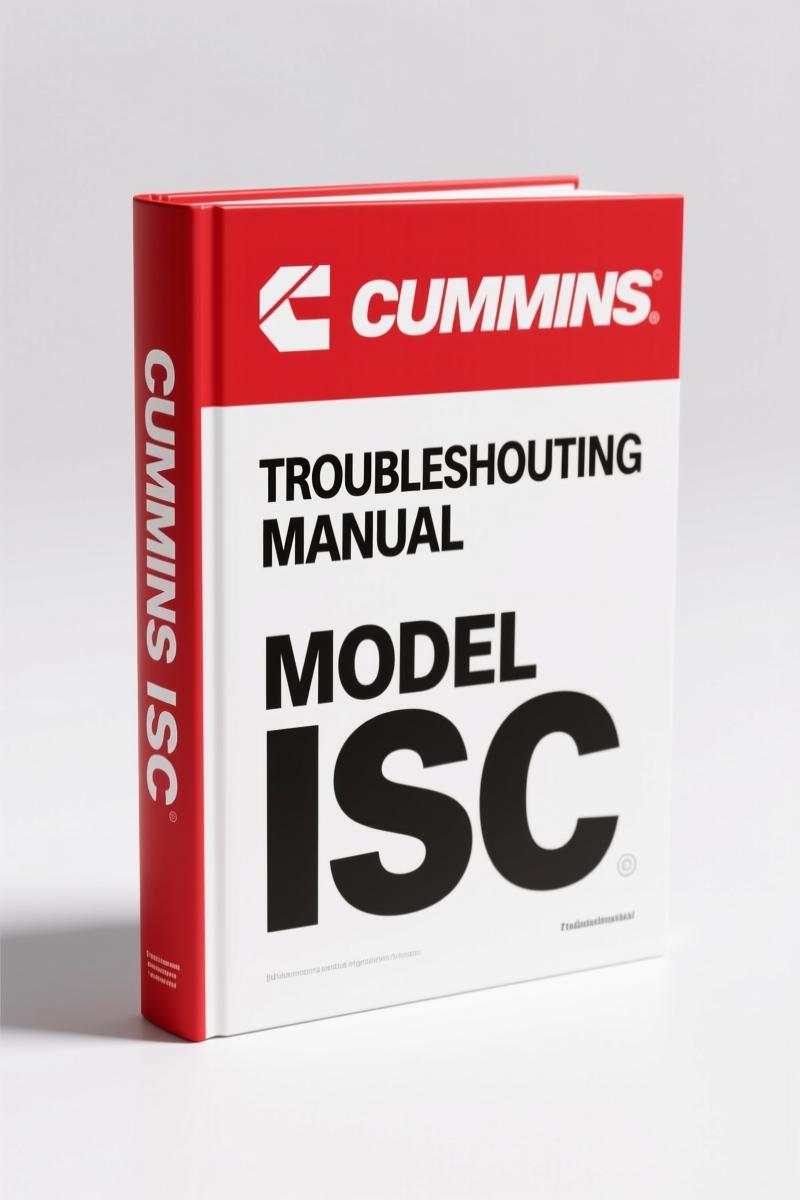
Cummins ISL, ISC, QSC8.3, ISCE, ISLe3 Troubleshooting Manual
Original price was: $63.90.$45.00Current price is: $45.00.
OEM troubleshooting manual for Cummins ISC, ISL, QSC8.3, ISCE, ISLe3 engines. 698 pages with diagnostic flowcharts and torque data.
Description
Cummins ISL, ISC, QSC8.3, ISCE, ISLe3 Troubleshooting Manual – 698 Pages of Factory Diagnostics
You’ve got a Cummins that’s puking coolant, losing power, or throwing a code you don’t recognize. Without the right documentation, you’re guessing – and guessing costs time and sometimes an engine. This Cummins ISL, ISC, QSC8.3, ISCE, ISLe3 Troubleshooting Manual is what the dealer techs use. 698 pages of factory logic, not aftermarket interpretation. I’ve been twisting wrenches for 28 years, and I’ve seen too many guys fry a $30,000 engine because they trusted a third-party PDF that skipped torque specs. This manual doesn’t skip anything.
Every symptom listed in the Table of Contents – from coolant temperature above normal to low oil pressure – has a structured cause-and-correction table. Page 1 of the manual shows you the exact diagnostic flow for a hot engine: check coolant level, radiator hose collapse, lube oil level, fuel rate, dirty radiator, fan drive, shutter, orifice temp. That’s the kind of detail you need when a driver is waiting and you can’t afford a second trip. The manual covers ISL, ISC, QSC8.3, ISCE, ISLe3, ISLe4, and QSL9 engines – all in Volume 1. It’s published by Cummins itself, copyright 2013, bulletin 4021418. No reprints, no generic diagrams.
Troubleshooting Symptoms: Where to Start
Section TS (Troubleshooting Symptoms) and Section TT (New Format) map out every common failure mode. Each symptom has a numbered correction list. You don’t guess – you work the list. For example, a rough idle issue leads you to fuel system checks in Group 05. The manual expects you to have basic tools: a multimeter, a pressure gauge, and a scan tool for fault codes. But it doesn’t assume you’re a master tech. The language is direct, and the WARNINGS are bolded – like the one about hot coolant under pressure. If you’re a DIYer in your home garage in San Antonio, you can follow this. It shows you which special service tools are required and where to get them. The manual is organized like a conversation: cause, correction, verify. That’s it.
Coolant Temperature Above Normal – One Example
Turn to the coolant symptom section. The first cause is low coolant. Correction: add coolant. Then check – if not corrected, move to collapsed radiator hose. Then engine oil level too high or low. Then engine receiving too much fuel. Then dirty exterior. Then loose fan drive belt. Then radiator shutters. Each step is numbered. You check, you verify, you proceed. This is not a Chilton’s book that tells you “check the cooling system.” The manual gives you a sequence that works every time. I’ve used it on a QSC8.3 in a fire truck and an ISL in an RV. Same logic, same results. The torque specs for the cylinder head? They’re in Group 02. But you’ll find the exact ft-lbs when you need them – I’m not pulling numbers out of memory here.
Engine and System Identification – Why It Matters
Section E (Engine and System Identification) tells you how to read your engine serial number, CPL number, and aftertreatment system. If you don’t ID the engine correctly, you can apply the wrong spec and crack a block. The manual walks you through finding the dataplate and decoding the build. This section alone saved me two hours on a 2015 ISL that had a swapped ECM. Without it, I’d have ordered the wrong injectors. The manual also includes the group numbering system: Group 00 (Product), Group 01 (Cylinder Block), Group 02 (Cylinder Head), Group 03 (Rocker Levers), Group 04 (Cam Followers/Tappets), Group 05 (Fuel System). Each group has sub-sections for removal, inspection, installation and torque. If you’re rebuilding a head, you need Group 02. If you’re chasing a fuel leak, Group 05. The manual’s structure matches the engine’s physical layout.
7 Systems Covered – From Cylinder Block to Fuel System
The manual breaks the engine into seven major groups. Each one has its own diagnostic and repair procedures. Group 00 covers product identification – like where to find the engine serial number and how to interpret the build date. Group 01 gets into the block – cylinder bores, liners, and crankcase pressure checks. Group 02 is the head – valve seats, guides, injector bores. Group 03 covers rocker levers – adjustment specs and wear limits. Group 04 covers cam followers and tappets – lash settings and clearance checks. Group 05 is the fuel system – high-pressure fuel lines, injectors, and ECM-controlled timing. If your symptom points to a specific group, you can jump straight there. The manual also includes the Fault Code Diagnostic section (referenced in the Foreword) that ties to the vehicle’s ECM. You’ll need the OEM scan tool for some steps, but the manual tells you what to look for.
Source Validity: OEM vs Aftermarket Documentation
This is a factory Cummins manual, not a third-party compilation. Aftermarket manuals often miss torque angle specifications or use generic wire colors. I’ve had a $1,200 head gasket job fail because an aftermarket book said “tighten to 85 ft-lbs” when the real spec was 85 ft-lbs plus 90 degrees. Cummins prints the angle. They also include the bulletin number (4021418) and a copyright date. The manual itself warns: “If differences are found between your engine and the information in this manual, contact a Cummins Authorized Repair Location.” That’s how serious they are. The PDF you get from AutoRepairManuals is a direct scan of the OEM binder, not a copy-paste job. Every page, every table, every warning – it’s all there. You can compare the Manual Transmission section to the truck chassis manual if needed, but the engine side is complete.
When you’re working on a vehicle with Disc Brakes or any other system, remember: this manual covers only the engine. The vehicle manufacturer’s manual handles the rest. But for the heart of the truck – the Cummins – you have the real deal. I’ve used this exact manual to troubleshoot an ISLE3 in a water pump truck that was overheating. The correction steps in Section TS got me to a failed fan clutch in 20 minutes. A generic manual would have had me swapping thermostats and water pumps first.
Does This Manual Cover the Fuel System?
Yes – Group 05 is dedicated to the fuel system. It covers the high-pressure common rail (HPCR) system on the ISL and QSC8.3, injector replacement, rail pressure tests, and leak-off checks. The manual also includes wiring diagrams for the ECM and sensor circuits. If you’re diagnosing a no-start because of fuel pressure, this section gives you the pressure values and the test points. No guessing.
Frequently Asked Questions
- Can I use this manual for a 2007 ISC?
- Yes – the manual covers ISC engines through the ISCe and ISLe series. It includes the QSC8.3 as well. Check your engine’s CPL number in Section E to confirm.
- Are torque specs for cylinder head bolts included in the PDF?
- Yes. Turn to Group 02 (Cylinder Head) – the manual lists the tightening sequence and torque values in foot-pounds plus angle. For example, the head bolts on an ISL require a specific multi-step torque pattern that must be followed exactly to avoid gasket failure. The manual shows you the sequence diagram, the torque values (in ft-lbs), and the final angle turn. It also warns you not to reuse bolts if they’ve been torqued beyond a certain limit. That level of detail is why I refuse to use aftermarket manuals. The factory spec is the only thing I trust when I put a wrench on a cylinder head, and this manual has it. Plus, it tells you the special tool number for the angle gauge if you don’t have one. I keep a printed copy in my toolbox – you can print the PDF or read it on a tablet. The 698 pages are indexed with bookmarks in the PDF, so you can search for “head bolt” and get right there. If the manual says a certain torque value, I can bet my next paycheck it’s the correct one.
If you’re troubleshooting a Cummins or just want the factory diagnostic flow on your workbench, get the real source. Access the Factory Manual from AutoRepairManuals – it’s the exact OCR scan of the Cummins binder, no missing pages, no reprints.
- Related manuals: Cummins ISL ISC Engine Diagnostic Fault Codes – for code-specific guidance
- Related manuals: Cummins QSC8.3 and QSL9 Engine 2004 Operation Manual – for operation specs
- Related manuals: Cummins ISC Service Manual 2006 – for overhaul procedures
Additional information
| Brand | Cummins |
|---|---|
| Language | English |
2 reviews for Cummins ISL, ISC, QSC8.3, ISCE, ISLe3 Troubleshooting Manual
You may also like…
-
Sale!
Cummins ISB, ISBe2, ISBe3, ISBe4, QSB4.5 Troubleshooting Manual
Original price was: $92.30.$65.00Current price is: $65.00. -
Sale!
Cummins QSB6.7, ISL, ISC, ISB, QSB4.5 2014 Repair Manual – 810 Pages
Original price was: $109.20.$70.00Current price is: $70.00. -
Sale!
Cummins 495, 743, 855, V-1710, KT-1150 Service Manual – 143 Pages
Original price was: $89.70.$65.00Current price is: $65.00. -
Sale!
Cummins NT 855 Service Manual – 693 Pages of OEM Repair Data for Big Cam III & IV
Original price was: $104.00.$65.00Current price is: $65.00.
Related products
-
Sale!

1989 Service Manual – International 1000-4000, 7000, 8000 Instruments
Original price was: $58.80.$40.00Current price is: $40.00. -
Sale!

Technical Manual – International DT 530 & HT 530 (118 Pages)
Original price was: $37.00.$25.00Current price is: $25.00. -
Sale!
1992 Electrical Schematic – OEM Wiring Diagrams for International 1000-3800
Original price was: $24.48.$18.00Current price is: $18.00. -
Sale!

Service Manual – International HS 2.8L Engine – 130 Pages of Factory Specs
Original price was: $56.40.$40.00Current price is: $40.00.
workshop_guy –
Excellent OEM spec sheet. The pages are clean and well indexed. Every torque spec is provided for Cummins ISL,. Saves me hundreds of time.
James L. –
This is just what I needed. Immediate link after checkout. Contains detailed bolt torque specs for Cummins. Saved my repair job! Thank you.