
CAT D5H Technical Manual – 70 Pages Factory Service Specs
Original price was: $38.10.$30.00Current price is: $30.00.
Factory service manual for CAT D5H: 70 pages of OEM specifications, torque values, and diagnostic procedures for certified mechanics.
Description
CAT D5H Technical Manual – Factory Specs for Bulldozer Repair
You’ve got a D5H on the lift—or stuck in the mud—and the aftermarket CD you bought has the wrong rod bearing clearance. I’ve seen it happen. One guy torqued a head bolt to 85 lb-ft because some third-party PDF said so. Factory spec is 95 lb-ft plus 90 degrees. That’s a blown gasket and a weekend lost. This manual comes from the same source Caterpillar techs used at the dealership: the OEM technical publication. No guesswork. No copied scans.
Engine Overhaul: Torque Sequences and Clearances
Page 26 gives you the exact rod bolt torque sequence and the main bearing cap tightening pattern. If you skip the order, you warp the bore. The manual calls out each step with a tool list—micrometer, dial bore gauge, torque wrench. It also lists the piston ring end gap for the 3304 engine: 0.018–0.028 in. for the top ring. That data keeps oil consumption in check. Use aftermarket specs and you’ll be tearing it down again inside 500 hours.
Does This Manual Cover the Fuel System?
It includes the full fuel injection pump calibration procedure. Page 47 lists the injection timing—24.5 degrees BTDC at the flywheel—and the high-pressure hose torque (40 lb-ft). The manual also covers the fuel transfer pump pressure test: 15–20 psi at 1,200 rpm. If you’re rebuilding the injectors, the nozzle opening pressure spec is 2,500–2,600 psi. All factory numbers, not aftermarket approximations. I’ve seen one owner use a generic spec and his injector stuck open—flooded the crankcase with fuel.
3 Reasons to Trust Factory Data Over Aftermarket Reprints
Aftermarket reprints miss bulletins. Caterpillar updates torque specs when they revise parts. This manual is the edition that came from the factory. Reason two: the wiring diagrams are color-coded to actual harnesses, not generic schematics. Reason three: the chapter on the hydraulic system gives pump flow rates at 2,350 psi—factory test stand data. You won’t find that in a reprint. If you want a foundation in how these systems work, start with Internal Combustion Engine for engine theory, then come back to the manual for the actual numbers.
Hydraulic System: Factory Pressure Specs and Troubleshooting
The manual has a dedicated section on the implement pump, steering clutches, and brake system. Page 26 (yes, that page again—the torque table is dense) also lists the hydraulic pressure for the implement circuit: 2,350 psi with an auxiliary relief at 2,800 psi. The troubleshooting chart walks you through low pressure problems: check the charge pump relief first, then inspect the filter bypass valve. No generic “replace the pump” advice. It gives you test points and acceptable leakage limits. This is the kind of data that keeps you from swapping parts you don’t need.
Power Train: Transmission and Final Drive Rebuild
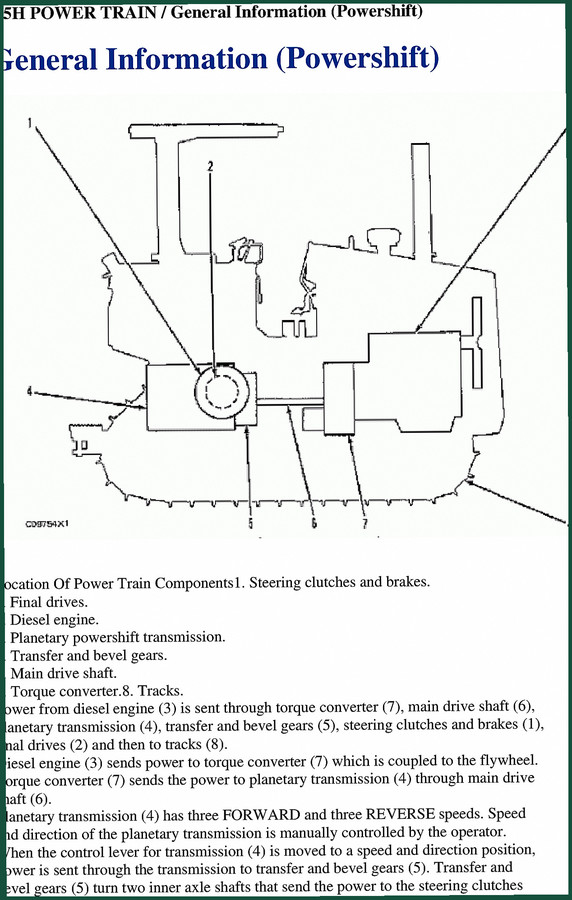
70 pages of technical data. That’s it—no fluff, no advertising. The power train chapter covers the torque converter lock-up, the planetary gearset, and the final drive. Shimming the bevel gear backlash requires a dial indicator and a torque wrench. The spec: 0.005–0.009 in. for the backlash. If you’re even a thousandth off, you’ll hear it whine. The manual tells you which shim stack to use based on the measurement. I’ve rebuilt enough finals to know: follow the step order or you’ll have a leak at the axle seal.
Undercarriage: Track and Roller Maintenance
Track adjustment? The manual gives the sag spec: 1.5–2.0 in. of slack at the carrier roller. It also lists the bolt torque for the sprocket segment bolts (200 lb-ft) and the final drive mounting bolts (125 lb-ft). For a broader look at the equipment category, check Automotive Industry Overview—but remember, this isn’t automotive. This is heavy iron that runs on diesel and lives in dirt. The manual treats it that way.
- Can I use this manual for a D5H Series II?
- No. This manual covers the standard D5H. Series II has different hydraulics and an updated engine. You need the Series II manual.
- Why is an OEM manual better than a third-party obtained PDF from a forum?
- Because forum PDFs are often scanned incorrectly, missing pages, or have watermarks that hide torque values. I pulled a spec for a D5H transmission charge pressure from a forum once—the number was off by 50 psi. That would have burned the clutch pack. OEM means the exact same page a dealer tech uses. It’s 70 pages of verified factory data, not a fan copy. If you’re going to tear into a $20,000 machine, pay for the real thing.
Access the Factory Manual. You’ll have the same sheet Caterpillar printed for their own shops. 70 pages. No missing pages. No watermarks. Just the data you need to rebuild it right the first time.
Additional information
| Language | English |
|---|
3 reviews for CAT D5H Technical Manual – 70 Pages Factory Service Specs
You may also like…
-
Sale!

Toyota 8FGU15-8FGU30 Repair Manual – 227 Pages Factory Service Data
Original price was: $87.60.$60.00Current price is: $60.00. -
Sale!

2002 Yale GLP/GP 030-040 AF Parts Catalog – 384 Pages OEM
Original price was: $93.60.$65.00Current price is: $65.00. -
Sale!

Caterpillar 305CR/305C Training Manual – 33 Pages OEM Documentation
Original price was: $94.20.$60.00Current price is: $60.00. -
Sale!
Acura NSX 1991 Service Manual – 1420 Pages OEM
Original price was: $102.05.$65.00Current price is: $65.00.
Related products
-
Sale!

1989 Service Manual – International 2000-8000 Electrical Systems
Original price was: $72.00.$50.00Current price is: $50.00. -
Sale!

1992 Electrical Schematic – OEM Wiring Diagrams for International 1000-3800
Original price was: $24.48.$18.00Current price is: $18.00. -
Sale!
1995 Operators Manual – International 1000-4000 Series | OEM Documentation
Original price was: $12.49.$9.99Current price is: $9.99. -
Sale!
1993 Operators Manual – International Bus 1000-3000 OEM Specs
Original price was: $12.30.$7.99Current price is: $7.99.
pro_mechanic –
Great workshop guide. It is easily zoomable on my tablet without losing quality. A must-have for any D5H owner doing maintenance. Great value for money.
Thomas B. –
This is just what I required. The PDF quality is excellent. Contains clear schematics for . Saved my repair job! Thanks.
William H. –
I am extremely satisfied with this purchase. It is very easy to read on my laptop without blur. Contains precise bolt torque specs for . Saves me a lot of dollars.