
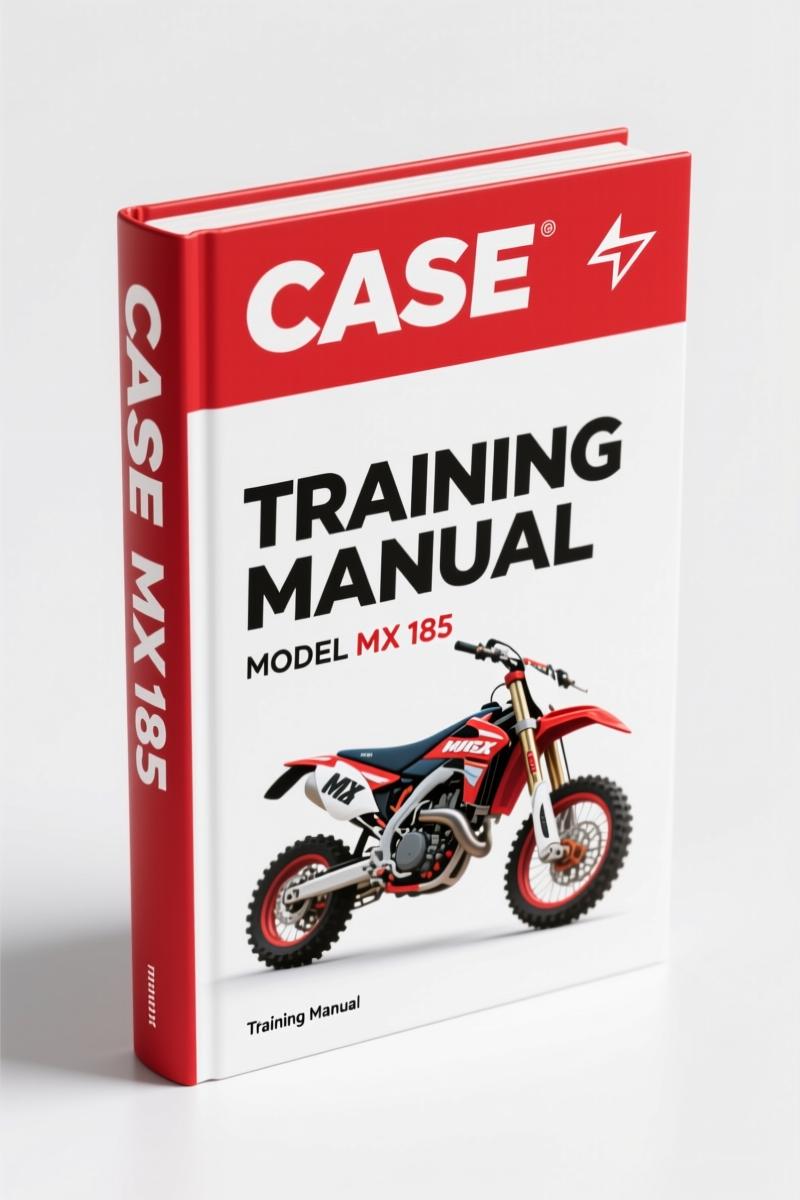
Case Mx 185, Mx 285 1998 Training Manual – Factory Diagnostics
Original price was: $54.60.$35.00Current price is: $35.00.
Factory training manual for Case Mx 185, Mx 285 (1998). 938 pages of controller calibration, fault codes, and hydraulic system diagnostics.
Description
Case Mx 185, Mx 285 1998 Training Manual – Factory Troubleshooting and Calibration
I’ve been wrenching on farm equipment for 28 years and I can tell you this: if you’re working on a Case Mx 185 or Mx 285 and you don’t have the factory training manual from 1998, you’re working blind. Case put 938 pages into this document so their techs could diagnose and calibrate every controller on these tractors without guessing. That 938-page document includes fault code retrieval, controller configuration, and system operation for the transmission, hydraulics, hitch, PTO, brakes, and more. If you’ve ever chased a ghost code or wasted an afternoon because an aftermarket manual skipped the calibration procedure, you know why this matters.
Let’s get one thing straight: this is a training manual, not a parts catalog or a quick-reference card. It walks you through Case Mx 185, Mx 285 1998 Training Manual content that tells you how the system is supposed to work before you start throwing parts at it. That’s the difference between a guess and a repair.
Transmission Controller Calibration & Fault Codes
Section 10003 covers the transmission controller calibration and fault codes. If you’ve got a transmission that’s shifting hard or not at all, you need to pull the fault codes from the controller before you drop the pan. The manual tells you exactly how to enter diagnostic mode and interpret the blink codes or display messages. I’ve seen guys replace solenoids, only to find the controller wasn’t configured for the right tire radius. Page 1 of the TOC lays out where to find each section. Don’t skip the calibration steps—this manual warns you that the controller must be recalibrated if it’s moved to another tractor.
Does This Manual Cover the Hydraulic System?
Yes, Section 8000 is the hydraulic system “How it works” with troubleshooting. Case hydraulic systems are sensitive to contamination and air. The manual details the flow paths and pressure checks, but keep in mind this is a training manual—it explains theory and diagnostic strategies, not step-by-step disassembly. You’ll learn how the load-sensing pump works and how to isolate a faulty valve. Pair it with a service manual for the actual teardown. For a different Case model with similar hydraulics, the Case 721D 2003 Training Manual – OEM Factory Specs gives the same level of factory detail.
3 Sections Every Owner Should Read First
Before you touch anything, read Section 1001 – Safety, general information/maintenance schedule. It’s only a few pages but it covers lockout/tagout procedures and fluid specifications. Then hit Section 10001 on instrumentation programming—page 2 shows the operation setup steps. Last, Section 6000 on the powershift transmission system explains how the clutch packs engage and what happens when the pressure drops.
Get the Right Calibration Data from the Factory
Third-party manuals are notorious for copying the wrong tire radius codes or skipping the armrest controller calibration. This training manual came from Case in 1998, before a lot of those reprints existed. Section 10004 covers armrest controller calibration, and Section 10005 lists remote hydraulics controller fault codes. If your armrest functions are intermittent, you need those codes. The manual also includes the OTO controller configuration (Section 10006) and performance monitor controller fault codes (Section 10008). That level of specific controller detail is what separates this from a chilton.
Brake System: Factory Troubleshooting Steps
The brake system section is listed as “How it works & troubleshooting.” For a tractor this size, brake failure is a safety hazard. The manual covers the hydraulic circuit and adjustment procedures. You’ll find the differential lock control system in Section 6014 and the MFD control system (mechanical front drive) in Section 6013. All these systems talk to each other over the Case Data Bus, and the manual explains the communication.
One thing that drives me nuts: people working on these tractors and never consulting the fault code retrieval procedure. Section 10001 includes a full table of fault codes for the standard instrumentation controller, starting on page 2. Without those codes, you’re shooting in the dark. The manual makes it clear: “If any fault codes are recorded, they must be corrected before configuration is possible.” That’s from the manual itself—I’m quoting it because it’s that important.
For a deeper dive into how the transmission interacts with the engine, the Manual Transmission article explains the basic principles, but this manual gives you Case-specific diagnostics. And if you’re working on a different series, the Case 521D 2001 Training Manual – Electrical System Diagnosis | Factory OEM covers electrical troubleshooting for that platform.
Another related resource: Case 621D 521D 2003 Training Manual – Factory Specs provides specs for those models. But for the Mx 185 and Mx 285, this 1998 training manual is the only factory document that combines all the controller calibration and fault code data into one 938-page volume.
If you’re still using a photocopied aftermarket manual that doesn’t include the tire radius codes, you’re losing time. The manual lists tire radius codes in Section 10001 as well—page 2 shows the table of contents includes “TIRE RADIUS CODES” on page 49. That matters for speedometer accuracy and transmission shift points. I’ve seen a tractor set to the wrong radius code shift at 1,500 rpm instead of 2,000. That’s hard on the drivetrain.
For general background on how manual transmissions operate, the external Manual Transmission resource is decent, but it won’t tell you the specific pressure ranges for the Mx 285 powershift. Only the factory manual does.
FAQ
- Does this manual include wiring diagrams?
- No, it’s a training manual, not a service manual. It focuses on system operation and calibration, not wire-by-wire schematics.
- What is the difference between this training manual and a service manual?
- A service manual gives you step-by-step disassembly, assembly, and torque specs for every bolt. A training manual like this one explains how the systems work, how to calibrate them, and how to interpret fault codes. If you’re a professional mechanic, you need both. The training manual helps you understand why you’re doing what you’re doing, which cuts diagnostic time in half. For example, the transmission controller calibration section shows you the logic behind the shift schedule, so you know when a pressure test is necessary versus a simple recalibration. You won’t get that from a service manual alone. That’s why I keep both on the shelf.
Look, I’ve torqued more head bolts than most people have had hot meals, and I can tell you that factory documentation is the only thing worth your time. Access the Factory Manual for your Case Mx 185 or Mx 285 and stop guessing. Every calibration step, every fault code, every system description came from Case engineers. That’s the difference between a repair that sticks and a comeback.
Additional information
| Brand | Case |
|---|---|
| Language | English |
3 reviews for Case Mx 185, Mx 285 1998 Training Manual – Factory Diagnostics
You may also like…
-
Sale!
Case 26, 26B, 26S 1975 Parts Catalog – Factory Exploded-View Parts Identification
Original price was: $114.00.$75.00Current price is: $75.00. -
Sale!
Case 2500 Service Manual – OEM Factory Specs for Cruz-Crane
Original price was: $97.30.$70.00Current price is: $70.00. -
Sale!
Case 34, 680 CK 1967 Parts Catalog – OEM Factory Parts
Original price was: $107.25.$75.00Current price is: $75.00. -
Sale!
Case 50 Crawler Series D Service Manual – Factory Specs & Electrical
Original price was: $98.00.$70.00Current price is: $70.00.
Related products
-
Sale!

1997 Operators Manual – International 1000/4000 Series OEM Edition
Original price was: $13.49.$9.99Current price is: $9.99. -
Sale!
1991 Electrical Schematic – 112-Page OEM Wiring Diagram for International 1000-3000 Series
Original price was: $22.75.$17.50Current price is: $17.50. -
Sale!
1992 Electrical Schematic – International 1000/3000/4000/2554 OEM Wiring Diagrams (132 Pages)
Original price was: $26.40.$20.00Current price is: $20.00. -
Sale!
1989 Service Manual – International 1000-4000, 7000, 8000 Instruments
Original price was: $58.80.$40.00Current price is: $40.00.
Charles W. –
I am very pleased with this purchase. It is very easy to read on my iPad without blur. It assisted me to repair my Case Mx engine. Saves me so much time.
gearhead88 –
This is just what I was looking for. It is very easy to read on my iPad without losing quality. It assisted me to rebuild my Case Mx transmission. I will recommend this shop to others.
Richard G. –
Perfect OEM spec sheet. The file quality is excellent. Every torque spec is included for Case Mx. Saves me a lot of money.