
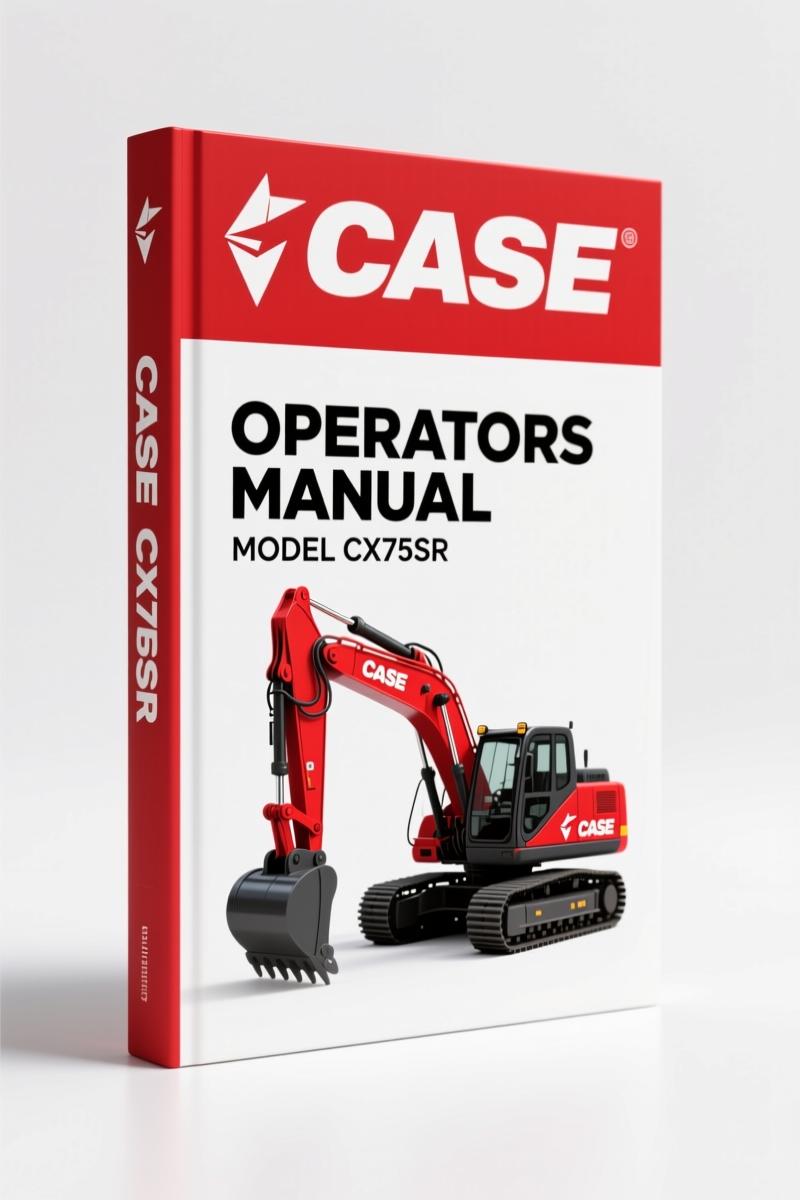
Case CX75SR, CX80 2004 Repair Manual – Factory Specifications
Original price was: $39.60.$30.00Current price is: $30.00.
Factory OEM repair manual for Case CX75SR and CX80 (2004). 862 pages of torque specs, wiring diagrams.
Description
Case CX75SR, CX80 2004 Repair Manual – What a Pro Sees
You’ve got a CX75SR or a CX80 sitting in the yard, and the book that came with it is long gone. Or maybe you’re buying used and the seller handed you a photocopied mess. I’ve seen backyard manuals that spec’d the wrong hydraulic fluid – cost that owner a pump. This Case CX75SR, CX80 2004 Repair Manual is the factory print from CNH France S.A., December 2004. 862 pages. Not a reprint of a reprint. Not a generic “fits all” guide. This is what the guys at Case designed the machine around.
Before you reach for a wrench, understand what’s inside. The manual is split by system – lettered A through H. You get the full Table of Contents on page 4. That tells you exactly where to find Distribution Systems, Power Production, Travelling, Body and Structure, Frame Positioning, Working Arm, and Tools/Couplers. The engine service information for the CC-4JG1 is handled in a separate engine manual, but this book references it. Page 5 starts the Introduction section; read it. It explains the configurations covered: CX75SR NA, CX75SR WE, monobloc boom, offset boom, CX80 NA, CX80 WE. Know which one you have before ordering parts.
Distribution Systems: Where the Hydraulic Lines Live
Section B – Distribution Systems – is where most of the high-pressure work happens. You’ll find the main control valve, swing motor, travel motor, and all the relief valve settings. If you’re chasing a drift in the arm or slow track response, start here. The manual lists required tools – you’ll need a 0–6000 psi gauge and a flow meter. Safety warnings in this section are written with the assumption you’ve already locked the machine, blocked the tracks, and pinned the boom. Don’t skip them.
Power Production: Engine Overhaul and Injection Specs
Section C covers Power Production – the diesel engine installation, fan drive, exhaust, fuel system, and cooling. The CC-4JG1 is a four-cylinder indirect injection. The manual doesn’t give internal engine rebuild steps (that’s the separate engine manual), but it does include the mounting, alignment, and removal sequence. Torque specs for the engine mounting bolts are in the frame charts. Use a calibrated torque wrench – I’ve seen bellhousings crack from bolts run down with an impact. That’s money out of your pocket.
Does This Manual Cover the Fuel System?
Yes – Section C includes the fuel tanks, pre‑filter, fuel lines, and injection pump settings. The injection pump timing procedure is laid out with specific orientation marks. Don’t guess. If you get the pump out of phase, the engine won’t start or will run white smoke. The manual shows the degree wheel and the lock pin dimensions. Follow it exactly.
3 Reasons the OEM Print Wins Over Aftermarket
Aftermarket manuals? I don’t use them. Here’s why: (1) Torque values in aftermarket books are often converted incorrectly from metric. I’ve seen a 65 ft‑lb called out when the factory spec was 55 N·m – that’s a stripped bolt waiting to happen. (2) Wiring diagrams in this OEM manual are large‑format schematics for both CX75SR and CX80 (part no. 9‑43610). Aftermarket reprints lose detail. (3) The safety warnings are specific to this machine – like the boom drop hazard during pin removal. Third‑party books leave those out. This manual has them because Case wrote it.
Frame Positioning: Why Specs Matter
Section F – Frame Positioning – is short but critical. It covers the blade, stabilizers, and undercarriage. The track tension specification is given in psi (accumulator charge) and track sag measurement. No guessing. Get the track tension wrong and you’ll wear out sprockets and rollers in a season. The manual also includes the blade tilt cylinder removal – pin sizes and retaining ring specs are right there. I keep page 4 bookmarked because the TOC saves me flipping through 800 pages blind.
Working Arm: Boom, Stick, Bucket – Full Procedure
Section G – Working Arm – is where you’ll spend time if the machine is bending or leaking at the pins. The manual covers the monobloc boom and offset boom separately. Pin joint inspection limits are given. Bushing inner diameter wear limits are printed – not a suggestion. When you replace bucket pins, the manual says to pack the cavity with grease before installation. That’s not a “nice to know” – it prevents galling. The offset boom cylinder removal requires blocking the boom in a specific position; the manual shows a wood block dimension. Use it.
Tools and Couplers: What This Manual Includes
Section H – Tools and Couplers – lists the special service tools Case recommends. Some you can fabricate, like the pin press adapters. Others, like the hose clamp torquing fixture for the swing motor, you’ll need to buy. The part numbers are in the manual. Don’t rig it. A friend of mine used a strap wrench on a swing motor hose and crushed the fitting. That repair cost more than the tool.
General Advice from the Shop Floor
If you’re a home garage guy working on a CX75SR or CX80, treat this manual like your insurance policy. Read the safety warnings at the start of each section. Never use aftermarket torque charts. I’ve been wrenching for 28 years and I still open the book on every job that involves hydraulics over 2000 psi. The manual’s table of contents (page 4) gives you immediate access to the section you need. For general background on Manual Transmission systems used in some equipment, you can check Wikipedia, but for your Case – trust the OEM data. There’s also a separate Manual Transmission article if you need basic theory. For your specific machine, you’ll want the related CASE CX75SR CX80 2004 Service Manual for quick reference alongside this repair manual. The CASE CX75SR Hydraulic Excavator Operator’s Manual covers daily operation and minor maintenance. If you have a later model, check the CASE CX80 TIER 3 Operator’s Manual for emission system changes.
- Does this manual cover the engine rebuild?
- No – the engine service manual for the CC-4JG1 is separate, but this book references it and includes mounting, alignment, and fuel system steps.
- Can I use this 2004 manual for a Tier 3 CX80?
- The 2004 edition covers CX80 NA and WE models. The Tier 3 version introduced electronic engine controls and changed injection timing. You need the later operator’s manual for Tier 3 specifics – CASE CX80 TIER 3 Operator’s Manual covers that. Always verify your machine’s serial number against the manual’s VIN range printed in the introduction. Some Tier 3 machines retained the same pump and valve body, so the hydraulic sections in this 2004 manual will still apply. But injector calibration and ECM wiring are different. If you’re working on the engine electronics, get the correct supplement. Otherwise you risk smoke or no-start issues.
Access the Factory Manual – and keep a clean copy on your tablet or print it to a binder. This isn’t a book you read once and shelve. It stays greasy, dog-eared, and open on the toolbox. When you need to know the swing motor torque sequence or the pilot pressure spec, you’ll already have it. That’s the difference between a repair that lasts and one that comes back in sixty hours.
Additional information
| Brand | Case |
|---|---|
| Language | English |
2 reviews for Case CX75SR, CX80 2004 Repair Manual – Factory Specifications
You may also like…
-
Sale!
Case 26, 26B, 26S 1975 Parts Catalog – Factory Exploded-View Parts Identification
Original price was: $114.00.$75.00Current price is: $75.00. -
Sale!
Case 2500 Service Manual – OEM Factory Specs for Cruz-Crane
Original price was: $97.30.$70.00Current price is: $70.00. -
Sale!
Case 50 Crawler Series D Service Manual – Factory Specs & Electrical
Original price was: $98.00.$70.00Current price is: $70.00. -
Sale!
Case 34, 680 CK 1967 Parts Catalog – OEM Factory Parts
Original price was: $107.25.$75.00Current price is: $75.00.
Related products
-
Sale!

1994 Troubleshooting Manual – International 1000-4000 FBC
Original price was: $60.00.$50.00Current price is: $50.00. -
Sale!

2011 Parts Catalog – International 7400 SFA 6X6 – 1886 Pages of OEM Part Numbers
Original price was: $32.00.$25.00Current price is: $25.00. -
Sale!
1996 Operators Manual – International 1000-4000 Series (246 pages)
Original price was: $15.28.$9.99Current price is: $9.99. -
Sale!

1991 Operators Manual – International Truck OEM Specs (108 Pages)
Original price was: $13.63.$10.99Current price is: $10.99.
Charles W. –
Excellent quality! It is easily zoomable on my iPad without blur. It helped me to repair my Case CX75SR, transmission. Highly recommended for mechanics.
James L. –
Great OEM spec sheet. It is easily zoomable on my phone without blur. It assisted me to troubleshoot my Case CX75SR, electrical system. I will definitely buy again.