
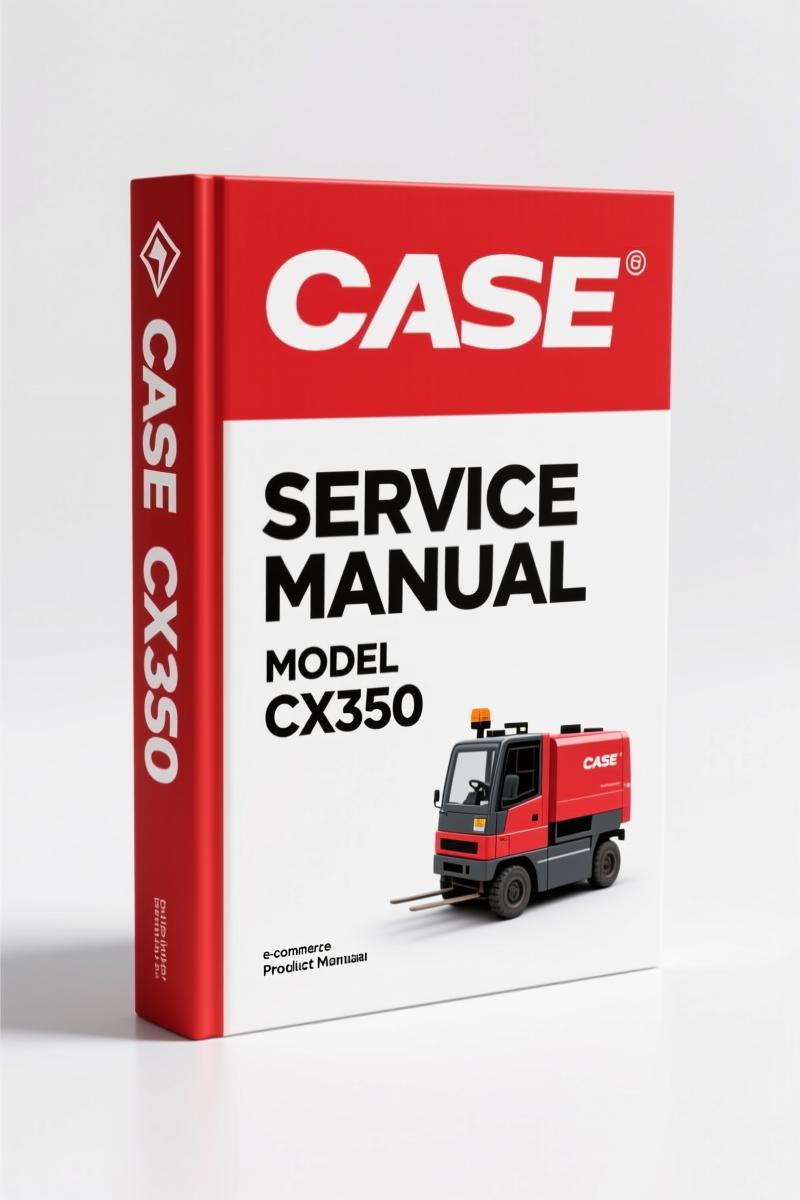
Case CX330, CX350, CX330NLC 2006 Service Manual
Original price was: $84.50.$65.00Current price is: $65.00.
OEM service manual for Case CX330, CX350, CX330NLC 2006 excavators. 650 pages of factory torque specs, diagnostics, and hydraulic procedures.
Description
Case CX330, CX350, CX330NLC 2006 Service Manual
I’m Mike Callahan. I’ve been turning wrenches since before some of you were born, and I’ve seen what happens when a shop relies on third-party copies or internet forum torque values. You end up with a hydrostatic drive that won’t hold pressure, or a head gasket that leaks after 50 hours. This Case CX330, CX350, CX330NLC 2006 Service Manual is the real factory document. 650 pages, printed by CNH, not some scanned mess with missing pages. If you’re working on a CX330, CX350, or CX330NLC Tier 3 crawler excavator, you need the OEM specs. Period. This manual gives you the fuel system flow rates, engine torque sequences, electrical wiring diagrams with pin numbers, and hydraulic pressure settings that come straight from the Case engineers. Stop guessing. Start using the right data.
Case CX330, CX350, CX330NLC 2006 Service Manual – Section Breakdown
The manual is divided into divisions that match the actual machine systems. Division 1 covers general information, safety, and standard torque data. Division 2 is the engine: removal, installation, disassembly, assembly, and specs. Division 3 is the fuel system – tank, lines, injection. Division 4 covers the electrical system: troubleshooting, battery inspection, and electronic control boxes. Divisions 5 through 8 cover undercarriage, drive train, undercarriage hydraulics, and upperstructure hydraulics. Division 9 wraps with upperstructure components like boom, dipper, and bucket. Each section references a specific publication number – for example, Section .4001 for electrical troubleshooting. That level of traceability is absent in aftermarket reprints.
System Chart of Function: Reading the Display Correctly
On page 4, you get the System Chart of Function. This is your map to what the monitor can show you. The manual walks you through Normal Display (page 46), Message Display (page 49), and how to access the monitor displays (page 50). If you’ve ever had a machine throw a code and you didn’t know which screen to pull up, this chapter saves you from digging through menus blind. The diagnostic code section on page 54 gives you the procedure to read and interpret fault codes. Machine history on page 59 shows you how to review past events. Resetting procedures start on page 62. You don’t need a dealership laptop for basic diagnostics if you follow these factory steps.
Diagnostic Codes – How the Manual Guides Troubleshooting
Diagnostic code troubleshooting is where most DIYers get stuck. You see “ESX control override” or a hydraulic pressure error and you have no idea what to check. This manual dedicates a full subsection to diagnostic codes. It tells you what each code means, what conditions trigger it, and what to inspect. The “Machine condition” section on page 51 explains how the system self-checks. Prior inspections start on page 69 – a checklist you should run before you even plug in a scan tool. Too many guys skip that and end up chasing a dead battery when the real issue is a loose ground. The manual lays it out in order. Follow the organization charts on page 70.
Fuel System and Low Oil Pressure: Sections You’ll Use
Fuel system troubleshooting is on page 72. Need to add coolant? Page 73. Low engine oil pressure procedure is on page 74. Overheating? Page 75. Defective battery charge circuit on page 78. These are the pages you will dog-ear within the first week. The manual gives you the sequence – don’t jump to replacing parts before you check pressure, wiring, and fluid levels. OEM torque specs for the fuel injection pump and engine fasteners are listed in Division 1 under standard torque data. That is not a suggestion; it’s the difference between a seal that holds and a fuel leak that grounds the machine. If you need the bleed procedure for the fuel system, it’s in Section .3001. No guesswork.
Why OEM Documentation Beats Aftermarket Reprints
Aftermarket manuals often reprint specs from a generic database. They might list the wrong oil viscosity for the CX350 hydraulic system or skip a critical caution about depressurizing the accumulator before removing a line. This Case manual includes original CNH copyright, printed in France in May 2006. The wiring diagrams in Division 4 are original vector graphics, not blurry scans. The hydraulic circuit schematics in Section .8020 are legible and color-coded. You get the manufacturer’s warnings – for example, the proper procedure for bleeding the swing motor (Section .8019). Aftermarket copies leave that out. That’s why I only recommend OEM manuals for any serious work on these machines. For related models, check the Case CX330 CX350 2002 Service Manual if you have an earlier year. The CASE CX330 CX350 Service Manual covers similar specs, but always verify publication date. If you’re moving to a different series, the Case CX210B, CX230B, CX240B 2009 Service Manual – OEM Factory Specs is a good reference for similar systems.
Electrical System Troubleshooting: From Battery to Control Boxes
The electrical section (Division 4) is 300+ pages of detailed diagnostics. It covers inspection and maintenance of batteries, connecting a booster battery (Section .4002), and the main and engine electronic control boxes (Section .4003). The “Electrical system troubleshooting” chapter on page 80 walks you through voltage drops, open circuits, and short-to-ground checks. If you’re not comfortable with a multimeter, the manual explains how to isolate circuits without damaging the ECM. For general understanding of transmission types in heavy equipment, you might also read about Manual Transmission principles, but this manual focuses on hydrostatic drive and final drives. Similarly, the drive train section (Division 6) covers removal and installation of drive motor and final drive transmission – see Section .6001. For a broader background on manual gearboxes, refer to Manual Transmission articles, but for this specific case, follow the factory steps.
Hydraulic Pressure Settings and Depressurization
Divisions 7 and 8 cover hydraulics. You must depressurize the system before any work – Section .8000 gives the vacuum pump bleeding procedure. Section .8001 includes specifications, troubleshooting, checks, and hydraulic pressure settings. Do not attempt to adjust pressure without the factory values. The manual lists pressure settings for main pump, pilot pump, and individual functions. The disassembly and assembly procedures for the main hydraulic control valve (Section .8011) and attachment cylinders (Section .8012) include torque values for valve body bolts and cylinder gland nuts. Ignoring those specs will cause internal leakage and poor cycle times. The foot control levers (Section .8014) and six-solenoid valves (Section .8015) are covered in detail. This is not a generic hydraulic theory book; it’s the specific setup for the CX330NLC.
Audience Fit: Who Should Buy This Manual
This manual is for anyone who owns or services a Case CX330, CX350, or CX330NLC excavator. If you are a shop technician, you need this on the bench. If you are an equipment owner doing your own maintenance, you need it to avoid expensive mistakes. The manual assumes you have basic mechanical skill – it gives step-by-step procedures but expects you to know how to use a torque wrench and a multimeter. Beginners will benefit from the prior inspection checklist and the organization charts. The language is technical English, but the photos and diagrams compensate. Do not expect a “repair for dummies” book. This is a factory service manual for professionals. If you are unsure about your ability, start with the safety section and the general information division before tearing into the fuel system or hydraulics.
Source Validity: OEM Factory Print, Not a Copy
What you are getting from AutoRepairManuals is the original OEM document – 650 pages, complete, no missing pages, no watermarks from a third-party republisher. The PDF is scanned from the printed manual but at high resolution so that all torque specs and wiring diagrams are readable. The metadata shows the original CNH France copyright and publication date of May 2006. This is the same document that Case dealerships used when these machines were current. Aftermarket versions may be missing the “Safety” subsection or the standard torque data from Division .1001. That data is critical: head bolt torque for the engine, track tension specifications, and hydraulic fitting torque. I have seen stripped banjo bolts because a tech used an aftermarket manual that listed the wrong value. Don’t be that guy. Buy the real thing.
FAQ
- Does this manual cover both the CX330 and the CX350?
- Yes, the manual covers all three models.
- What torque specs are included?
- Division 1 includes standard torque for bolts and nuts. Special torque settings for engine, hydraulics, and undercarriage are listed in their respective sections. Page numbers are referenced in the table of contents.
- Is the wiring diagram legible?
- The wiring diagrams are legible and include connector views. Section .4001 has the troubleshooting procedures.
- Can I use this for a CX330NLC with Tier 3 engine?
- Yes. This manual is specific to Tier 3 models, covering the CX330NLC with Tier 3 engine. The engine section includes specifications for the Tier 3 power unit, including injection pump timing, valve adjustment, and compression test values. It also covers the fuel system and electrical system specific to Tier 3 emissions components. If you have a Tier 4 machine, the aftertreatment system differs significantly, and you need the later manual. Do not rely on this document for Tier 4 repairs, as the ECM programming and sensors are different.
Look, I don’t have time to rewrite what the factory already did right. If you are working on a Case CX330, CX350, or CX330NLC and you want to get the job done with the right specs the first time, stop wasting time on forum threads and aftermarket copies. Access the Factory Manual from AutoRepairManuals and put it on your tablet or print the pages you need. You will save yourself a headache and a tow bill.
Additional information
| Brand | Case |
|---|---|
| Language | English |
2 reviews for Case CX330, CX350, CX330NLC 2006 Service Manual
You may also like…
-
Sale!
Case 50 Crawler Series D Service Manual – Factory Specs & Electrical
Original price was: $98.00.$70.00Current price is: $70.00. -
Sale!
Case 26, 26B, 26S 1975 Parts Catalog – Factory Exploded-View Parts Identification
Original price was: $114.00.$75.00Current price is: $75.00. -
Sale!
Case 2500 Service Manual – OEM Factory Specs for Cruz-Crane
Original price was: $97.30.$70.00Current price is: $70.00. -
Sale!
Case 34, 680 CK 1967 Parts Catalog – OEM Factory Parts
Original price was: $107.25.$75.00Current price is: $75.00.
Related products
-
Sale!

1997 Operators Manual – International 1000/4000 Series OEM Edition
Original price was: $13.49.$9.99Current price is: $9.99. -
Sale!

Technical Manual – International 6.0L Power Stroke FICM Diagnostics
Original price was: $29.80.$20.00Current price is: $20.00. -
Sale!
1996 Operators Manual – International 1000-4000 Series (246 pages)
Original price was: $15.28.$9.99Current price is: $9.99. -
Sale!
1989 Service Manual – International 1000-4000, 7000, 8000 Instruments
Original price was: $58.80.$40.00Current price is: $40.00.
Thomas B. –
Superb resource! The scan is high-quality and well indexed. Contains detailed wiring diagrams for Case. I will recommend this shop to others.
Michael T. –
This is just what I was looking for. The text is searchable and easy to navigate. A must-have for any Case CX330, DIYer doing maintenance. I will definitely buy again.