
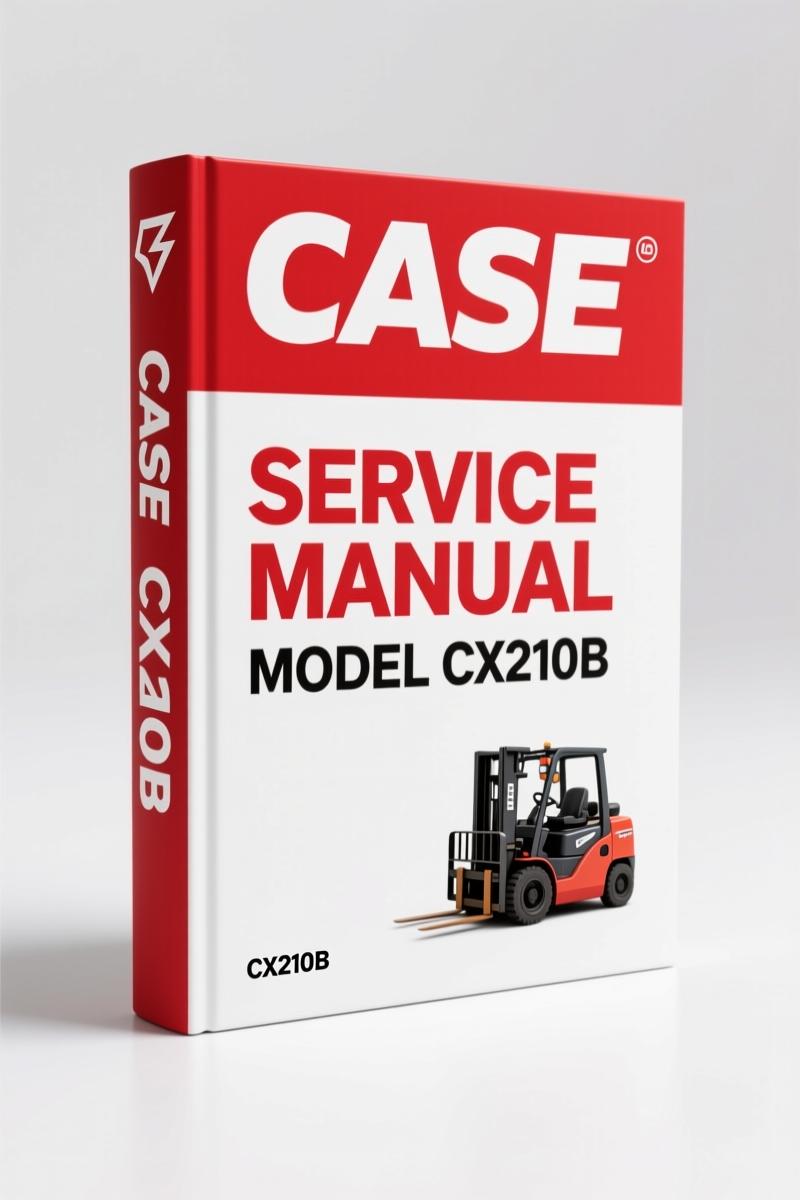
Case CX210B Service Manual – Factory Specs for Engine, ECM & Emissions
Original price was: $50.40.$40.00Current price is: $40.00.
83-page OEM service manual covering Case CX210B engine, ECM, sensors, common rail, cooled EGR, and Tier 3 emissions compliance.
Description
Case CX210B Service Manual – What You Get When Factory Specs Matter
You’ve got a CX210B on the bay with a rail pressure fault or an ECM that won’t talk to your scan tool. The aftermarket PDF you obtained from some sketchy forum says “tighten to spec” but doesn’t give you the spec. That’s where this Case CX210B Service Manual changes everything. It’s 83 pages of factory-level documentation, straight from the people who bolted the Isuzu AI-4HK1X to the frame. I’ve been turning wrenches in San Antonio for 28 years, and I can tell you – the difference between a manual that lists torque values and one that explains why the ECM locks out the fuel solenoid is the difference between a job that finishes and a job that haunts you.
This manual covers the Tier 3 CX210B and the Tier 2 CX210. If you’re working on either, you need the main data table that starts on page 2 – it lists dry weights, displacements, compression ratios. The 4HK1 engine (4-cylinder, 5.193L) runs at 157 hp at 1800 rpm, max torque 463 lb-ft at 1500 rpm. That’s not a guess. That’s printed in the Isuzu blueprint. You get the full engine summary with component locations (EGR cooler, common rail, supply pump, turbo) and a section on the ECM that will save your ass when the control module starts acting up.
Engine Specs and Fluid Capacities – OEM Data Table
The manual opens with a two-page engine specification sheet. You get the rated output, torque curve, displacement, compression ratio (17.5/1 for the 4HK1), fuel consumption rate (229.3 g/kWh and below), alternator output (50A-24V from NDTC or Mitsubishi), and the Bosch-style common rail system from DENSO. Oil pan capacity ranges from 13.0 to 20.5 L depending on configuration. If you are swapping an engine or rebuilding the top end, you need these numbers. Page 2 is your reference.
Don’t trust a third-party reprint on oil capacity. I’ve seen guys overfill by half a gallon because some aftermarket site rounded up. This manual gives you the factory range, not a guess. And for the common rail system, it lists the control device – TransTron ECM for the 4HK1, Cummins for the 6TA. That matters when you’re diagnosing a rail pressure drop.
ECM (Engine Control Module) – Three Roles and Sensor Logic
The ECM section walks through the three roles of the control module: governing, fault monitoring, and actuator control. It also details the sensor inputs – crank position, cam position, coolant temp, fuel temp, barometric pressure, common rail pressure, boost pressure, oil pressure, boost temperature, intake air temperature, and EGR position. The manual explains how each sensor feeds the ECM and what happens when a signal drops. No other aftermarket book I’ve seen covers the Tier 2 vs Tier 3 sensor differences this clearly.
If you are chasing a no-start or an intermittent derate, read the ECM section before you throw parts at it. The manual shows the difference between the two tiers – for example, Tier 2 uses a Cummins ECM; Tier 3 uses a TransTron unit. That changes how you test the fuel solenoid and the QOS-II preheat system. The book also includes a comparison table of sensor presence between Tier 2 and Tier 3. If you are swapping a control unit from a different year, you’ll need that table.
Supply Pump and Common Rail – Fuel System Disassembly
You get a dedicated subsection on the supply pump, the common rail, and the pressure limiter. The manual describes how to replace parts on the fuel delivery side. It’s not a cartoon – it’s a factory procedure that lists every O-ring, every torque angle. The common rail section covers the pressure limiter valve and what it does when rail pressure spikes. If you are replacing injectors or the HP3 pump, you’ll need the fuel system diagram and the bleed procedure. That is not information you want to guess on a Tier 3 machine.
For the guys who think they can skip the bleed procedure – don’t. This manual gives you the step order so you don’t air-lock the high-pressure system. I’ve seen a tech warp a rail by starting the engine with air in the supply line. The book also lists required tools – you’ll need a suitable scan tool to force the ECM into prime mode. That’s in the manual.
Cooled EGR and Turbo – Exhaust Gas Recirculation Details
The cooled EGR section covers valve, cooler, and control logic. The manual shows the EGR position sensor and how it integrates with the ECM and the QOS-II preheat system. The turbo section lists the IHI type RHF55 turbocharger. It includes the bell-mouth fan guide and fan belt specs (V-shape ribbed belt, single drive for Tier 3; Type-B V-belt, dual-drive for Tier 2). If you are replacing the turbo or the EGR valve, you need to know the orientation and the torque pattern. This manual shows it.
On page 3 and 4, the engine summary diagram labels every component – air intercooler, radiator, fuel cooler, oil cooler, A/C condenser. You can use it as a roadmap when you are hunting a coolant leak or an oil leak. It’s a 1:1 factory drawing, not a redrawn generic. I’ve found that aftermarket manuals often flip the cooling fan direction. This one won’t.
Pressure Limiter and How to Replace Parts – Practical Guidance
The final section of the manual deals with the pressure limiter on the common rail and gives a general “How to Replace Parts” guide. It’s short but dense – it warns about using only genuine Case seals and the correct torque for the limiter. There’s also a note about pre-filling the fuel filter with clean diesel before cranking. That prevents dry-start wear on the HP3 pump. It’s the kind of detail you don’t get from a $9.99 access.
If you work on these machines regularly, you should also consider the CASE CX210B CX290B 2007 Hydraulic Training Manual for the hydraulic side of the CX210B. The CASE CX210B CX290B 2007 Diagnostics Manual covers electrical troubleshooting specifically for the Tier 3 CAN bus system. And the CASE CX210B CX230B CX240B 2007 Service Manual gives you the full machine coverage beyond the engine. For general transmission basics, the Manual Transmission theory is useful for understanding the drivetrain interface on this excavator – but that’s a separate subject covered by Manual Transmission documents.
Who Needs This Manual – Real-World Use Case
If you are a shop owner with a CX210B in the fleet, or a DIY landowner maintaining your own machine, this manual is for you. The content assumes you can read a wiring diagram and use a multimeter. It does not assume you know the ECM logic. The manual is written for a technician who understands diesel engines but may not have Case factory training. The step order is logical: sensor diagnostics, ECM roles, supply pump removal, common rail service, EGR and turbo work. You can fix a no-crank condition by reading the starter section (NDTC 5.0kW-24V). You can diagnose an overfueling issue by checking the common rail pressure sensor. The manual gives you the factory procedure, not a summary.
One more thing – the OCR in this file indicates it’s a digital copy of an original Case document. It has the page numbers, the Case part number (18009000957), and the same formatting you’d see in a paper manual. No reprint, no third-party editing. You are buying the same document I use when I have a CX210B in bay 3.
FAQ – Common Questions About This Manual
- Does this manual cover the Tier 2 CX210 as well as the Tier 3 CX210B?
- Yes. The manual includes a difference table on page 2 comparing the two models. It lists separate specs for the 4HK1 and 6TA engines. Both versions share the same general structure, but sensor configuration and ECM type differ. The manual points out where to look.
- Can I use this manual to replace the ECM without a scan tool?
- No. The manual explains the ECM roles and sensor wiring, but any ECM replacement requires a dealer-level tool to flash the software and match the injector codes. You won’t find a workaround in this manual.
- What torque values are printed in the manual?
- The manual references torque for common rail line fittings and pressure limiter, but does not list every fastener. You get the critical ones for fuel system and engine mounts. If you need chassis torque specs, buy the CASE CX210B CX230B CX240B 2007 Service Manual.
- Is the fuel system section enough to rebuild the supply pump?
- No. The manual identifies the pump (DENSO HP3) and gives replacement procedures, but it is not a rebuild manual. It tells you how to remove and install the pump, not how to disassemble it internally. For pump rebuild, you need a separate DENCO technical publication.
Access the Factory Manual. I’ve been in this business long enough to know that a printed spec sheet from Case is cheaper than one blown head gasket or one seized fuel pump. This PDF opens on any tablet or phone – keep it in the shop tablet, bookmark the ECM section, and stop chasing ghosts. The price of this manual is less than one hour of dealer diagnostic time. Get it, read it, torque it.
Additional information
| Brand | Case |
|---|---|
| Language | English |
3 reviews for Case CX210B Service Manual – Factory Specs for Engine, ECM & Emissions
You may also like…
-
Sale!
Case 26, 26B, 26S 1975 Parts Catalog – Factory Exploded-View Parts Identification
Original price was: $114.00.$75.00Current price is: $75.00. -
Sale!
Case 2500 Service Manual – OEM Factory Specs for Cruz-Crane
Original price was: $97.30.$70.00Current price is: $70.00. -
Sale!
Case 50 Crawler Series D Service Manual – Factory Specs & Electrical
Original price was: $98.00.$70.00Current price is: $70.00. -
Sale!
Case 34, 680 CK 1967 Parts Catalog – OEM Factory Parts
Original price was: $107.25.$75.00Current price is: $75.00.
Related products
-
Sale!
Acura NSX 1991 Service Manual – 1420 Pages OEM
Original price was: $102.05.$65.00Current price is: $65.00. -
Sale!

1989 Service Manual – International 2000-8000 Electrical Systems
Original price was: $72.00.$50.00Current price is: $50.00. -
Sale!

1993 Operators Manual – International Bus 1000-3000 OEM Specs
Original price was: $12.30.$7.99Current price is: $7.99. -
Sale!

2006 Service Manual – International DT 466E, 530E Diesel Engine
Original price was: $67.50.$50.00Current price is: $50.00.
workshop_guy –
I am extremely satisfied with this purchase. The text is searchable and well indexed. A must-have for any Case CX210B owner doing repairs. Saves me a lot of money.
David K. –
Excellent quality! It is very easy to read on my laptop without losing quality. Every wiring layout is included for Case CX210B. Saves me hundreds of time.
Charles W. –
I am very pleased with this manual. The scan is high-quality and easy to navigate. A must-have for any Case CX210B mechanic doing repairs. Saved my repair job! Thank you.