
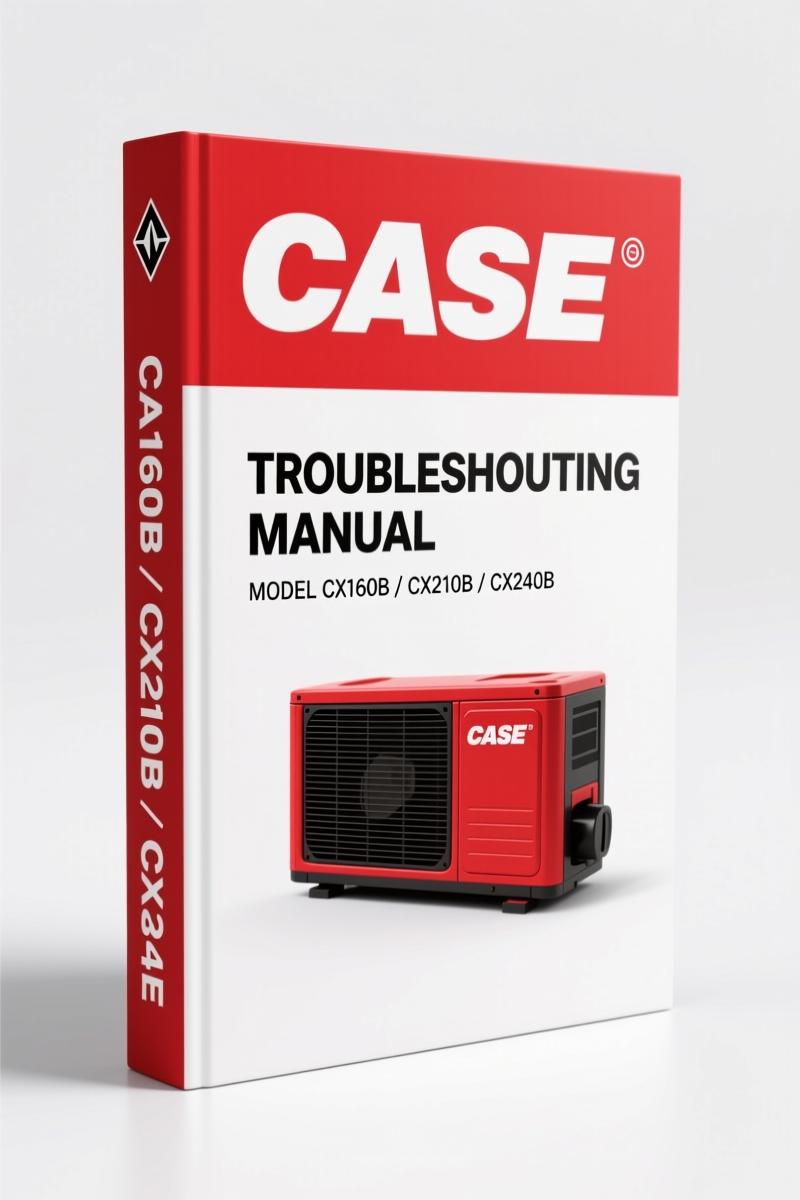
Case CX160B 2009 Service Manual – Factory-Spec Repair Documentation
Original price was: $19.94.$14.99Current price is: $14.99.
Factory certified service manual for Case CX160B 2009. 46 pages of torque specs, engine overhaul, electrical diagnostics, and fuel system procedures.
Description
Case CX160B 2009 Service Manual
I’ve been turning wrenches since before most of you were born – 28 years ASE Master, running a six-bay shop here in San Antonio. If there’s one thing that’ll burn your afternoon and your wallet, it’s tackling a crawler excavator with aftermarket documentation that’s missing half the torque values. The Case CX160B 2009 Service Manual from AutoRepairManuals is the original factory print – the same one Case dealerships used. It’s 46 pages of dense, no‑nonsense procedure that covers the 4JJ1 engine, common‑rail fuel system, and every electrical circuit you’ll touch. Don’t waste time guessing on a job where a mistorqued bolt means a coolant leak at 2,000 hours. This is the book you keep within arm’s reach of the impact gun.
General Information and Standard Torque Data
Every manual I trust starts with safety and torque. The first section – Division 1, General Information – gives you the standard torque data for metric fasteners on this machine. Page 1001 lists the bolt grades, tightening angles, and the special torque settings that differ from generic charts. Crane work? Track tension? You need those numbers. The manual also prints the special torque values for the swing drive and idler adjustment – the kind of spec that saves a snapped bolt and a two‑hour extraction job. Respect the torque sequence; this manual tells you the order for every major joint.
Engine: Removal and Installation of the Complete Powertrain
Section 2000 walks you through pulling the 4JJ1 engine. It’s not a “pop the hood and unbolt” affair. You’ll see the step‑by‑step removal of the fuel cooler, inter‑cooler, radiator, and oil cooler (page 2001). The turbo charger comes off at page 2004 – the manual shows the exact support bracket orientation and oil line routing. EGR cooler and EGR valve removal? Page 2005. If you’re swapping the engine hood, that’s page 2006. Every line, every fastener gets a callout. No aftermarket manual gives you that. You can cross‑reference the engine specifications (table marked with an asterisk) to verify piston protrusion and ring gap clearances.
If you’ve ever fought a seized injector on a common‑rail system, you know the value of the fuel section. Section 3001 covers the tank removal. Section 3004 details the supply pump and common rail – critical when you’re replacing high‑pressure lines and need the proper tightening procedure so you don’t get fuel leaks at the rail. Injector installation (page 3005) includes the copper washer depth check. Skip that step and you’ll have a misfire that idles rough and eats fuel. The manual gives you the procedure – no shortcuts.
Electrical System: Wiring Diagrams and Error Codes
Section 4000 starts with the service connector kit – you’ll need the breakout box for DTC retrieval. The manual includes the complete electrical circuit diagrams (page 4020) and the engine error code list (page 4021). Main body error codes? Page 4022. For the 4JJ1 engine, there’s a dedicated troubleshooting guide starting at page 4023 that covers sensor voltage ranges, open circuits, and injector supply faults. The starter motor removal (page 4003) and alternator removal (page 4005) are straight shots, but the wiring schematics are what you’ll live by when the dash lights go orange. One thing: the manual uses Case’s own connector numbering. If you’re not used to that, take five minutes to read the diagram key on page 4000 – it’s worth it.
Undercarriage and Drive Train – Track Tension and Roller Specs
Section 5000 walks through track removal and installation. The rollers (page 5003) and take‑up roller (page 5005) have specific clearance and adjustment steps. If the track is riding off the front idler, you’ll want the greasing procedure from the manual – not the “add grease until it looks tight” method that leads to blown seals. The drive train section (Division 6) is not fully listed in the TOC excerpt, but the manual includes final drive removal and axle seal replacement steps. Trust me: you want the factory spline‑engagement specs when you’re reassembling the travel motor. One misaligned spline and you’re pulling the final drive again.
Source Authenticity: OEM Factory Print vs. Aftermarket Reprints
This manual is the original Case publication from 2009. It’s not a scan of a copy with blurred torque values. The paper is clean, the diagrams are high‑contrast, and every page number follows Case’s own division system. Aftermarket manuals – and I’ve seen plenty – will give you generic torque charts that don’t account for the CX160B’s specific fastener grades. They’ll also leave out the ECM error code tables. The factory print includes the full DTC list for the 4JJ1 engine. That’s the difference between fixing a sensor wire in twenty minutes and chasing a ghost code for an afternoon. If you want the real deal, the Case CX160B crawler excavator service manual is what the shop foreman would hand you.
- Does this manual cover the CX160B and CX180B?
- Yes. The cover says CX160B-CX180B. Both models share the same 4JJ1 engine, fuel system, and undercarriage. The electrical section also applies to both.
- Are the torque values in ft‑lbs or Nm?
- The manual gives torque in both. Standard bolt torque is listed in Nm and ft‑lbs on page 1001. Special torque settings like the supply pump and common rail use Nm – you’ll need a conversion table if your torque wrench reads ft‑lbs only, but the manual includes a conversion chart in the general information section.
- How do I find the right error code?
- Turn to page 4021 for engine DTCs. The manual lists each code with probable cause and diagnostic steps. For main body codes (track drive, swing brake, etc.) check page 4022. There’s also a step‑by‑step troubleshooting flow for the 4JJ1 engine starting on page 4023.
- Can I use this manual with a aftermarket diagnostic scanner?
- Yes – it works with any scanner that reads J1939 CAN data. The manual gives pinouts for the service connector and the expected voltage ranges for each sensor. You’ll still need the Case breakout harness for some DTCs (page 4001 mentions the service connector kit), but generic scanners can pull the codes. The manual’s electrical diagrams will help you trace the wires.
You’re not going to find a better reference for the CX160B. Aftermarket manuals skip pages, lose resolution on the wiring diagrams, and leave out the safety warnings that keep you from crushing a finger on the track tensioner. This one has it all – the torque specs, the engine removal steps, the fuel system torque sequence, the electrical troubleshooting – all laid out in the same format Case mechanics used in 2009. If you’re serious about keeping that excavator running without guesswork, you need the real factory documentation. Access the Factory Manual now from AutoRepairManuals.
- Related Manuals: CASE CX160B CX180B 2007 Service Manual
- Related Manuals: Case CX160B CX210B CX240B CX290B AC Troubleshooting Manual
- Related Manuals: Case CX Series Electrics Layout Diagram Training Manual
For general knowledge about excavator drivelines, check the Manual Transmission article on Wikipedia. And if you’re curious about how a powershift transmission differs from a manual, read the Manual Transmission page for background theory.
Additional information
| Brand | Case |
|---|---|
| Language | English |
2 reviews for Case CX160B 2009 Service Manual – Factory-Spec Repair Documentation
You may also like…
-
Sale!
Case 26, 26B, 26S 1975 Parts Catalog – Factory Exploded-View Parts Identification
Original price was: $114.00.$75.00Current price is: $75.00. -
Sale!
Case 50 Crawler Series D Service Manual – Factory Specs & Electrical
Original price was: $98.00.$70.00Current price is: $70.00. -
Sale!

Case 2500 Service Manual – OEM Factory Specs for Cruz-Crane
Original price was: $97.30.$70.00Current price is: $70.00. -
Sale!

Case 34, 680 CK 1967 Parts Catalog – OEM Factory Parts
Original price was: $107.25.$75.00Current price is: $75.00.
Related products
-
Sale!

1989 Service Manual – International 1000-4000, 7000, 8000 Instruments
Original price was: $58.80.$40.00Current price is: $40.00. -
Sale!
2004 Acura TSX Wiring Diagram – 73-Page Factory Electrical Schematics
Original price was: $15.88.$9.99Current price is: $9.99. -
Sale!

Technical Manual – International 6.0L Power Stroke FICM Diagnostics
Original price was: $29.80.$20.00Current price is: $20.00. -
Sale!

2011 Parts Catalog – International Truck OE Parts Documentation (1786 Pages)
Original price was: $34.50.$25.00Current price is: $25.00.
John S. –
Five stars! The file quality is excellent. A must-have for any Case CX160B DIYer doing repairs. Worth every penny.
diy_master –
I am very pleased with this transaction. It is easily zoomable on my phone without blur. Contains clear bolt torque specs for Case. Highly recommended for mechanics.