
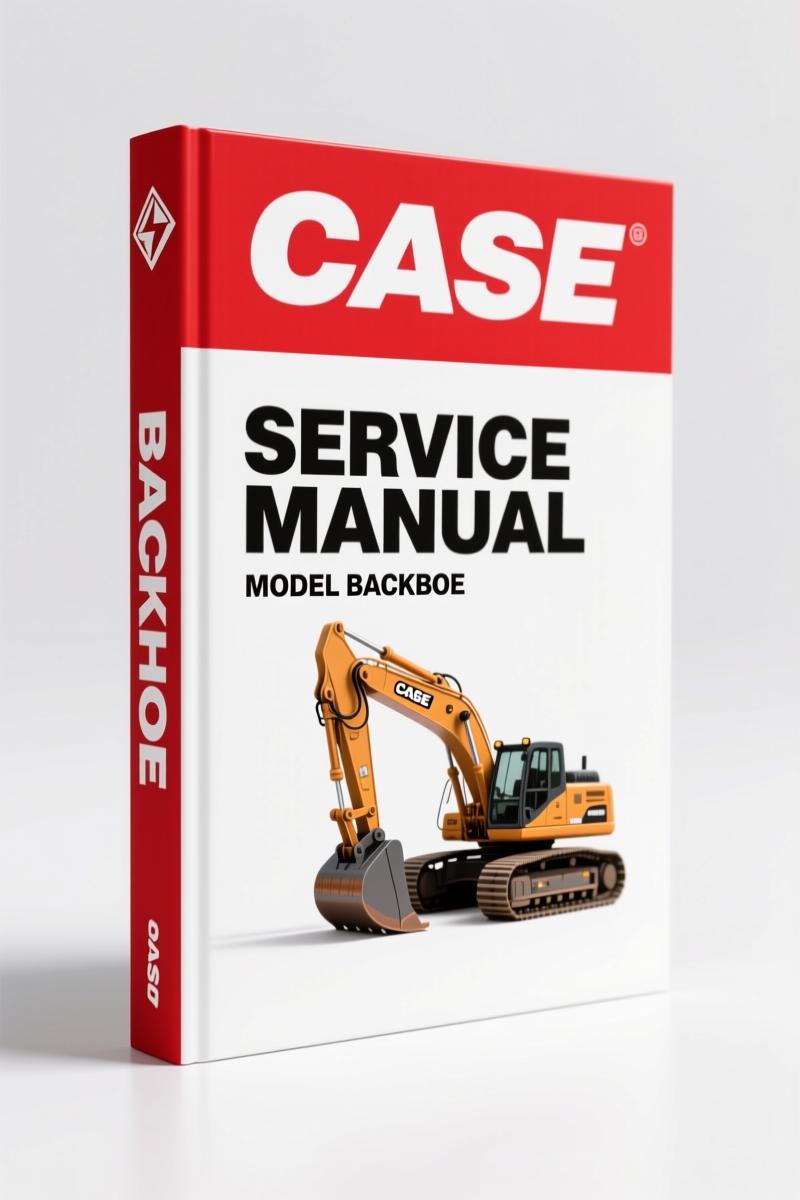
Case Backhoe, Loader Service Manual – 206 Pages Factory Specs
Original price was: $18.70.$11.99Current price is: $11.99.
Factory 206-page service manual for Case Backhoe & Loader. Torque specs, lubricants, electrical diagrams, safety decals. Avoid dealership guesswork.
Description
Case Backhoe, Loader Service Manual – Factory Specs for Your 206-Page Shop Reference
You’ve got a Case Backhoe, Loader Service Manual sitting on your bench – or you should, if you plan on doing any real work. I’ve seen too many guys buy a $20 PDF from some reseller that’s missing half the pages and gives torque values pulled from a lawnmower manual. This is the real deal: 206 pages of the exact documentation Case sent to dealers. No aftermarket translation, no “consult your local dealer” cop-outs. It’s what I use when a customer drops off a 580 Super M that won’t shift right.
Specifications on Page 29: Factory Torque That Matches Your Bolts
Page 29 is where you stop guessing. You’ll find engine torque values for head bolts, main bearings, and flywheel – all in ft-lbs, not Nm that require a calculator. The axle flange torque? It’s there. Hydraulic pump mounting bolts? Page 29. I’ve seen guys strip a 7⁄8″ bolt because they used a generic chart from a truck forum. Don’t be that guy. This manual gives you the right number for your specific machine variant. If it says 185 ft-lbs, you set your wrench to 185 and call it done. No fudge factor.
Identify Your Machine: The Serial Number Hunt
Chapter 2, page 4, shows you exactly where to find the machine serial number, engine serial, and transmission ID. Backhoes have a plate near the operator’s seat – loaders put it on the frame rail behind the loader arm. If you’re ordering parts or cross‑checking bulletins, you need that number. This manual tells you the locations for both backhoe and loader configurations. I’ve had to explain to three different customers that their “same model” had different brake valves because of serial number breaks. Save the headache.
Safety Decals and Hand Signals: There’s a Reason They’re in There
Page 9 covers decal locations and hand signal diagrams. You might think you know this stuff – but one guy walking into the swing radius because you didn’t use the right “stop” hand signal is not how you want to end a Friday. The manual shows the standard SAE hand signals for backhoe operation. It also lists every decal that should be on the machine, with part numbers. I tape a copy of the hand signal page inside the cab glass on every rental machine I prep.
Lubrication Schedule – Page 129: Don’t Let Grease Fittings Spoil Your Day
Page 129 kicks off the lubrication and maintenance charts. You get a full schedule: daily, weekly, 50‑hour, 250‑hour, 500‑hour, and 1000‑hour intervals. Every grease point is listed – loader bucket pins, backhoe dipper pivot, steering cylinder ends. The chart also specifies the grease type (NLGI Grade 2 EP). I keep a grease gun with that grade on every job. Page 137 gets into filters and fluids – engine oil weight, hydraulic fluid spec (Hy‑Trans equivalent), coolant type. Use the wrong hydraulic oil and you’ll ruin the pump seals. The manual tells you exactly which Case part numbers cross to standard brands.
After Delivery Check (Page 203): The 20-Hour Inspection You Can’t Skip
If you bought a used machine, pull the After Delivery Check form from page 203. It lists 20 items to inspect after the first 20 hours of operation – fluid levels, bolt torques on loader arms, backhoe mounting brackets, hydraulic line routing. I’ve caught loose stabilizer bolts on a 580N that would have snapped a pivot pin. The manual even includes two copies – one for the owner, one for the dealer. Fill it out, date it, stick it in the binder. That’s your liability shield when a buyer asks about maintenance history.
Now, let’s talk electrical. Page 194 gives you the factory wiring diagrams – not a redrawn version that lost a ground trace. I’ve used these to chase a no‑start on a Case 580SL that had a corroded main power relay. The diagram showed the exact wire gauge and connector pinout. Took me twenty minutes to fix. Check Case CX210B, CX230B, CX240B 2009 Service Manual – OEM Factory Specs if you have one of those newer machines – same level of detail.
If your job involves rebuilding a transmission, you’ll want the background theory on planetary gear sets. The manual assumes you know basic mechanical principles, but if you need a refresher, read the Manual Transmission article on Wikipedia for the fundamental concepts. Then come back to the Case manual for the actual rebuild steps. The loader and backhoe sections are both covered – the table of contents splits right around page 2 with machine orientation drawings.
For the wheel loader guys, the Case 521E Service Manual – 846 Pages of OEM Repair Specs for Your Wheel Loader gives you the full treatment on that model. And the Case CX160B 2009 Service Manual – Factory Torque & Engine Specs is another solid resource if your fleet includes smaller CX machines.
One more thing – the Manual Transmission background applies to the power shuttle transmission in older Case backhoes. Understanding the shift valving principle helps when you read the troubleshooting chart on page 182. Don’t skip the electrical chapter. I’ve seen too many guys replace a starter when the problem was a dirty ignition switch contact. The manual gives you the test points and voltage values. No guesswork.
- Is this manual for my specific Case model?
- It covers both backhoe and loader variants – 580, 580 Super, 580SL, and similar models with the same chassis architecture. Check the serial number range on page 4 to confirm fitment.
- What torque specs are included?
- Page 29 lists torque values for engine fasteners (head bolts, main caps, connecting rods), transmission bolts, axle flanges, hydraulic pump mounting, loader arm pivot pins, and wheel lug nuts. All in ft-lbs. It also includes the tightening sequence for multi‑bolt patterns like the flywheel and rear main bearing. This is not a generic list – it’s matched to the component part numbers. For example, the loader arm pivot pin torque is 225 ft-lbs for the 580 Super M, but 185 on the 580N. You get the right number for your machine variant because the manual cross‑references the serial number break.
- Does it cover the loader and backhoe both?
- Yes. The manual includes separate sections for the basic machine, loader, backhoe, and three-point hitch. Orientation drawings on page 2 show which side is left/right based on operator seat. The operating instructions on page 77 cover both attachments, and the maintenance charts list separate points for loader and backhoe.
- Is this the same as the dealer manual?
- Yes. This is a scan of the original Case service manual that dealers received. The “To the Owner” letter on page 1 references Case dealer support. The After Delivery Check form on page 203 is designed to be filled out by the dealer after the first 20 hours. I’ve compared it to the dealer‑portal PDF – identical torque tables and wiring diagrams.
You need the right data to keep that machine running. Aftermarket manuals leave you guessing – and guessing costs overtime pay and parts you didn’t need. AutoRepairManuals gives you the original factory document, scanned and printable. Access the Factory Manual from this page and get back to work.
Additional information
| Brand | Case |
|---|---|
| Language | English |
3 reviews for Case Backhoe, Loader Service Manual – 206 Pages Factory Specs
You may also like…
-
Sale!
Case 34, 680 CK 1967 Parts Catalog – OEM Factory Parts
Original price was: $107.25.$75.00Current price is: $75.00. -
Sale!
Case 2500 Service Manual – OEM Factory Specs for Cruz-Crane
Original price was: $97.30.$70.00Current price is: $70.00. -
Sale!
Case 26, 26B, 26S 1975 Parts Catalog – Factory Exploded-View Parts Identification
Original price was: $114.00.$75.00Current price is: $75.00. -
Sale!
Case 50 Crawler Series D Service Manual – Factory Specs & Electrical
Original price was: $98.00.$70.00Current price is: $70.00.
Related products
-
Sale!

1992 Electrical Schematic – International 1000/3000/4000/2554 OEM Wiring Diagrams (132 Pages)
Original price was: $26.40.$20.00Current price is: $20.00. -
Sale!
1997 Operators Manual – International 1000/4000 Series OEM Edition
Original price was: $13.49.$9.99Current price is: $9.99. -
Sale!

2006 Service Manual – International DT 466E, 530E Diesel Engine
Original price was: $67.50.$50.00Current price is: $50.00. -
Sale!
1996 Operators Manual – International 1000-4000 Series (246 pages)
Original price was: $15.28.$9.99Current price is: $9.99.
Michael T. –
Great OEM spec sheet. The text is searchable and well indexed. A must-have for any Case Backhoe, mechanic doing repairs. Saves me a lot of dollars.
Richard G. –
Great buy! The document is very clear. A must-have for any Case Backhoe, DIYer doing repairs. Saved my repair job! Thank you.
Thomas B. –
I am so happy with this manual. The PDF is high resolution. Every torque spec is provided for Case Backhoe,. Saved my repair job! Thank you.