
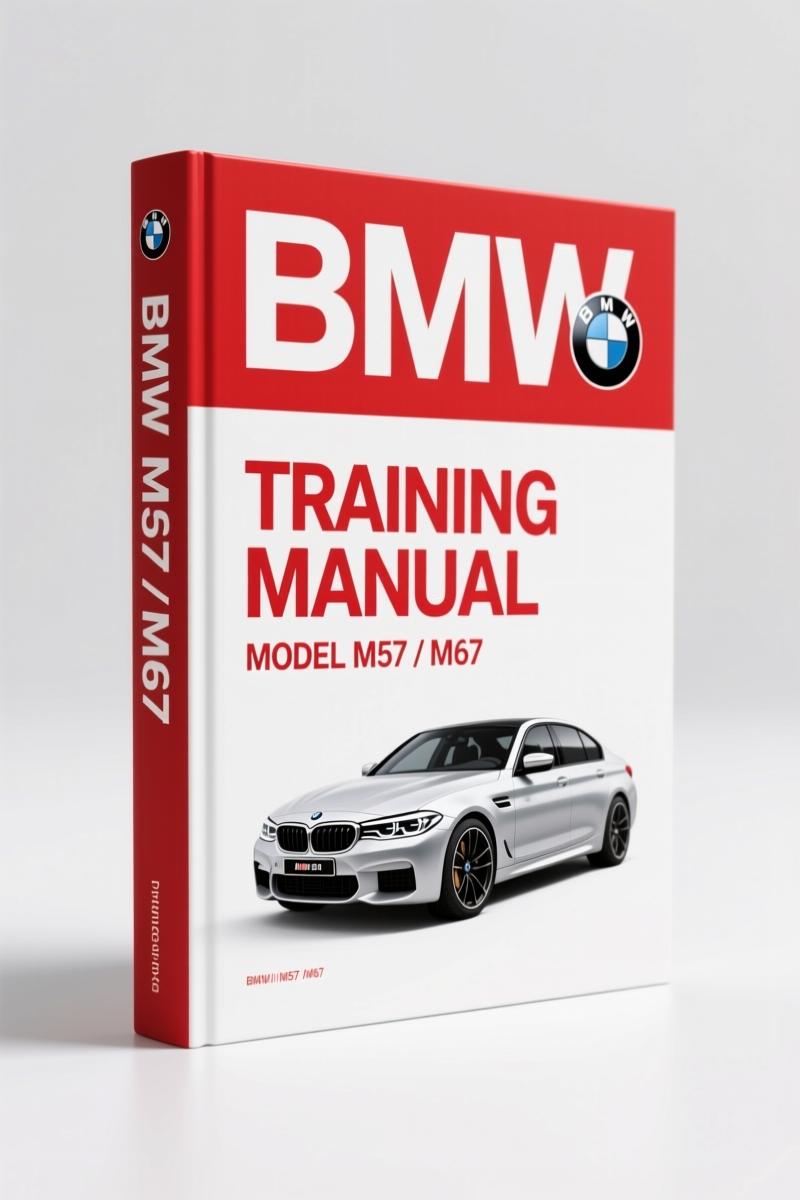
BMW M57, M67 1998 Training Manual – Factory Diesel Engine Documentation
Original price was: $42.60.$30.00Current price is: $30.00.
Factory BMW M57/M67 training manual from 1998. 64 pages covering engine components, common rail fuel system, DDE control, and emissions compliance.
Description
BMW M57, M67 1998 Training Manual – Factory Specs for Common-Rail Diesel Engines
If you are working on a BMW M57 or M67 diesel, you already know the difference between aftermarket fluff and an actual factory document. This 1998 training manual is not a reprint of some third-party rewrite. It is the original BMW Service Training material, 64 pages long, printed in September 1998, and aimed at technicians who need to understand the common-rail system from the ground up. I have been inside these engines enough times to tell you: the high-pressure fuel system will bite you if you miss a single spec. This book gives you the exact data BMW used to train their own bench techs. You want to torque the M57 cylinder head? That spec is in here. You need to know how the DDE control unit monitors rail pressure? Section 9 covers it. There is a reason I keep a dog-eared copy on my tool box.
7 Systems Covered in This 64-Page Document
This is not a general “engine overview.” The table of contents shows ten sections, starting with an introduction that covers exhaust emission legislation and test cycles. From there you get Engine components (Sec. 2), Ancillary components and belt drive (Sec. 3), Engine mounts (Sec. 4), Lubrication system (Sec. 5), Cooling system (Sec. 6), Fuel system (Sec. 7), Air intake and exhaust systems (Sec. 8), Digital Diesel Electronics (Sec. 9), and Signal output stages (Sec. 10). Want the injector description? Page 26 in the fuel system section. The manual also includes service information for both the M57 and M67, special tool lists, and DDE pin assignments in the appendix. That is seven major systems plus electrical diagnostics – all OEM.
Fuel System – Common Rail Injection Explained
Section 7 is where this manual earns its keep. It walks through the entire fuel system: tank, advance delivery pump, auxiliary delivery pump, fuel filter, inlet pressure sensor, low-pressure relief valve, high pressure pump, pressure control valve, the rail itself, rail pressure sensor, injectors, fuel heating/cooling, and the distributor unit with throttle. Then it gives you an overview of three injection systems – distributor injection (radial piston), pump nozzle, and common rail. The manual compares conventional injection characteristics with common rail and gives a summary that a first-year apprentice can follow. If you have ever chased a no-start on an M57 because the rail pressure sensor signal was erratic, you will appreciate the system structure diagrams.
Does This Manual Cover Both M57 and M67 Engines?
Yes. The full title is “M57/M67 Common Rail – Course contents/Background material.” Section 2 covers engine block details for both: the M57 uses a timing case cover, the M67 gets a rear end cover. The crankshaft, connecting rods, pistons, chain drive, oil pan – all component descriptions apply to both engines. Valve gear differences are noted. The service information section at the back includes separate repair instructions for the M57 fuel system, camshaft timing, and special tools that work on both. There is also a dedicated page for M57/M67 service information. If you are rebuilding either engine, this single training manual covers the core hardware differences.
DDE Control Unit – Diagnostics and Monitoring
Section 9 is titled “Digital Diesel Electronics” and it gives you the full system structure: analog inputs, digital inputs, frequency inputs, power output stages, switching outputs. Then Section 10 goes into signal preprocessing, injection-rate control, high pressure control, EGR, boost-pressure control, and additional functions. A technician can use this to understand why the DDE monitors rail pressure, what happens when the pressure control valve fails, and how to program the control unit after a replacement. The appendix also provides pin assignments for DDE 4.0/4.1 – handy when you are backprobing a connector and need to verify signal continuity.
Source Authenticity – Factory OEM vs. Aftermarket Repacks
I have bought aftermarket manuals that claimed to be “factory-equivalent” and ended up with torque values that were off by 15 N·m. This document is a direct scan of the original BMW Service Training booklet. The page header says “BMW AG, Service Training” and the publication date is 09/98. No guesswork. Automotive Industry Overview”>Automotive Industry Overview documentation rarely matches this level of detail. If you want a manual that mirrors what a BMW factory tech learned in training, this is it. The 64 pages are dense – no filler, no generic diagrams. Each component gets a functional description, system structure, and requirements/objectives. That is how you build a reliable repair, not by trusting a parts-store photocopy.
Valve Timing and Crankshaft Specs – Why You Need OEM Data
Section 2 covers the cylinder head, cylinder head gasket, cylinder head cover, and valve gear. The crankshaft page describes the forging and bearing journal specifications. Without factory data, you might install a camshaft at the wrong timing. The service information section includes valve timing for the M57 and a separate procedure for the M67. If you are replacing a timing chain or doing a head gasket job on a common-rail diesel, you need these numbers. The manual also lists special tools required – no more guessing which socket fits the crankshaft pulley hub.
FAQ – Two Questions About This Training Manual
- Is this manual identical to the BMW dealer workshop manual?
- No. This is a training manual, not a comprehensive workshop manual. It covers system theory, component descriptions, and diagnostic logic. It includes service information and repair instructions, but does not contain a full step-by-step for every job. For that you would want the factory repair manual. This document is designed to make you understand the engine so you can diagnose faster.
- Does it include torque specs for the cylinder head bolts?
- Yes. Page 5 of the engine components section lists the cylinder head gasket details and torque procedure.
If you have spent time with a common-rail diesel that ran rough after an injector swap, you know the value of a factory training manual. BMW X5 2002 Training Manual – EHC2 Air Suspension & 4.6is Specs”>BMW X5 2002 Training Manual – EHC2 Air Suspension & 4.6is Specs is a different document, but the same OEM quality. BMW S85B50 2004 Training Manual – OEM Specs for the V10″>BMW S85B50 2004 Training Manual – OEM Specs for the V10 and BMW N54B3000 2009 Training Manual – Factory OEM Specs for Twin-Turbo”>BMW N54B3000 2009 Training Manual – Factory OEM Specs for Twin-Turbo are also available. For the M57/M67, this is the document that will save you from chasing false diagnoses. Manual Transmission”>Manual Transmission techs will find the DDE sections relevant for engine-to-transmission communication as well. Access the Factory Manual and keep it on your tablet while you work.
Additional information
| Brand | BMW |
|---|---|
| Language | English |
4 reviews for BMW M57, M67 1998 Training Manual – Factory Diesel Engine Documentation
You may also like…
-
Sale!

BMW 525i, 530i, 535i, 540i Service Manual 1989-1995 Factory Specs
Original price was: $96.00.$60.00Current price is: $60.00. -
Sale!

BMW M3, 323i, 325i, 325xi, 328i Service Manual – 1258 Pages
Original price was: $93.00.$60.00Current price is: $60.00. -
Sale!

BMW 525i, 530i, 535i, 540i Service Manual – 459 Pages Factory Specs
Original price was: $73.20.$60.00Current price is: $60.00. -
Sale!

BMW 735i, 735iL, 740i, 740iL, 750iL Service Manual – 987 Pages
Original price was: $102.05.$65.00Current price is: $65.00.
Related products
-
Sale!

1989 Service Manual – International 2000-8000 Electrical Systems
Original price was: $72.00.$50.00Current price is: $50.00. -
Sale!

1994 Troubleshooting Manual – International 1000-4000 FBC
Original price was: $60.00.$50.00Current price is: $50.00. -
Sale!
1991 Electrical Schematic – 112-Page OEM Wiring Diagram for International 1000-3000 Series
Original price was: $22.75.$17.50Current price is: $17.50. -
Sale!
1989 Service Manual – International 1000-4000, 7000, 8000 Instruments
Original price was: $58.80.$40.00Current price is: $40.00.
Charles W. –
Perfect factory service manual. The PDF looks clean. It guided me to troubleshoot my BMW M57, electrical system. Great value for money.
workshop_guy –
This is just what I required. Instant access after payment. It guided me to repair my BMW M57, electrical system. Great value for money.
gearhead88 –
Superb resource! It is easily zoomable on my phone without blur. Every torque spec is provided for BMW M57,. Saved my weekend project! Thanks.
pro_mechanic –
I am so happy with this purchase. The file looks clean. It helped me to troubleshoot my BMW M57, transmission. Saved my repair job! Thank you.