
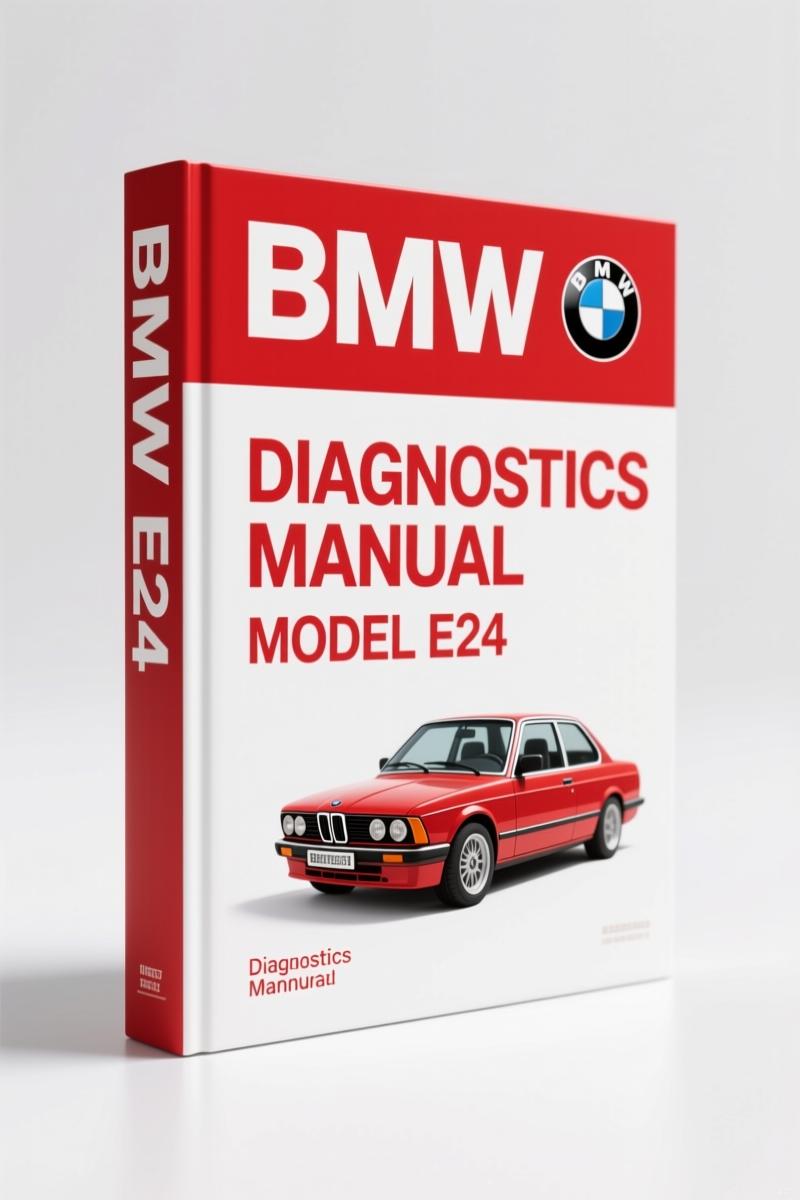
BMW E30, E24 2000 Diagnostics Manual – Factory DTC Guide
Original price was: $20.70.$15.00Current price is: $15.00.
Factory BMW diagnostics manual covering DTC retrieval for E30 and E24 models. 32 pages of official fault code data, including Motronic and SRS systems.
Description
BMW E30, E24 2000 Diagnostics Manual
If you’re chasing a check engine light on a 1989–1994 E30 or E24 and you don’t have the factory fault code breakdown, you’re working blind. I’ve seen techs swap oxygen sensors three times because they didn’t know code 1212 means the lambda sensor on bank 2 is slow to respond – not dead. That’s parts money and billable hours down the drain. This 32-page BMW E30, E24 2000 Diagnostics Manual from AutoRepairManuals gives you the actual diagnostic trouble code tables, pedal-procedure instructions, and system-specific code lists that the dealer techs used. No aftermarket compilation – this is the OEM document.
DME Control Unit Code 1211: What the Factory Says
On page 2 of the manual, code 1211 is spelled out: the DME self-test failed. The procedure is clear – clear stored codes, run the car for 30 seconds, kill the ignition for 30 seconds, rerun diagnosis. If the code comes back, replace the DME. No chasing ghosts. That level of specificity is what separates this manual from a generic OBD list. You get the exact conditions and the exact fix for each of the four-digit pedal fault codes.
Motronic ‘Pedal’ Fault Codes: The Procedure
Page 1 walks you through the pedal method: turn the ignition to run (don’t start the engine), floor the gas pedal five times. The check engine light blinks out the four-digit codes in order. The manual tells you that the ECU clears codes after 60 start cycles or if you disconnect the battery – so if you’ve been chasing a code that disappears, you’re now reading the stored history. That’s the kind of trap a DIY guy walks into on a Saturday afternoon. Don’t be that guy.
Supplemental Restraint System (Airbag) Codes
Airbag systems on these cars are finicky. The manual breaks out SRS 1, SRS 2, and SRS 3 with a special note on the E24 and E30 specific systems. If you’ve got an airbag light that won’t clear, the factory diagnostic path saves you from accidentally deploying a bag while probing wires. I’ve seen that happen. Twice. Page numbers for the SRS section are not listed in the bookmark data, but the table of contents in the PDF shows three separate SRS entries – that’s how deep this thing goes.
Electronic Transmission Codes (EGS Versions)
Automatic transmission faults on the E30 and E24 can lock you into limp mode. The manual covers EGS versions 1.XX through 9.XX, including late-model variants. If you’re getting a transmission warning, you need to know which control module version you’re dealing with. The factory code tables tell you exactly which solenoid or speed sensor is at fault. No more swapping the whole valve body.
3 Reasons to Choose OEM Documentation Over Aftermarket
First, aftermarket manuals often group codes by generic OBD-II standards – but these cars are OBD-I, and the code structure is different. Second, the aftermarket compilations I’ve seen skip the special airbag handling notes for the E24 and E30. Third, the factory manual includes the exact pedal procedure that the dealer training manuals reference. You don’t get that from a third-party reprint. If you want the real deal, start with the OEM document.
The manual is 32 pages, published in 2000, and covers all 1989–1994 BMW E30 and E24 models. It includes not just the Motronic codes but also DDE diesel engine codes (DDE 1 and DDE 2) if you happen to be working on a diesel variant. That’s rare to find in a single 32-page reference.
Need a complementary resource? Check out the BMW E30 Repair Manual for the mechanical side. For later model diagnostics, the BMW N62 Diagnostics Manual – Factory OEM Shop Specs covers V8 powertrain DTCs. And if you’re working on 2004-era BMWs with MS43 engine management, grab the BMW MS43 2004 Diagnostics Manual – Factory OEM DTC Codes & Circuit Tests.
For a broader look at automotive diagnostic standards, take a moment to read the Automotive Industry Overview. And if you want to compare how other manufacturers handle self-diagnostics, the Automotive Industry Overview provides context.
- Does this manual cover OBD-II codes?
- No. This is for OBD-I systems on 1989–1994 BMW E30/E24 vehicles. The codes are four-digit pedal fault codes, not the universal P-codes used after 1996.
- Can I use this manual for a 1995 E36?
- Not reliably. The E36 transitioned to a different Motronic version and a different diagnostic connector. This manual is specifically written for the E30 and E24 chassis with the Bosch DME 1.1 through DME 3.3.1 systems. The pedal procedure and code tables are different on the E36. Stick to the correct chassis manual.
You’ve got a car that’s throwing a code. You’ve got the factory procedure. Access the Factory Manual and get that DME code read the way Bosch intended – without second-guessing the blink pattern.
Additional information
| Brand | BMW |
|---|---|
| Language | English |
3 reviews for BMW E30, E24 2000 Diagnostics Manual – Factory DTC Guide
You may also like…
-
Sale!

BMW M3, 323i, 325i, 325xi, 328i Service Manual – 1258 Pages
Original price was: $93.00.$60.00Current price is: $60.00. -
Sale!

BMW 525i, 530i, 535i, 540i Service Manual – 459 Pages Factory Specs
Original price was: $73.20.$60.00Current price is: $60.00. -
Sale!

BMW 525i, 530i, 535i, 540i Service Manual 1989-1995 Factory Specs
Original price was: $96.00.$60.00Current price is: $60.00. -
Sale!

BMW 735i, 735iL, 740i, 740iL, 750iL Service Manual – 987 Pages
Original price was: $102.05.$65.00Current price is: $65.00.
Related products
-
Sale!

1994 Troubleshooting Manual – International 1000-4000 FBC
Original price was: $60.00.$50.00Current price is: $50.00. -
Sale!

2005 Parts Catalog – International NGD 3.0 L Engine (77 pages)
Original price was: $44.70.$30.00Current price is: $30.00. -
Sale!

Acura Integra 1998 Service Manual – 1891 Pages Factory OEM Documentation
Original price was: $31.75.$25.00Current price is: $25.00. -
Sale!
Acura NSX 1991 Service Manual – 1420 Pages OEM
Original price was: $102.05.$65.00Current price is: $65.00.
pro_mechanic –
This is exactly what I required. It is very easy to read on my tablet without blur. Every spec sheet is provided for BMW E30,. Saved my weekend project! Thanks.
John S. –
Perfect workshop guide. Immediate link after checkout process. Every torque spec is provided for BMW E30,. I will recommend this shop to others.
Michael T. –
Highly recommended! The PDF is high resolution. Every spec sheet is included for BMW E30,. I will definitely buy again.