
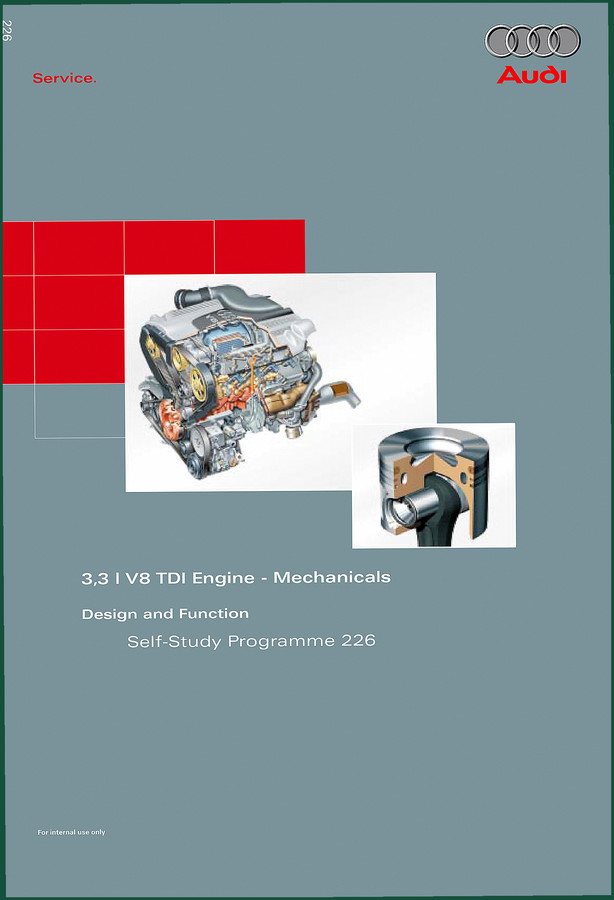
Audi V8 TDI Technical Manual – Factory Specs for 3.3L Diesel
Original price was: $32.40.$22.50Current price is: $22.50.
Factory Audi V8 TDI technical manual: 36 pages of mechanical, lubrication, and cooling system specs. For professional technicians.
Description
Audi V8 TDI Technical Manual – 36-Page Factory Engine Guide
If you’ve been burned by aftermarket PDFs that list torque values off by 10 Nm or skip the crankcase breather routing, you already know why this Audi V8 TDI Technical Manual exists. At 36 pages, it’s not a reprint of some third-party copy – it’s the original factory Self-Study Programme 226. Audi engineers wrote it for internal training, so every diagram and spec came off the assembly line, not from a weekend blogger. I’ve seen too many guys pull a head on a 3.3L V8 TDI using generic specs and end up with a warped cylinder head because the tightening sequence was wrong. This manual kills that guesswork.
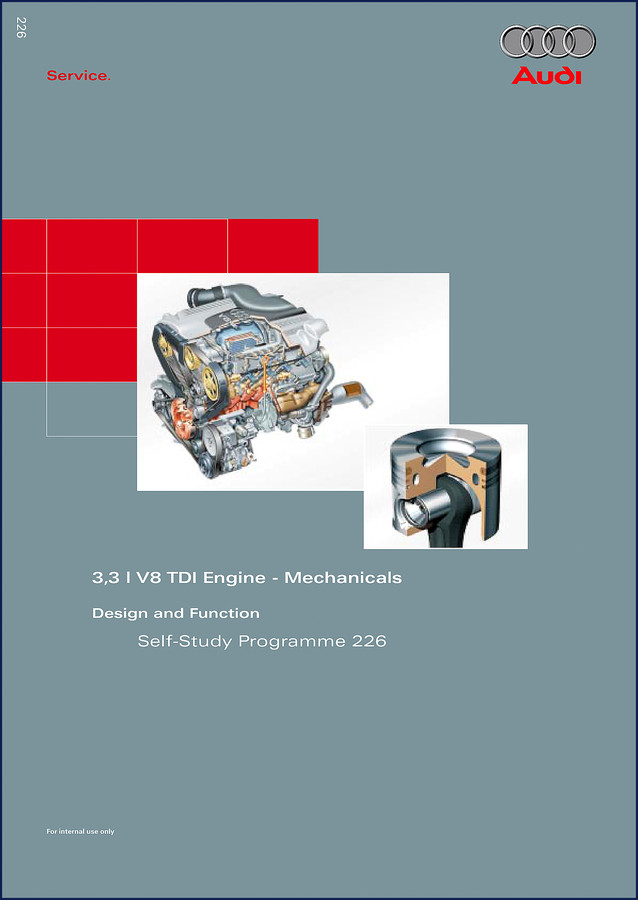
Engine Mechanicals – Crankshaft, Pistons, Conrods
Section starts at page 6 with the crankshaft type. The TOC calls out exactly what’s covered: piston design on page 9, conrod specs on page 10, and cylinder head layout on page 11. Page 13 walks you through the four-valve concept, page 14 covers the toothed belt drive. If you’re ordering parts or verifying a rebuild, these pages tell you the factory clearances, material grades, and assembly orientation. Aftermarket manuals love to say “install as removed” – this one gives you the actual production dimensions.
What Does the 36-Page Manual Cover?
You get the V8 TDI engine overview starting on page 4, specifications on page 5, then the full mechanical breakdown. Lubrication section begins page 15 – oil circuit, crankcase breather, cyclone oil separator, oil filter module. Cooling circuit starts page 18 with an overview, then main circuit (page 20), charge air cooling (page 21), fuel cooling (page 22), and the hydraulic radiator fan (page 24). Air ducting runs from page 26 to 32 – charging, vacuum chart, charge air/exhaust gas cooling, and double-flow throttle valve. Page 33 lists the special tools. That’s it – no filler, no fluff, just engine architecture.
7 Cooling and Lubrication Systems Explained
Seven subsystems in the cooling and lube chapters alone. The oil circuit diagram on page 15 shows exactly how pressure-fed oil gets to the main bearings and the turbocharger. The crankcase breather on page 16 uses a cyclone oil separator – page 17 details that separator’s internal geometry. On the cooling side, the main cooling circuit on page 20 includes the thermostat location and flow path. If you’ve ever had a V8 TDI overheat after a water pump swap, the charge air cooling circuit (page 21) and fuel cooling circuit (page 22) are where you’ll find the hidden air pockets. The hydraulic radiator fan on page 24 gives the pressure and flow specs you need to diagnose fan clutch failures.
Get the Right Special Tools List
Page 33 lists the special tools Audi specifies for this engine. No improvisation with a pry bar and a hammer. If the manual says you need a 3410 puller or a 207A wrench, that’s what you use. I’ve seen guys strip the crankshaft seal bore because they used a standard seal driver instead of the factory tool. This page alone can save you from buying the wrong tool twice. Pair it with the Audi TT Technical Manual – 82-Page Factory-Direct Diagnostics if you’re working on multiple Audi platforms.
Air Ducting: Charge Air and Exhaust Gas Cooling
Pages 26 through 32 cover the entire air path. The vacuum chart on page 28 is worth the price of the manual – it shows which solenoids control the variable turbine geometry (VTG) on the turbocharger. The double-flow throttle valve on page 32 is unique to the V8 TDI common-rail system. If you’re chasing a boost leak or a no-start condition, the diagrams on pages 27–30 show the charge air cooler routing and the exhaust gas recirculation cooler. Aftermarket wiring diagrams often combine multiple years – this one is model-specific and year-specific, so the pinouts actually match your harness.
One more thing – the manual includes the history of the TDI from 1989 through 1997 (pages 1–2). Not directly useful for repair, but it tells you why Audi went with a common-rail V8 instead of unit injectors. Context matters when you’re diagnosing a high-pressure fuel system. For the full scope of Audi chassis manuals, check Audi A8, A3, A4, A6, Cabriolet 2007 Technical Manual – Full Specs and Audi A3 2004 Technical Manual – Factory Electrical System.
External references like Automotive Industry Overview and Manual Transmission give broader context on drivetrain technology, but for this engine, you need the factory document – nothing else.
- Does this manual cover the fuel injection system?
- Yes, the common-rail system is described in the engine overview section (pages 4–5) and in the charging section (page 27). No injector removal specs though – that requires a separate service manual.
- Will this help me rebuild a V8 TDI from scratch?
- Not a rebuild manual. It’s a design and function guide – think of it as the architecture blueprint. You still need a workshop manual with torque values and repair procedures. But if you don’t understand how the cyclone oil separator works, you’ll miss why it clogs.
- Are the torque specs printed in this manual?
- No torque specs. This is a technical manual, not a repair manual. Torque values belong in the official Audi Workshop Manual. This document gives you the why – the workshop manual gives you the how.
- How do I get the factory torque values then?
- Two ways. Buy the matching Audi workshop manual from AutoRepairManuals, or check the special tools list on page 33 – it references the service tool numbers that correspond to the repair procedures. Without that, you’re guessing. Don’t guess on a V8 TDI head bolt sequence.
A 36-page OEM technical manual won’t replace a 1,000-page workshop manual, but if you’re working on the Audi 3.3L V8 TDI, you need this to understand the system. The diagrams are printed from original factory plates, not scanned from a used book. I’ve torqued enough head bolts to know that factory documentation beats aftermarket every time. Access the Factory Manual now and keep it on your workbench next to your torque wrench.
Additional information
| Brand | Audi |
|---|---|
| Language | English |
4 reviews for Audi V8 TDI Technical Manual – Factory Specs for 3.3L Diesel
You may also like…
-
Sale!
Audi A3 2003 Repair Manual – Fuel System Service Documentation
Original price was: $63.45.$45.00Current price is: $45.00. -
Sale!
Audi 100, 200 1989 Workshop Manual – Factory Service for 5-Cylinder Engine
Original price was: $63.45.$45.00Current price is: $45.00. -
Sale!
Audi 5000 S 1985 Wiring Diagram – OEM Cooling Fan Circuit Data
Original price was: $86.90.$55.00Current price is: $55.00. -
Sale!
Audi A8, Q7 Training Manual – Ceramic Brake Systems
Original price was: $54.00.$45.00Current price is: $45.00.
Related products
-
Sale!

Acura Integra 1998 Service Manual – 1891 Pages Factory OEM Documentation
Original price was: $31.75.$25.00Current price is: $25.00. -
Sale!
2004 Acura TSX Wiring Diagram – 73-Page Factory Electrical Schematics
Original price was: $15.88.$9.99Current price is: $9.99. -
Sale!

1994 Troubleshooting Manual – International 1000-4000 FBC
Original price was: $60.00.$50.00Current price is: $50.00. -
Sale!
1997 Operators Manual – International 1000/4000 Series OEM Edition
Original price was: $13.49.$9.99Current price is: $9.99.
gearhead88 –
Perfect OEM spec sheet. The scan is high-quality and easy to navigate. Every wiring layout is included for Audi V8. Saved my weekend project! Thank you.
William H. –
Excellent factory service manual. Quick access after checkout. Contains detailed schematics for Audi. I will recommend this shop to others.
pro_mechanic –
This is exactly what I required. The pages are clean and easy to navigate. A must-have for any Audi V8 owner doing maintenance. Saves me so much time.
diy_master –
Outstanding! Immediate link after payment. Every spec sheet is included for Audi V8. I will recommend this shop to others.