
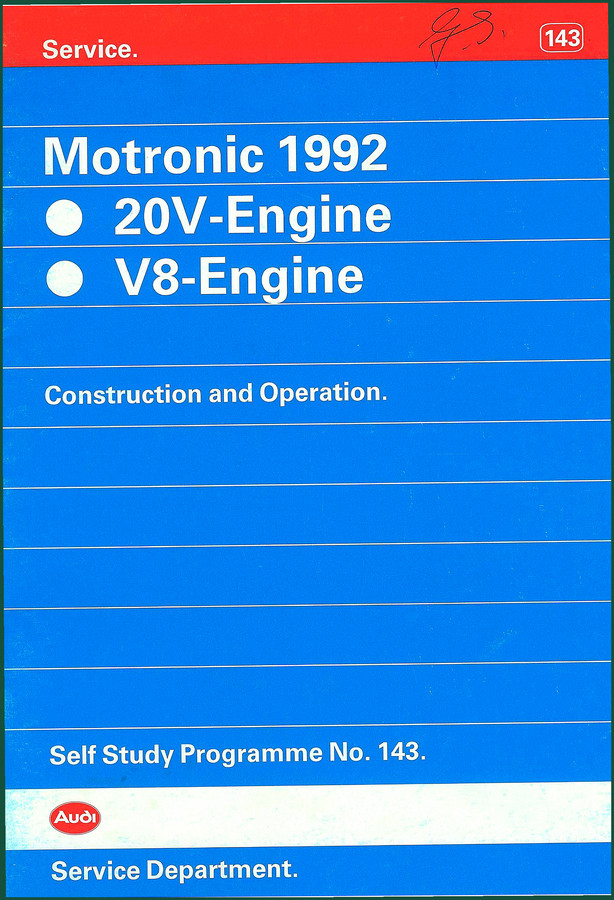
Audi V8, 20V 1992 Technical Manual – Factory Specs & Diagrams
Original price was: $30.38.$22.50Current price is: $22.50.
1992 factory technical manual for Audi V8 20V engines. 80 pages of Motronic system surveys, functional diagrams, and diagnostic protocols.
Description
Audi V8, 20V 1992 Technical Manual
If you’ve ever wasted billable hours chasing a Motronic ghost on a 1992 Audi 20V or V8, you know the difference between a factory schematic and some aftermarket scan. This Audi V8, 20V 1992 Technical Manual – Self-Study Programme No. 143 – is the exact binder Audi Service used to train technicians. No reprints, no third-party condensation. 80 pages of pure OEM engineering documentation.
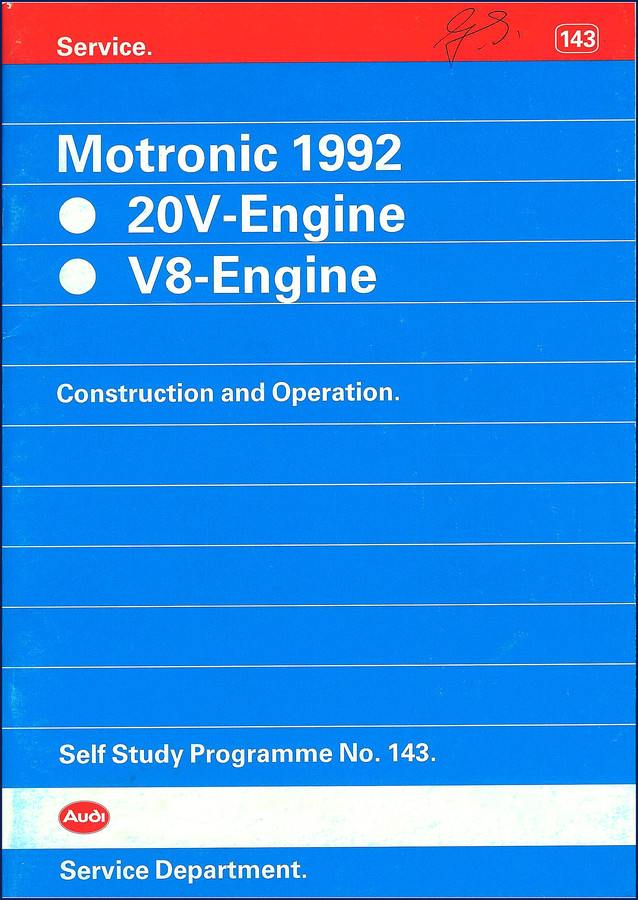
Engine Survey: 20V AAN and V8 ABH
Opens with a full system survey for both engines. The 20V AAN is a 2.226 L (135.8 cu in) five-cylinder turbocharged inline, producing 169 kW (230 HP) at 5900 rpm and 350 N·m (258 lb-ft) of torque as low as 1950 rpm. Compression ratio 9.3:1. Charge pressure max 1.15 bar (16.7 psi). The V8 ABH – 3.6 L, later 4.2 L – uses the same Motronic architecture with different sensor sets. Page 8 lays out the component locations for the 20V; page 27 for the V8. Both are cross-referenced so you don’t mix up harness pins.
Motronic M 2.3.2 vs M 2.4.1 — What Changed?
The old Motronic versions (M 2.3 for 20V, M 2.4 for V8) were superseded in 1992. This manual documents the new M 2.3.2 and M 2.4.1 systems. Key differences: revised power supply circuit (page 24 for 20V, page 30 for V8), a holding relay inside the control unit, and expanded self-diagnosis capability. The functional diagrams on pages 25 and 37 are lifesavers when tracing a no-start or intermittent stall. Anyone trying to use an older manual for a ’92 model will miss these updates.
7 Systems Covered in 80 Pages
This isn’t a fluff overview. The table of contents hits: System Survey, Location of Components, Actuators/Systems, Crankcase Ventilation (20V only, page 14 – critical for oil leaks on the AAN), Power Supply, Functional Diagrams, Sensors (V8 page 39), Additional Signals, Holding Relay, Self-Diagnosis, and a Reference List. Seven distinct subsystems per engine, each with factory wiring colors and pin numbers. You get the crankcase ventilation routing that aftermarket manuals always skip.
Self-Diagnosis Procedure on Page 63
Page 63 walks you through the Motronic self-diagnosis mode – how to trigger fault codes, interpret flashes, and clear them. This is the factory workflow, not a generic OBD-I cheat sheet. Combined with the sensor descriptions on page 39, you can isolate a bad MAF or knock sensor without swapping parts. For electrical troubleshooting, the holding relay operation (page 58) explains why the control unit stays powered for a few seconds after key-off – a common cause of drain complaints.
Get the Right Torque Data from Page 8
Need the charge pressure spec? Page 8 gives it in bar and psi (max 1.15 bar / 16.7 psi). The performance diagram on page 5 shows the torque curve. While this manual doesn’t list every fastener torque, it provides the system parameters required to set up boost and fuel pressure correctly. Pair it with a factory repair manual for bolt specs. The Automotive Industry Overview notes that OEM self-study programmes fill the gap between theory and actual repair.
Factory documentation means you’re not guessing about wire colors or component locations. The Manual Transmission section in the V8 portion references the transmission control interface – important if you’re swapping a manual into a car that came automatic.
Audience Fit: Who Needs This on the Bench?
DIY mechanics tackling engine swaps or chasing Motronic gremlins on an Audi V8 or 20V. Shop owners who want their techs to stop guessing and start using OEM diagnostics. Beginners? Not the primary audience – this is a technical manual written for people who already know how to use a multimeter and scan tool. If you’re new, buy it anyway and study it alongside a repair manual. You’ll learn why the system behaves the way it does.
Source Validity – Why OEM Beats Aftermarket
This is a direct scan of the original Audi Self-Study Programme No. 143, released by Audi Service Department in 1992. It’s not a copy-paste from a third-party website. The page numbers, diagrams, and flowcharts match the binder that cost Audi technicians hundreds of dollars. Aftermarket documentation often omits the holding relay logic or mislabels the crankcase vent lines. Here, every actuator on page 12 (20V) and page 28 (V8) is listed with its function and electrical test points.
Related factory manuals that complement this one:
- Audi V8-5V Engine Construction Features Training Manual – for later five-valve heads
- Audi V8 4.2 5V Engine Technical Manual – covers the 32-valve ABZ engine
- Audi TT Technical Manual – 82-Page Factory-Direct Diagnostics – if you work on modern Audis
- Does this manual cover the V8 engine with 3.6L displacement?
- Yes. The V8 section specifies that all information for the 4.2L also applies to the 3.6L as of 1992 models. Page 27 starts the V8 system survey.
- What about the turbocharger system?
- No.
- Is this a factory original manual?
- It is a digital copy of the original Audi Self-Study Programme No. 143, printed by Audi Service. Not a third-party rewrite. The page numbers, torque specs, and wiring diagrams are identical to the binder that Audi issued to its own technicians in 1992.
- Can I use this to diagnose Motronic faults on a 20V engine?
- Yes. The self-diagnosis section on page 63 gives the factory procedure for reading fault codes and interpreting flash patterns. Combined with the sensor data on page 10 (component locations) and the functional diagram on page 25, you can diagnose most Motronic M 2.3.2 issues without a factory scan tool.
That 80-page PDF sits on your tablet or laptop, searchable, printable, and ready to save you from guesswork. When you need to understand why the V8 holding relay kills the battery, or how the 20V crankcase ventilation ties into boost pressure, this is the document that answers it. Access the Factory Manual now and keep it on the bench next to your multimeter.
Additional information
| Brand | Audi |
|---|---|
| Language | English |
2 reviews for Audi V8, 20V 1992 Technical Manual – Factory Specs & Diagrams
You may also like…
-
Sale!

Audi A8, Q7 Training Manual – Ceramic Brake Systems
Original price was: $54.00.$45.00Current price is: $45.00. -
Sale!

Audi 100, 200 1989 Workshop Manual – Factory Service for 5-Cylinder Engine
Original price was: $63.45.$45.00Current price is: $45.00. -
Sale!
Audi 5000 S 1985 Wiring Diagram – OEM Cooling Fan Circuit Data
Original price was: $86.90.$55.00Current price is: $55.00. -
Sale!
Audi A3 2003 Repair Manual – Fuel System Service Documentation
Original price was: $63.45.$45.00Current price is: $45.00.
Related products
-
Sale!

1991 Operators Manual – International Truck OEM Specs (108 Pages)
Original price was: $13.63.$10.99Current price is: $10.99. -
Sale!

1992 Electrical Schematic – International 1000/3000/4000/2554 OEM Wiring Diagrams (132 Pages)
Original price was: $26.40.$20.00Current price is: $20.00. -
Sale!
1993 Operators Manual – International Bus 1000-3000 OEM Specs
Original price was: $12.30.$7.99Current price is: $7.99. -
Sale!
2004 Acura TSX Wiring Diagram – 73-Page Factory Electrical Schematics
Original price was: $15.88.$9.99Current price is: $9.99.
John S. –
Excellent quality! It is easily zoomable on my laptop without losing quality. It helped me to troubleshoot my Audi V8, transmission. Saves me hundreds of money.
Richard G. –
Highly recommended! It is easily zoomable on my iPad without losing quality. Contains detailed schematics for Audi. Saves me a lot of money.