
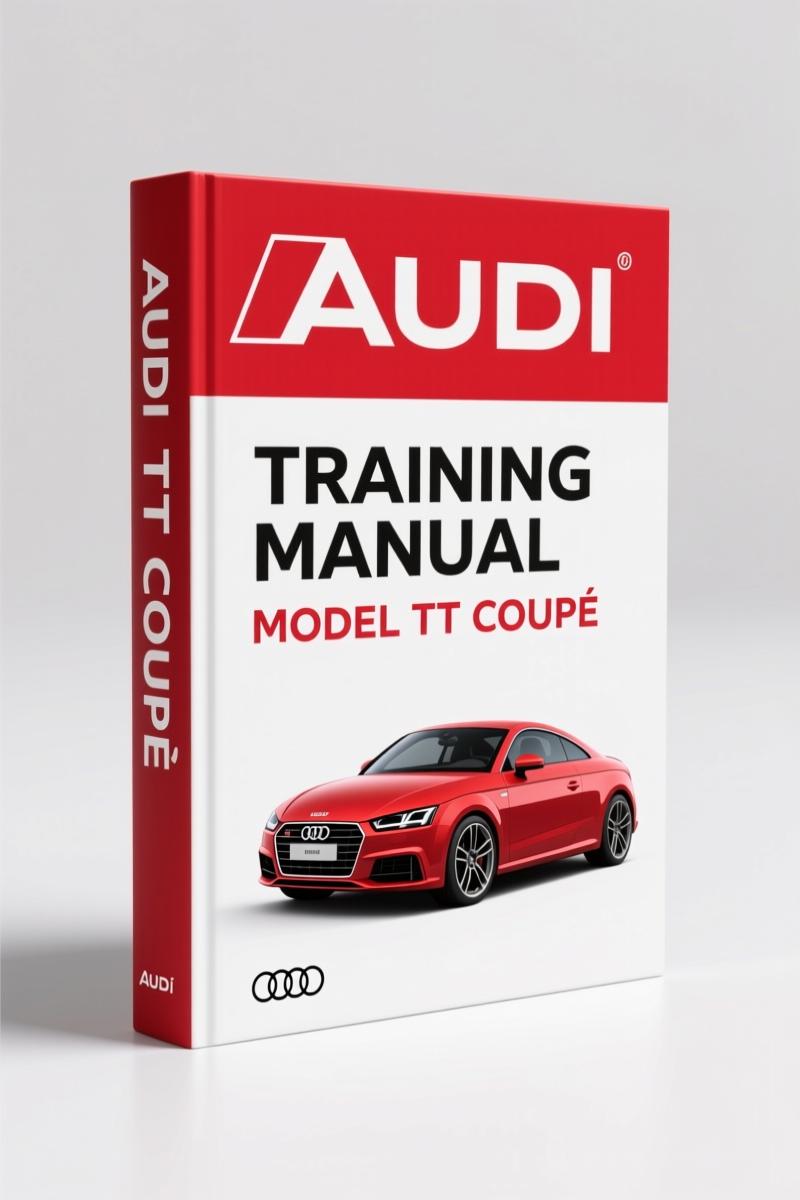
Audi TT Coupé Training Manual – Factory Body Structure & Repair Guide
Original price was: $45.00.$30.00Current price is: $30.00.
Factory training manual for Audi TT Coupé body structure: 32 pages on ASF joining techniques, repair concepts, and crash safety.
Description
Audi TT Coupé Training Manual – 32 Pages of OEM Body Structure & Joining Tech
If you are planning to cut into an aluminum-steel space frame without the right sequence, you are asking for trouble. The Audi TT Coupé Training Manual is a 32-page document that Audi’s own service network uses to understand how this body goes together and comes apart. It is not a repair manual—read the note on page 3 of the original PDF—but without it you will guess which joint requires MIG versus laser welding, and guessing costs you time and a customer’s car.
Every shop that touches European cars should have this on the bench next to the specific workshop manual. Why? Because the Audi TT Coupé uses a hybrid aluminum-and-steel Space Frame (ASF) that behaves nothing like a conventional unibody. The training manual explains the exact joining techniques, the corrosion protection between dissimilar metals, and the repair concept for each material zone. I have seen techs burn through an aluminum panel with the wrong weld setting because they did not have this background. Don’t be that guy.
Audi Space Frame ASF: Why This Manual Matters
Page 4 starts with dimensions, then page 5 dives into the technological concept. The TT Coupé body uses an ASF that weighs 48% less than an all-steel equivalent. That weight saving comes from mixing materials, and every joint requires a specific process. The manual walks you through the combination of steel and aluminum (page 7) and how to avoid contact corrosion. If you skip the corrosion section, you will be redoing repair panels inside two years.
7 Joining Techniques Detailed in 32 Pages
This training manual covers punch riveting (page 13), clinching (page 13), MIG welding (page 14), resistance spot welding and MAG welding (page 14), structural bonding (page 15), and two newer methods: solid punch riveting (Kerb-Konus) on page 16 and Flow Drill screwing on page 17. Aluminum laser welding gets its own spread on page 18. Each technique comes with application diagrams and the tooling required. For a shop that does collision repair or structural work, this is the difference between a repair that holds and one that fails an insurance inspection.
Repair Concepts for Aluminium, Steel, and Mixed Materials
The manual splits repairs into three categories: aluminium repairs (page 20), steel repairs (page 22), and aluminium-steel repairs (page 23). That last category is where most DIYers and even some pros get it wrong. You cannot treat a mixed joint the same as a single-material joint. The manual explains the separation layers, the welding sequence, and when you must use structural bonding instead of welding. Page 26 covers head-on collision, side impact, and rear collision load paths—critical knowledge if you are reconstructing a crash-damaged TT.
Workshop Equipment and Qualification Requirements
Page 24 lists the workshop equipment needed for proper repairs. Page 25 covers qualification of aluminium—meaning the temper condition after welding and how to avoid heat-affected zone cracking. This is not generic advice; it is specific to the Audi TT Coupé. If your shop lacks the correct rivet guns or laser welder, the manual tells you what alternatives are approved. I have seen people try to MIG-weld a Flow Drill joint and wonder why it cracks. Read page 17 first.
Source Validity: OEM Training vs Aftermarket Documentation
I have seen aftermarket “body repair manuals” that list generic torque values and ignore the Audi-specific joining sequence. This document is an original Audi Self-Study Programme (SSP 383). It was written by the engineers who designed the ASF. You will not find this level of detail in a Haynes or Chilton that covers 20 different models. Aftermarket docs also skip the electromechanical rear spoiler operation (page 28) and pedestrian safety features (page 28). Those systems affect how you remove and install panels. Ignore them at your own risk.
For related factory documents, check the Audi TT Coupé ’07 Self-Study Programme 380 Manual”>, the Audi A3, TT Roadster, TT Coupé, S3 Training Manual – 52 Pages”>, and the Audi multitronic 01J Training Manual – CVT Design & Function (100 Pages)”>. For a broader perspective on automotive manufacturing, see the Automotive Industry Overview”> and the Manual Transmission”> resources.
Frequently Asked Questions
- Can I use this training manual alone to repair my Audi TT Coupé?
- No. This is a self-study programme, not a workshop manual. You need the factory repair manual for torque specs, wiring diagrams, and step-by-step procedures. Use this manual to understand the body structure and joining methods before you pick up a tool.
- Is this manual still relevant for later model years?
- The 2007 TT Coupé ASF design formed the basis for many subsequent Audi models. The joining techniques (Kerb-Konus riveting, Flow Drill screwing, laser welding) are still used in current production. Yes, it is still relevant.
Stop relying on YouTube guesses and aftermarket summaries. Access the Factory Manual from AutoRepairManuals and get the real training material Audi gives its own technicians. Your TT and your customers deserve that accuracy.
Additional information
| Brand | Audi |
|---|---|
| Language | English |
4 reviews for Audi TT Coupé Training Manual – Factory Body Structure & Repair Guide
You may also like…
-
Sale!
Audi A8, Q7 Training Manual – Ceramic Brake Systems
Original price was: $54.00.$45.00Current price is: $45.00. -
Sale!
Audi 100, 200 1989 Workshop Manual – Factory Service for 5-Cylinder Engine
Original price was: $63.45.$45.00Current price is: $45.00. -
Sale!
Audi 5000 S 1985 Wiring Diagram – OEM Cooling Fan Circuit Data
Original price was: $86.90.$55.00Current price is: $55.00. -
Sale!
Audi A3 2003 Repair Manual – Fuel System Service Documentation
Original price was: $63.45.$45.00Current price is: $45.00.
Related products
-
Sale!

1991 Operators Manual – International Truck OEM Specs (108 Pages)
Original price was: $13.63.$10.99Current price is: $10.99. -
Sale!

Technical Manual – International 6.0L Power Stroke FICM Diagnostics
Original price was: $29.80.$20.00Current price is: $20.00. -
Sale!

Acura Integra 1998 Service Manual – 1891 Pages Factory OEM Documentation
Original price was: $31.75.$25.00Current price is: $25.00. -
Sale!

1989 Service Manual – International 2000-8000 Electrical Systems
Original price was: $72.00.$50.00Current price is: $50.00.
gearhead88 –
Five stars! The file quality is excellent. It helped me to troubleshoot my Audi TT engine. Worth every penny.
workshop_guy –
Highly recommended! The scan is high-quality and easy to navigate. Every spec sheet is included for Audi TT. Saves me a lot of money.
David K. –
This is exactly what I required. The text is searchable and easy to navigate. It guided me to repair my Audi TT engine. Saves me so much time.
Richard G. –
I am extremely satisfied with this manual. The document quality is excellent. Contains detailed schematics for Audi. Saves me a lot of money.