
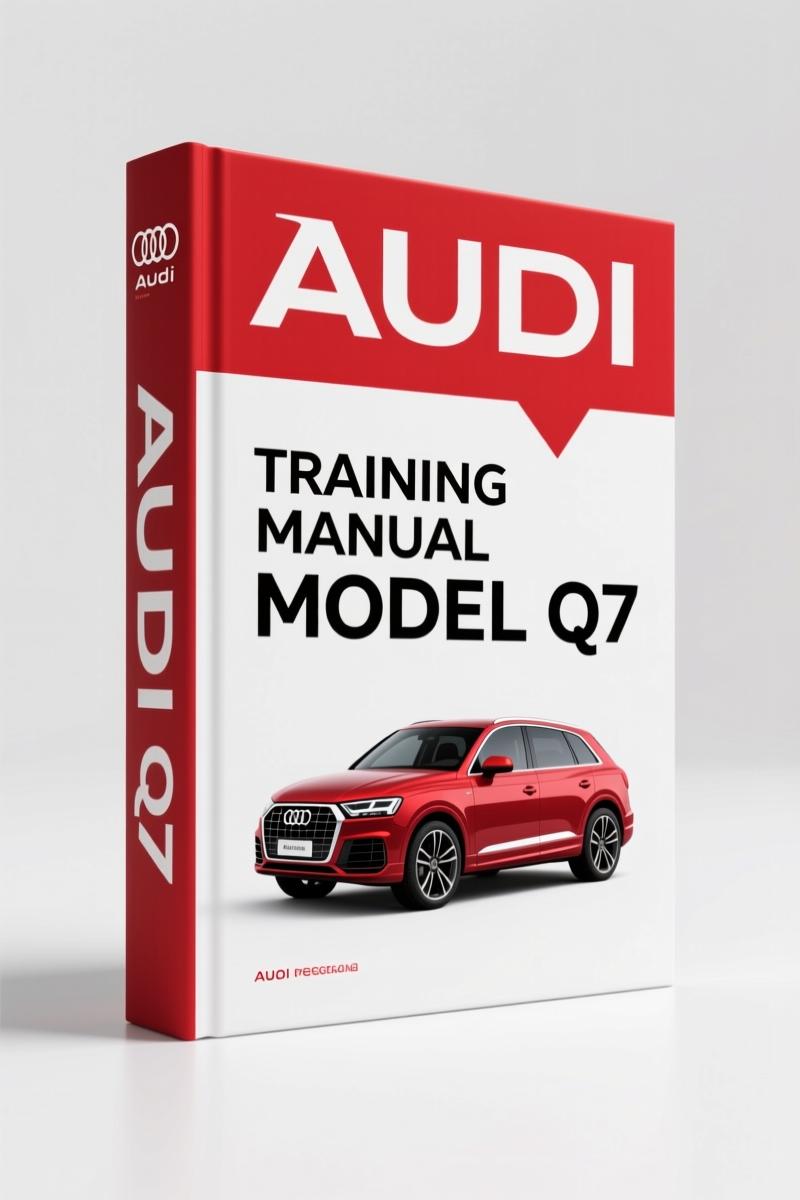
Audi Q7 Training Manual – Factory Self-Study Programme 362
Original price was: $39.90.$30.00Current price is: $30.00.
Audi Q7 Training Manual (48 pages) – running gear, brakes, air suspension, and service procedures from the factory Self-Study Programme.
Description
Audi Q7 Training Manual – This Is What Factory Knowledge Looks Like
If you’ve ever tried to diagnose an adaptive air suspension fault on a Q7 using a generic aftermarket PDF, you already know the pain. The wiring colors don’t match, the valve block orientation is reversed, and the ride-height specs are off by a half-inch. That’s why I keep a copy of this Audi Q7 Training Manual on the bench. It’s 48 pages of Audi’s own Self-Study Programme 362, written for techs by the engineers who designed the running gear. Not a workshop manual, yeah – the inside cover says that. But if you want to understand how the active brake servo talks to the ESP, or why the foot-operated handbrake actuator behaves the way it does, this thing is worth its weight in ARP hardware.
Front Axle and Rear Suspension – Factory Layout
The manual starts with the front axle (page 5) and rear suspension (page 6). You get exploded views of the control arms, subframe mounts, and the twin-tube shock layout. Steel-spring and adaptive air suspension both covered. If you’re pulling a front knuckle on a Q7, the geometry callouts tell you exactly where the alignment shims go. Aftermarket manuals often skip the rear suspension toe-links – this one doesn’t. It shows the full multilink arrangement with bushing orientation arrows. That alone has saved me from pressing a bushing in backward on a Saturday rush job.
Brake System – Foot-Operated Handbrake and Active Brake Servo
Section three (page 7) covers the brake system, with two subsections I use constantly: the foot-operated handbrake (page 8) and the active brake servo (page 12). The handbrake mechanism on the Q7 is a cable-driven drum-in-hat setup, and the adjuster can seize if you don’t lube the pivot. The manual calls out the exact pawl engagement angle. For the active brake servo, it explains the vacuum vs. electric assist transition – critical when you’re diagnosing a hard pedal after a battery disconnect. Brake caliper piston retraction specs are implied in the drawings; you’ll need the workshop manual for actual torque values, but the system concept here is spot-on.
ESP and Steering – 7 Systems Covered in One Section
The ESP overview (page 4) is brief – this is a training doc, not a diagnostic flowchart. But the Steering / wheels and tyres chapter (page 17) packs in more than most service manuals. It covers system components (page 24) and service work (page 26). Page 26 is the one I tab: tie-rod removal procedure, rack centering marks, and the torque sequence for the steering gear mounting bolts. You won’t find that in a Chilton. The manual also lists the tyre pressure monitoring system – wheel sensors and reset procedure. If you need the Automotive Industry Overview context for Q7 chassis evolution, this manual fits into the larger trend of air-suspension integration in SUVs.
Adaptive Air Suspension (AAS) – Control Response and Ride Heights
The adaptive air suspension chapter (page 27) is the reason most techs buy this manual. It walks through the system components (page 32), vehicle ride heights and modes (page 38), control response (page 41), and operation and displays (page 42). Service work on page 47 covers manual deflation and fill procedures for the air springs. I’ve used that page to avoid blowing a bag when replacing a strut. The manual also explains the compressor duty cycle and the exhaust valve operation. If you’ve ever had the “AAS malfunction” light pop up after a lift, check the pressure lines – the manual shows the routing. For related chassis-electronics info, see the Audi Q7 Electrical System Self-Study Programme 364.
Who Needs This Manual?
This is for the home garage guy who owns a Q7 and wants to understand what the suspension is doing before he tears into it. Also for the independent shop that sees these trucks regularly – the adaptive air diagnosis alone can bill four hours if you go in blind. The manual won’t give you torque specs for every nut (that’s what the repair manual is for), but it will show you the system logic so you don’t swap a compressor when the problem is a stuck relay. If you’re working on the transmission or engine, grab Audi Q7 Self-study programme 375 Training Manual. For broader model coverage, Audi Q7 Self-study programme Training Manual series is worth bookmarking.
Source Validity – OEM vs. Aftermarket
This is a direct factory file from Audi Service Training. No third-party reprint, no editorial cuts. The diagrams are vector-quality line art that match what you’ll find in ELSA. Every component callout uses Audi part-number prefixes. Compare that to aftermarket manuals that redraw the suspension layout from a photograph – you’ll get mirror-image errors. The only downside: it’s a Self-Study Programme, meaning it explains system function, not repair steps. For actual disassembly, you need the workshop manual. But if you want to know why the Suspension drops to low-level after 10 minutes of driving, this tells you the control response criteria. That’s knowledge you can’t get from a torque chart.
FAQ
- Can I use this manual to replace a Q7 air spring?
- Not directly – it lacks step-by-step removal instructions. But it shows the spring layout, pressure lines, and control module location, which saves you hunting for components. For actual replacement steps, pair it with the factory workshop manual.
- What about torque specs for the suspension bolts?
- This manual does not list torque values. It is a training document covering system design and function. For torque specs, you need the official Audi workshop manual – that’s a different file. The value here is understanding why the suspension behaves as it does, not the nut-turning numbers.
The Audi Q7 running gear is not something you want to guess on – especially the adaptive air suspension and the active brake servo. This training manual gives you the engineering logic that aftermarket docs skip. Access the Factory Manual and keep it on your tablet when you’re under the lift. You’ll save time on diagnostics and avoid bending parts because you didn’t understand the system sequence. For transmission theory, check Manual Transmission resources – but for the chassis, this is your starting point.
Additional information
| Brand | Audi |
|---|---|
| Language | English |
2 reviews for Audi Q7 Training Manual – Factory Self-Study Programme 362
You may also like…
-
Sale!
Audi 5000 S 1985 Wiring Diagram – OEM Cooling Fan Circuit Data
Original price was: $86.90.$55.00Current price is: $55.00. -
Sale!
Audi A3 2003 Repair Manual – Fuel System Service Documentation
Original price was: $63.45.$45.00Current price is: $45.00. -
Sale!
Audi 100, 200 1989 Workshop Manual – Factory Service for 5-Cylinder Engine
Original price was: $63.45.$45.00Current price is: $45.00. -
Sale!
Audi A8, Q7 Training Manual – Ceramic Brake Systems
Original price was: $54.00.$45.00Current price is: $45.00.
Related products
-
Sale!

Technical Manual – International 6.0L Power Stroke FICM Diagnostics
Original price was: $29.80.$20.00Current price is: $20.00. -
Sale!

2006 Service Manual – International DT 466E, 530E Diesel Engine
Original price was: $67.50.$50.00Current price is: $50.00. -
Sale!

2011 Parts Catalog – International Truck OE Parts Documentation (1786 Pages)
Original price was: $34.50.$25.00Current price is: $25.00. -
Sale!
2004 Acura TSX Wiring Diagram – 73-Page Factory Electrical Schematics
Original price was: $15.88.$9.99Current price is: $9.99.
Charles W. –
I am extremely satisfied with this manual. The file is very clear. It helped me to rebuild my Audi Q7 engine. Great value for money.
Richard G. –
This is just what I was looking for. Immediate link after checkout process. Every wiring layout is provided for Audi Q7. I will recommend this shop to others.