
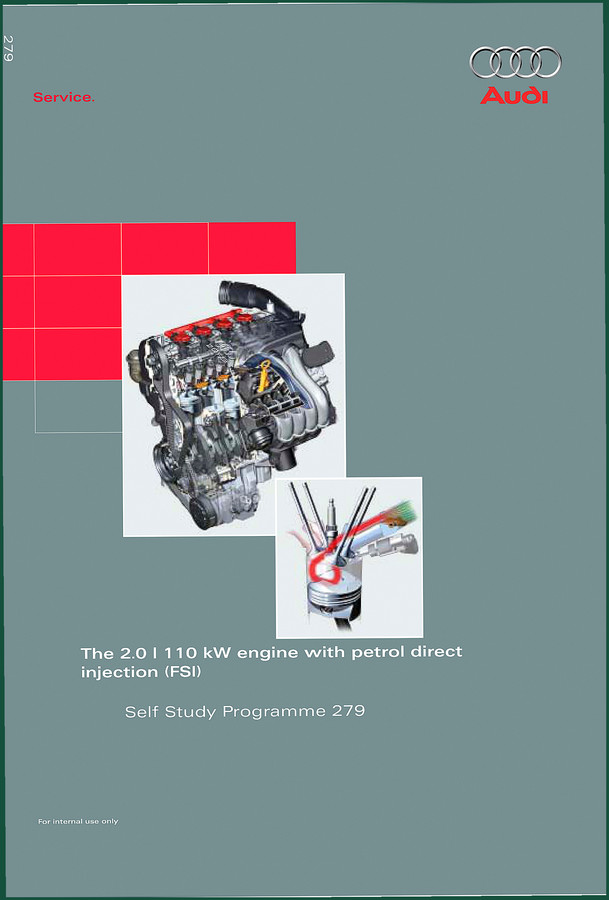
Audi 2.0 Technical Manual – 44 Pages – FSI Engine Design
Original price was: $35.19.$25.50Current price is: $25.50.
44-page factory document covering Audi 2.0L FSI engine design, operation modes, fuel system, exhaust treatment, and block diagram. For technicians.
Description
Audi 2.0 Technical Manual – What a Technician Needs to Know
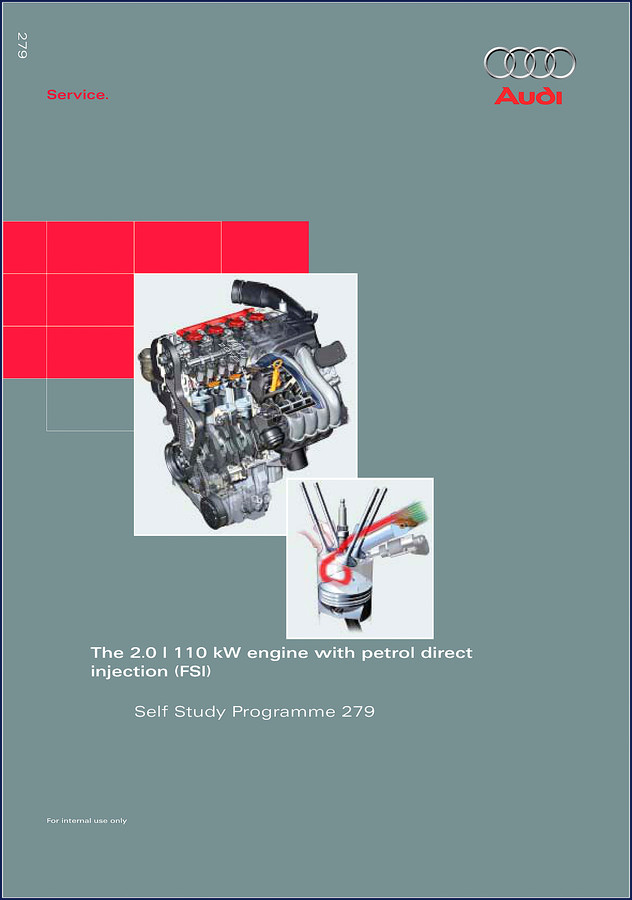
If you’re tearing into an Audi 2.0 with a direct-injection stumble, lean miss, or a NOx catalyst code, you don’t need guesswork. After twenty-eight years in the bay, I’ve seen too many guys throw parts at an FSI engine because they didn’t understand the stratified-charge logic or the high-pressure pump cycle. This 44-page Audi 2.0 Technical Manual is the factory self-study program – the same material Audi gave its own techs to understand the 2.0 l FSI engine. It’s not a workshop manual (no torque specs, no R&R steps), but it’s the best damn map of the system you’ll find short of an OEM training room.
2.0 l FSI Engine: Highlights and Hardware
Right from page 4, the manual lays out the highlights of the FSI engine – direct injection, stratified charge, and the hardware that makes it happen. The crankcase breather system (page 6) and oil circulation path (page 7) are drawn out so you can trace a pressure drop or a vacuum leak without chasing internet diagrams. The piston design and cylinder head flow are covered in enough detail to help you understand why a compression test reads different on a direct-injection motor versus a port-injected one. This is OEM data, not aftermarket reprints – every measurement comes from Audi’s engineering group.
Crankcase Breather and Oil Circulation: Real-World Diagnostics
I’ve had two cars this month with a 2.0 that would idle rough after a cold start, then smooth out. One had a clogged crankcase breather; the other had a stuck oil control valve. The manual’s section on oil circulation (page 7) shows the entire lubrication path, including the pressure-fed chain tensioner. That drawing alone saved me from pulling a timing cover unnecessarily. For DIY guys working in a home garage, understanding where the oil goes is half the battle. You don’t need a lift – you need the right schematic.
FSI Operation Modes: Stratified Charge and Homogeneous
Stratified charge operation (page 18) is where this manual earns its keep. The AutoRepairManuals copy – direct from Audi’s Self Study Programme 279 – explains how the engine runs lean under light load, then switches to homogeneous mode under power. The engine control unit logic and modes of operation are broken down on page 17. If you’re diagnosing a misfire that only happens at part throttle, you need to know which mode the ECU is in when the misfire occurs. This manual tells you exactly what sensors and actuators are involved. Aftermarket guides skip this. The factory doc doesn’t.
Fuel System Components: High-Pressure Pump and Injectors
The single-plunger high-pressure pump (page 26) and the fuel metering valve -N290 (page 28) are covered with cross-sections that show internal check valves and spill ports. The injectors -N30 through -N33 (page 31) are identified by their pintle design and spray pattern. Want to know why a particular cylinder injector fails? The fuel rail pressure sender -G247 (page 30) gives the expected voltage range under load. You won’t find that in a generic repair manual. This is the Audi 2.0 Technical Manual – straight from the factory, with part numbers and function descriptions that let you test rather than replace.
Exhaust Gas Treatment: NOx Storage Catalyst and Regeneration
Modern direct-injection engines run lean, which means NOx control is critical. The manual devotes pages 33–36 to the NOx storage catalytic converter, the regeneration phases, and the NOx sender -G295. If your 2.0 has a P0420 or a P0441 related to catalyst inefficiency, you owe it to your wallet to understand how the regeneration cycle works before condemning the cat. The exhaust-gas temperature sender -G235 location and function are shown on page 32. This isn’t theory – it’s the exact diagnostic path Audi uses.
Block Diagram and CAN Bus Interfaces
Page 38 has the block diagram – the whole electrical system drawn out with CAN bus interfaces, engine control unit pins, and signal paths. For a tech trying to trace a no-start or a communication failure, this is the single most useful spread in the booklet. The CAN bus interfaces (page 16) list every module that talks to the ECU, including the transmission control unit and ABS controller. I’ve resolved two drivability complaints in the last year just by verifying CAN signals with a scope – data I cross-referenced from this manual. You can too.
Who Should Buy This Audi 2.0 Technical Manual
If you’re a DIY owner with an Audi A3, A4, or A6 from the mid-2000s with a 2.0 FSI engine, this manual gets you inside the design philosophy. You’ll understand why the fuel pressure jumps at tip-in and why the engine sometimes runs in stratified mode after a full tank. Professional mechanics – especially shop owners training new guys – will use this as a reference when a job stall hits. Pair it with the actual workshop manual for torque specs. For system-level understanding, this is the key. Check out the LINK_ID_REL_0: Audi TT Technical Manual – 82-Page Factory-Direct Diagnostics or the LINK_ID_REL_1: Audi A8, A3, A4, A6, Cabriolet 2007 Technical Manual – Full Specs for broader coverage. For electrical systems in an Audi A3 2004, the LINK_ID_REL_2: Audi A3 2004 Technical Manual – Factory Electrical System complements this engine manual.
For context on how direct injection changed fuel system design, read the LINK_ID_EXT_0: Automotive Industry Overview on gasoline direct injection. For transmission basics that pair with this engine, the LINK_ID_EXT_1: Manual Transmission page gives gearbox fundamentals.
- Does this manual give torque values for head bolts or main bearing caps?
- No. This is a self-study program, not a workshop manual. It explains how the engine works, not how to rebuild it. Use an Audi factory repair manual for torque specs.
- Can I use this to diagnose a fuel pressure issue on my 2006 Audi A4 2.0T?
- Yes, but indirectly. The manual explains the high-pressure pump, fuel rail, and pressure sender functions. It will help you understand the system so you can interpret fuel pressure data correctly with a scan tool. It does not list diagnostic trouble codes or step-by-step test procedures.
- How many pages is the PDF, and what format does it come in?
- 44 pages. Delivered as a high-res scanned PDF, searchable, with the original German and English text. No reprints, no third-party alterations – just the factory document.
- Is this the same manual Audi gives to its own technicians?
- It is the Self Study Programme 279 (SSP 279), which Audi used to train its dealership techs on the 2.0 FSI engine. It’s identical to the original classroom material – no watermarks, no missing pages.
You’ve read the specs. You’ve seen the TOC. If you want to understand the Audi 2.0 FSI engine on a level that lets you diagnose instead of guess, Access the Factory Manual and keep it on your tablet or bench for the next job that walks in the door.
Additional information
| Brand | Audi |
|---|---|
| Language | English |
3 reviews for Audi 2.0 Technical Manual – 44 Pages – FSI Engine Design
You may also like…
-
Sale!
Audi 100, 200 1989 Workshop Manual – Factory Service for 5-Cylinder Engine
Original price was: $63.45.$45.00Current price is: $45.00. -
Sale!
Audi A3 2003 Repair Manual – Fuel System Service Documentation
Original price was: $63.45.$45.00Current price is: $45.00. -
Sale!
Audi 5000 S 1985 Wiring Diagram – OEM Cooling Fan Circuit Data
Original price was: $86.90.$55.00Current price is: $55.00. -
Sale!
Audi A8, Q7 Training Manual – Ceramic Brake Systems
Original price was: $54.00.$45.00Current price is: $45.00.
Related products
-
Sale!

1992 Electrical Schematic – OEM Wiring Diagrams for International 1000-3800
Original price was: $24.48.$18.00Current price is: $18.00. -
Sale!
International 1000-3000 Series Operators Manual – 132 Pages of OEM Specs
Original price was: $14.40.$10.99Current price is: $10.99. -
Sale!

Service Manual – International HS 2.8L Engine – 130 Pages of Factory Specs
Original price was: $56.40.$40.00Current price is: $40.00. -
Sale!
1995 Operators Manual – International 1000-4000 Series | OEM Documentation
Original price was: $12.49.$9.99Current price is: $9.99.
pro_mechanic –
Perfect workshop guide. The text is searchable and well indexed. Contains precise schematics for Audi. Saves me hundreds of dollars.
Charles W. –
This is exactly what I was looking for. The text is searchable and well indexed. Every spec sheet is provided for Audi 2.0. Saves me so much money.
workshop_guy –
Five stars! The scan is high-quality and easy to navigate. It assisted me to fix my Audi 2.0 transmission. Highly recommended for mechanics.